Published page
Boil-water advisory


A boil-water advisory is a public health directive issued by government or water utility authorities advising consumers to boil their tap water before consumption when the public …
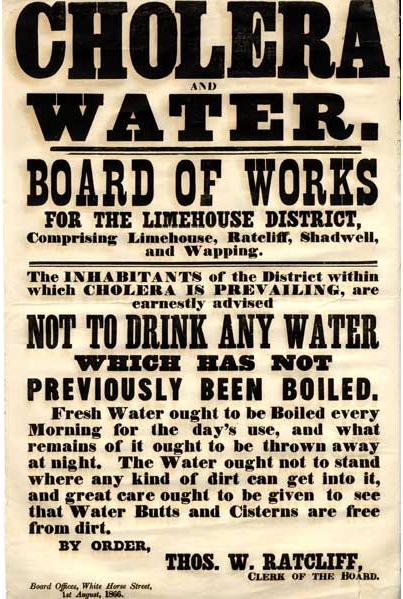
Boil-water advisory
A boil-water advisory is a public health directive issued by government or water utility authorities advising consumers to boil their tap water before consumption when the public …
london school of hygene and tropical medicine - image is in the public domain · Public domain · First Boil Water Notice 1866.jpg
A boil-water advisory is a public health directive issued by government or water utility authorities advising consumers to boil their tap water before consumption when the public water supply is, or may be, contaminated by disease-causing pathogens.
Modern municipal water systems are designed to deliver safe drinking water continuously, but unexpected infrastructure failures, natural disasters, or operational disruptions can compromise this safety. When tests indicate microbial contamination or when conditions exist that make such contamination highly probable, health officials implement this preventive measure to protect the population from waterborne illnesses.
1. Overview and Purpose
Drinking water safety relies on a multi-barrier approach, including source protection, filtration, chemical disinfection, and continuous monitoring. When any component of this system fails, the microbial quality of the tap water can deteriorate rapidly. A boil-water advisory serves as an immediate, low-tech, and highly effective intervention to bridge the gap between the onset of a contamination event and the restoration of safe municipal supply.
The primary objective of the advisory is to neutralize biological threats. Waterborne pathogens such as bacteria, viruses, and protozoa can cause severe gastrointestinal diseases, leading to symptoms like diarrhea, abdominal cramps, nausea, and dehydration.[1]https://www.cdc.gov/healthywater/drinking/travel/pathogens.html — Common waterborne protozoa such as Cryptosporidium feature protective outer shells that allow them to survive outside the body for long periods and resist standard chlorine disinfection. While advanced water treatment facilities utilize technologies like ultraviolet irradiation and chlorination, boiling remains the most foolproof method available to individual households to sterilize water without specialized equipment.
2. Causes for Issuance
Public health authorities and water purveyors issue boil-water advisories under specific environmental, operational, or mechanical circumstances. These triggers generally fall into two categories: confirmed contamination based on laboratory results and precautionary measures due to system vulnerabilities.
- Loss of System Pressure: A sudden drop in water pressure—often caused by a main break, power outage at a treatment plant, or extreme demand during firefighting—creates a vacuum within the distribution pipes. This net negative pressure can draw surrounding groundwater, soil, and potential contaminants into the drinking water network through small cracks or loose joints.
- Microbial Contamination: Routine monitoring may reveal the presence of indicator organisms, most notably *Escherichia coli* (*E. coli*) or total coliform bacteria. While not all coliforms are harmful, their presence indicates that the treatment process has failed or that sewage or animal waste has entered the system.
- Treatment Disruption: Operational failures at the water treatment plant, such as filter breakdowns, improper chemical dosing, or equipment failure during disinfection, mean that water leaving the plant may not meet safety standards.
- Environmental and Natural Disasters: Flooding, severe storms, hurricanes, and earthquakes can inundate water treatment facilities with raw sewage or heavy runoff, exceeding the treatment plant's processing capacity and severely degrading the source water quality.
3. Correct Boiling Techniques
To ensure complete microbial inactivation, specific guidelines must be followed. Simply heating water until it is hot or slightly steaming is insufficient to eliminate resilient pathogens.
```
[Tap Water] ──> Bring to [Rolling Boil] ──> [Maintain for 1 Minute*] ──> [Cool Naturally] ──> [Safe for Use]
(*Note: Maintain for 3 minutes at altitudes above 2,000 meters / 6,560 feet)
```
1. Boiling Process: Water should be placed in a clean vessel and heated until it reaches a full, rolling boil—a state where large bubbles continuously break the surface violently.
2. Duration: The water must remain at a continuous rolling boil for at least one full minute. At higher elevations exceeding two thousand meters, the boiling point of water decreases due to lower atmospheric pressure; therefore, the recommended boiling time is extended to three minutes to ensure thermal destruction of microbes.[2]https://www.cdc.gov/healthywater/emergency/drinking/making-water-safe.html — Because the atmospheric pressure drops as elevation increases, water boils at roughly 93°C at 2,000 meters altitude, necessitating the extra exposure time to compensate for the lower temperature.
3. Cooling and Storage: After boiling, the water should be allowed to cool naturally in a covered, food-grade container to prevent recontamination from airborne particles or dirty utensils.
4. Usage Guidelines during an Advisory
During an active advisory, residents must modify their daily water usage habits. Certain activities require strictly treated or boiled water, while others may proceed with tap water under specific conditions.
- Activities Requiring Boiled or Bottled Water
- Drinking directly, preparing beverages (such as coffee, tea, or juice), and making ice.
- Washing, preparing, and cooking food, particularly items consumed raw like salads and fruits.
- Brushing teeth and rinsing the mouth.
- Preparing infant formula, feeding bottles, and food for young children or immunocompromised individuals.
- Providing drinking water for domestic pets.
- Activities Permitted with Unboiled Tap Water
- Showering and Bathing: Adults and older children may shower or bathe using tap water, provided care is taken not to swallow any water. Infants, toddlers, and individuals with open wounds or severe skin conditions should be bathed using sponge baths with safe, boiled water.
- Washing Dishes: Commercial dishwashers are generally safe to use if they feature a high-temperature sanitizing cycle. Manual dishwashing requires washing with hot soapy tap water, followed by a final rinse in a solution of warm tap water mixed with a small amount of household bleach, or using boiled water.[3]A standard emergency ratio recommended by health agencies for manual dishwashing sanitation is roughly one teaspoon of unscented household liquid bleach per gallon of warm water.
- Laundry: Standard household laundering of clothing and linens using tap water and standard detergents is safe, provided the items are thoroughly dried before use.
5. Rescission and Post-Advisory Measures
A boil-water advisory remains in effect until the public water utility proves that the water meets stringent regulatory quality standards. Lifting the advisory requires a structured process involving system repairs, flushing, and multi-point laboratory testing.
Authorities typically require a minimum of two consecutive sets of water samples, collected twenty-four hours apart, to test negative for coliform bacteria and demonstrate adequate disinfectant residuals throughout the distribution system. Once these criteria are satisfied, an official notice of rescission is broadcast through public media, emergency alert systems, and utility communications.
Upon the formal cancellation of an advisory, consumers must take specific steps to clear their private plumbing systems:
- Flushing Pipes: Cold water taps throughout the residence should be run for several minutes to flush out any stagnant water remaining in the interior plumbing.
- Equipment Maintenance: Automatic ice makers should be emptied, cleaned, and allowed to cycle through several batches before using the ice. Refrigerator water filters, inline filtration units, and water softeners should be replaced or regenerated according to manufacturer specifications.
- Appliance Cleaning: Hot water heaters, water coolers, and coffee makers should be flushed according to their respective instruction manuals to ensure no residual contaminants remain in internal reservoirs.
6. Trivia
6.1 Public Health Jurisdictions and Institutional Dichotomies
The issuance of a boil-water advisory (BWA) serves as a classic case study in overlapping governmental authority. In the United States, while the Environmental Protection Agency (EPA) regulates standard water quality metrics under the Safe Drinking Water Act, the actual mandate to issue a BWA almost universally falls upon state or local public health departments and municipality-level municipal water utilities.[4]https://www.epa.gov/sdwa — The Safe Drinking Water Act was originally passed by the United States Congress in 1974 to protect the public water supply from both natural and man-made contaminants. Consequently, the threshold parameters for issuing an advisory vary drastically across borders; an identical spike in turbidity levels might trigger a mandatory BWA in one jurisdiction while merely prompting a internal monitoring flag in another.
6.2 Microbial Inactivation Kinematics
A common public misconception—often exacerbated by vague municipal notices—is that water must be boiled for extended periods to achieve sterilization. Thermodynamically, pasteurization of waterborne human pathogens (such as *Cryptosporidium parvum*, *Giardia lamblia*, *Escherichia coli*, and Enteroviruses) occurs rapidly at temperatures well below the boiling point ($100^\circ\text{C}$ or $212^\circ\text{F}$ at sea level). Achieving a rolling boil is not recommended because the exact temperature of $100^\circ\text{C}$ is required for microbial destruction, but rather because the physical state of a "rolling boil" serves as a fool-proof, visual indicator for the general public that the thermal threshold for total pathogen inactivation has been surpassed.[5]Most enteropathogenic bacteria and viruses are rendered inactive within minutes at temperatures between 60°C and 70°C, meaning water reaches safe pasteurization levels long before the first bubble for
6.3 Atmospheric Pressure and Altitude Dynamics
The physical mechanics of a BWA change radically at high altitudes due to the inverse relationship between atmospheric pressure and water's boiling point. In regions like Denver, Colorado, or high-altitude settlements in the Andes, water boils at significantly lower temperatures (e.g., approximately $95^\circ\text{C}$ at $1,500\text{ meters}$). To compensate for the reduced thermal transfer efficiency at these lower temperatures, public health agencies such as the Centers for Disease Control and Prevention (CDC) strictly mandate that residents at elevations above $2,000\text{ meters}$ ($6,561\text{ feet}$) maintain a continuous rolling boil for a minimum of three minutes, compared to the standard one-minute requirement at sea level.
6.4 Infrastructure Vulnerabilities and Back-Siphonage
The vast majority of BWAs in developed nations are not caused by direct contamination at the treatment plant, but by physical distribution failures—specifically, sudden drops in hydraulic pressure within the water mains (below $20\text{ psi}$). When pressure falls, a phenomenon known as back-siphonage occurs: the pressure differential actively draws surrounding groundwater, agricultural runoff, or non-potable fluids into the water pipes through micro-fractures, degraded pipe joints, or compromised water mains.
6.5 The Cryotherapy Contradiction in Dental and Medical Facilities
During a BWA, commercial and institutional facilities face hyper-specific operational disruptions that go far beyond residential inconvenience. Hospitals, dental clinics, and hemodialysis centers must instantly isolate their water supply lines. Dental units, which utilize water for cooling high-speed drills and irrigating oral cavities, cannot simply rely on boiled tap water due to potential biofilm buildup within the narrow lines of the equipment; they are forced to switch to self-contained sterile saline or closed-loop distilled water systems. Similarly, commercial ice machines—a major vector for norovirus and *Legionella* outbreaks—must be completely shut down, drained, and chemically sanitized post-advisory, as freezing temperatures merely preserve pathogens rather than inactivating them.[6]https://www.cdc.gov/legionella/about/causes-transmission.html — Freezing halts the metabolic activity of bacteria and parasites without killing them, allowing pathogens preserved in ice cubes to reactivate once the ice melts in a beverage.
6.6 Consumer Behavior and Economic Volatility
The declaration of a BWA triggers immediate microeconomic shifts within local retail ecosystems, frequently characterized by panic buying of bottled water—a phenomenon akin to the "snowcarting" effect observed prior to major blizzards. For the local food service industry, a BWA acts as a temporary operational shutdown. Restaurants are legally prohibited from using tap-fed commercial post-mix soda fountains, automatic coffee makers, and ice-dispensing units. The financial loss incurred by small businesses during a prolonged multi-day advisory often dramatically outpaces the physical cost required by the utility company to repair the underlying infrastructure defect.
Child documents of "Boil-water advisory"
None yet.