Published page
Calendar


A calendar is a system of organizing days for social, religious, commercial, or administrative purposes, accomplished by giving names to periods of time, typically days, weeks…
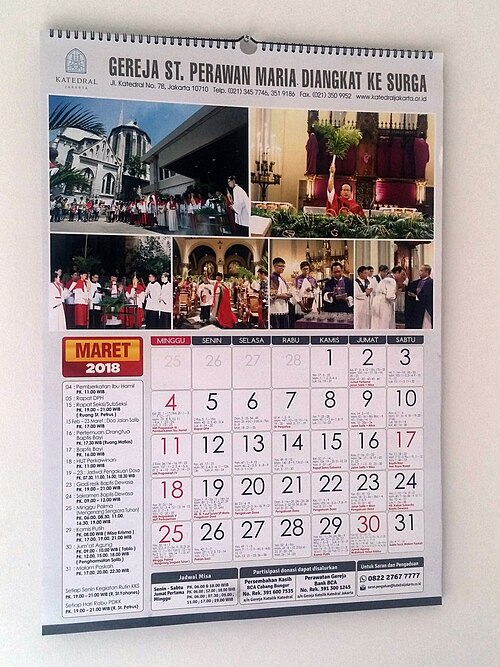
Calendar
A calendar is a system of organizing days for social, religious, commercial, or administrative purposes, accomplished by giving names to periods of time, typically days, weeks…
Rantemario · CC BY-SA 4.0 · Kalender Indonesia.jpg
A calendar is a system of organizing days for social, religious, commercial, or administrative purposes, accomplished by giving names to periods of time, typically days, weeks, months, and years.
1. system of organizing days
Important dates are often determined by the cycle of astronomical events, such as the movement of the Sun or the phase of the Moon. Throughout human history, various civilizations have devised distinct calendar systems tailored to their agricultural needs, geographical locations, and cultural worldviews.
1.1 Overview
At its core, a calendar serves as a fundamental framework for human society to quantify and structure the passage of time. Without a shared calendar system, coordinating economic activities, observing religious rituals, and maintaining historical records would be nearly impossible. A single date in a calendar system corresponds to a specific solar day, allowing individuals to pinpoint past events and plan future engagements with precision.
The period of a calendar year usually approximates the time taken for the Earth to complete one full orbit around the Sun, while a calendar month traditionally relates to the synodic period of the Moon. Because these natural astronomical cycles do not divide evenly into exact days, calendar design inherently involves complex mathematical adjustments, such as intercalation, to keep the calendar synchronized with the natural seasons.
1.2 Astronomical Basis
Calendar systems are largely categorized based on the specific astronomical phenomena they choose to track. The three primary celestial rhythms utilized are the rotation of the Earth on its axis (the day), the revolution of the Moon around the Earth (the month), and the revolution of the Earth around the Sun (the year).
Solar calendars are synchronized with the tropical year, ensuring that the seasons always align with the same calendar months. The modern Gregorian calendar is the most widely recognized example of a solar calendar. Solar calendars rely on equinoxes and solstices to maintain accurate alignment with the solar year, often adding a leap day every few years to account for the fractional length of the tropical year, which is approximately 365.2422 days.[1]The extra fraction of a day means calendar keepers are constantly playing a game of cosmic catch-up with the Sun.
Lunar calendars are based strictly on the cycles of the Moon's phases, ignoring the solar year entirely. A typical lunar year consists of twelve synodic months, totaling around 354 days. Because a lunar year is roughly eleven days shorter than a solar year, dates in a pure lunar calendar—such as the Islamic Hijri calendar—shift backward through the solar seasons over a roughly thirty-three-year cycle.[2]Because of this shift, Islamic holidays like Ramadan migrate through all four seasons over the course of three decades.
Lunisolar calendars attempt to bridge the gap between lunar months and the solar year. These systems track the phases of the Moon for month lengths but periodically insert an extra intercalary month to keep the year aligned with the solar seasons. Traditional Asian calendars, such as the Chinese, Korean, and Hebrew calendars, fall into this category, ensuring that seasonal festivals remain tied to their appropriate agricultural times.
1.3 Historical Evolution
The history of calendars reflects humanity's growing understanding of mathematics and astronomy. Early agrarian societies relied on simple observations of the Moon and stars to time their plantings and harvests. As empires expanded, the need for standardized, highly predictable calendars became a matter of state governance.
The ancient Egyptians were among the first to develop a solar calendar based on the heliacal rising of the star Sirius, which coincided with the annual flooding of the Nile River.[3]https://www.britannica.com/science/Egyptian-calendar — The appearance of Sirius just before sunrise heralded the vital annual flooding that sustained Egyptian agriculture. This system consisted of twelve months of thirty days each, plus five extra days at the end of the year.
The Roman calendar underwent numerous chaotic reforms before Julius Caesar introduced the Julian calendar. Developed with the help of Alexandrian astronomers, the Julian calendar instituted a purely solar framework with a standard year of 365 days and a leap year every four years. While far superior to previous systems, the Julian calendar overestimated the length of the solar year by about eleven minutes, causing the calendar to drift out of alignment with the equinoxes by one day every 128 years.
To correct this accumulated error, Pope Gregory XIII introduced the Gregorian calendar. The reform adjusted the leap year rule so that centurial years not divisible by four hundred would not be leap years, successfully refining the calendar's accuracy to within one day every three thousand years.[4]https://www.usno.navy.mil/USNO/astronomical-applications/astronomy-information-center/calendar-gregorian — Years like 1900 skipped leap year status, whereas the year 2000 retained its extra day under this centurial rule.
1.4 Modern Application and Variations
In the contemporary world, the Gregorian calendar functions as the de facto international standard for civil, commercial, and diplomatic purposes. Its widespread adoption facilitates seamless international trade, global travel, and synchronized digital communication networks.
Despite the global dominance of the civil calendar, traditional and religious calendars remain actively used worldwide. The Islamic calendar governs religious observances across the Muslim world, while the traditional lunisolar calendars of East Asia continue to dictate major cultural holidays such as Lunar New Year and the Mid-Autumn Festival. Similarly, the liturgical calendars of Christian churches specify feast days and seasonal observances independently of civil schedules.
In addition to traditional systems, modern society utilizes specialized computational calendars, such as Julian Day Count numbers used by astronomers, and fiscal calendars utilized by corporations and governments for financial reporting.
2. chart or printed schedule
A calendar is a physical or digital document, chart, or schedule designed to display the days, weeks, and months of a specific year, serving as an essential tool for tracking time, organizing events, and managing daily schedules. While the broader term "calendar" refers to the abstract system of organizing time (such as the Gregorian or Lunar calendars), this article specifically addresses the physical or visual artifact—the printed chart, wall hanging, desk accessory, or digital application interface used in daily life.
2.1 Overview
The calendar as a physical schedule is one of the most ubiquitous organization tools in human civilization. It translates the abstract concept of time into a tangible, grid-based visual format. Typically divided into twelve months for a standard solar year, a printed calendar displays dates sequentially, highlighting weekend days, national holidays, and astronomical phases such as full moons.
In contemporary society, these calendars exist in various formats, ranging from simple single-page wall charts to elaborate multi-page booklets, desk pads, and synchronized software applications on computers and smartphones. Despite the rapid growth of digital alternatives, physical printed calendars remain deeply popular due to their intuitive visibility, ease of quick reference, and aesthetic role in home and office decor.
2.2 History and Evolution
The visual representation of time dates back to ancient civilizations, where early calendars were carved into stone, wood, or clay to mark agricultural seasons, religious festivals, and celestial events.
With the advent of the printing press in the 15th century, mass-produced paper calendars became widely available. During the 19th and 20th centuries, promotional calendars gained immense popularity. Businesses began distributing free wall calendars featuring company branding alongside attractive artwork, landscapes, or photography, establishing the calendar as a staple item in virtually every household.[5]Insurance agencies and local hardware stores became the primary source of household art for generations of families.
In the late 20th and early 21st centuries, the nature of calendars underwent a major transformation with the birth of personal computing and mobile technology. Digital calendars introduced features such as automated reminders, shared family or workplace schedules, and real-time synchronization across devices, transforming the calendar from a passive reference chart into an interactive productivity hub.
2.3 Types and Formats
Physical and visual calendars are produced in a wide variety of formats tailored to specific user needs:
- Wall Calendars: Designed to be hung on walls, these usually feature a prominent image or artwork on the top page and a monthly grid on the bottom page. They are often used by households to track family activities.
- Desk Calendars: Compact structures, often supported by a cardboard easel, placed on office desks for quick daily reference. Some variations include "page-a-day" tear-off pads.
- Poster or Sheet Calendars: Single-sheet prints displaying the entire year at a glance, commonly utilized in academic or corporate environments for macro-planning.
- Pocket Planners and Agendas: Portable, book-bound calendars combined with notebooks, enabling individuals to carry their detailed daily agendas with them.
- Digital Calendars: Graphical user interfaces within operating systems and web applications that mimic traditional calendar grids while offering dynamic features such as color-coding, event invitations, and notifications.
2.4 Cultural and Commercial Significance
Beyond their functional utility, printed schedules and calendars hold significant cultural and commercial value. The annual release of specialized calendars—featuring fine art, celebrity photos, popular anime or movie franchises, and animal photography—functions as a major retail industry every late autumn.
In many cultures, receiving a new year's calendar is associated with fresh beginnings and seasonal greetings. Furthermore, localized calendars often serve as repositories of cultural tradition, embedding regional holidays, memorial days, lunar dates, and traditional seasonal markers directly into the daily date grid.
3. list of planned events
A Calendar (list of planned events) refers to a structured chronological document or digital tool designed to record, manage, and display scheduled activities, deadlines, appointments, and personal or organizational commitments over a specific timeframe.
3.1 Overview
Unlike an astronomical calendar, which functions primarily as a system for organizing days, weeks, months, and years based on celestial mechanics, a calendar of planned events serves a pragmatic administrative purpose. It translates abstract temporal frameworks into actionable schedules. By mapping human activities onto specific dates and times, this form of calendar acts as an essential instrument for time management, event planning, and resource allocation across both individual and institutional domains.
In modern usage, the term encompasses physical media such as wall planners, desk diaries, and pocket agendas, as well as digital software integrated into personal computer operating systems and mobile devices.
3.2 Historical Evolution
The practice of maintaining a structured list of upcoming events originates from early human attempts to organize religious rituals, market days, and civic duties around the seasonal or lunar cycles. In ancient Rome, the *Fasti* served as an early precursor, functioning as a public record of days on which official business could be lawfully transacted, alongside scheduled festivals and public games.[6]Roman officials posted these lists publicly so citizens knew precisely which days allowed court hearings or assemblies.
During the Middle Ages, illuminated manuscripts known as *Books of Hours* frequently featured calendar pages listing saints' days and agricultural tasks relevant to specific months. With the advent of the printing press, commercially produced almanacs became widespread, offering readers detailed lists of planned fairs, court sessions, and astronomical occurrences.
The modern personal planner emerged during the Industrial Revolution, driven by the increasing need for precise timekeeping in commercial enterprises. The late twentieth and early twenty-first centuries marked a major shift from paper-based registries to electronic systems, enabling real-time synchronization across multiple devices and collaborative scheduling among groups.
3.3 Key Functions and Characteristics
A list of planned events performs several critical functions within modern society:
- Temporal Organization: It visualizes the distribution of tasks and events, preventing overlapping commitments and aiding in long-term planning.
- Information Retention: It functions as an external memory aid, reducing cognitive load by storing specific dates, times, locations, and supplementary notes related to scheduled activities.
- Coordination and Collaboration: In shared environments, it allows multiple stakeholders to align their availability, facilitating meetings, projects, and public gatherings.
- Prioritization and Tracking: It enables users to monitor progress toward deadlines and adjust personal or professional workflows according to upcoming obligations.
3.4 Types and Classification
Calendars used for tracking planned events can be categorized by their medium, operational scope, and visual format.
- By Medium
- Paper-based Calendars: Includes traditional wall calendars, desk blotters, spiral-bound planners, and pocket diaries. These formats rely on manual entry and offer tangible visual cues without requiring electrical power or digital connectivity.
- Digital Calendars: Applications and web services that store event data electronically. These systems offer features such as automated notifications, recurring event setups, color-coding, and cloud synchronization across various hardware devices.
- By Operational Scope
- Personal Calendars: Maintained by individuals to track private commitments, such as medical appointments, birthdays, social engagements, and personal tasks.
- Corporate and Organizational Calendars: Managed by businesses, academic institutions, or governmental bodies to coordinate project timelines, employee shifts, public holidays, and operational milestones.
- Public and Academic Calendars: Published schedules intended for broad audiences, detailing event lineups for sports leagues, concert venues, academic terms, and legislative sessions.
3.5 Contemporary Impact and Usage
In contemporary culture, the digital list of planned events has become deeply embedded in daily life. Features such as algorithmic scheduling assistants, timezone auto-adjustment, and integration with communication platforms have transformed calendar management from a passive logging process into an active driver of productivity. However, reliance on dense scheduling has also sparked discussions regarding hyper-scheduling, reduced spontaneous leisure time, and the psychological impact of constant notification-driven routine management.
4. Trivia
4.1 The Julian Calendar Drift and Great British Calendar Shift of 1752
The transition from the Julian calendar to the Gregorian calendar required suppressing accumulated leap days to realign the calendar year with the astronomical solar year. Under the Julian system, an overestimation of the solar year by approximately 11 minutes per year caused a drift of one day roughly every 128 years. By the 18th century, the disparity reached 11 days.
When Great Britain and its American colonies enacted the Calendar (New Style) Act 1750, the month of September 1752 was truncated; Wednesday, September 2, was immediately followed by Thursday, September 14.[7]https://www.parliament.uk/about/living-heritage/transformingsociety/private-lives/relationships/collections/calendar-act-1750 — British citizens essentially went to sleep on Wednesday night and woke up on Thursday morning eleven days later. This sudden shift birthed popular urban legends regarding widespread "calendar riots" by citizens demanding the return of their "lost 11 days," though modern historical consensus suggests these protests were largely satirical political propaganda.
4.2 The Ethiopian Calendar and the Seven-Year Temporal Offset
The Ethiopian calendar, derived from the ancient Ge'ez liturgical system and closely linked to the Coptic calendar, maintains an approximate seven-to-eight-year divergence from the Gregorian calendar. This offset stems from an alternative calculation of the Annunciation of Jesus, finalized by the 5th-century monk Annianus of Alexandria, whereas the Western Dionysian calculation placed the birth of Christ eight years later.
Furthermore, the Ethiopian year consists of 12 months of 30 days each, plus a 13th intercalary month named *Pagumē* containing five or six days depending on leap years. Consequently, the Ethiopian calendar celebrated the turn of the third millennium on September 11, 2007, according to the Gregorian reckoning.[8]Ethiopian tourism authorities famously used the seven-year difference to promote the country as offering '13 months of sunshine'.
4.3 The French Republican Calendar and Decimal Time Integration
Following the French Revolution, the National Convention instituted the French Republican Calendar in 1793, designed to eradicate religious and monarchical influences in favor of a rationalized, scientific structure. Designed partly by the astronomer Jean-Baptiste Joseph Delambre, the system divided the year into 12 months of 30 days, categorized by natural phenomena (e.g., *Brumaire*, the month of fog).
The remaining five or six days were celebrated at the year's end as national holidays known as *Sans-culottides*. Crucially, the calendar attempted to decimalize time: each day was divided into 10 decimal hours, each hour into 100 decimal minutes, and each minute into 100 decimal seconds. The system proved overwhelmingly unpopular due to the abolition of the traditional seven-day week in favor of a 10-day work cycle (*décade*), leading Napoleon Bonaparte to formally abolish it in 1806.[9]https://www.gutenberg.org/files/4684/4684-h/4684-h.htm — Workers severely disliked the revolutionary system primarily because it stretched the traditional rest cycle from six days of work to nine.
4.4 The Doomsday Rule and Perpetual Calendar Algorithms
The Doomsday rule is an algorithm developed by mathematician John Horton Conway in 1973 for calculating the day of the week for any given date in the Gregorian calendar. The method relies on the mathematical property that certain dates within any given year always fall on the same day of the week, designated as the "Doomsday."
For instance, April 4 (4/4), June 6 (6/6), August 8 (8/8), October 10 (10/10), and December 12 (12/12), alongside the last day of February, share the identical day of the week in any specified year. By memorizing anchor days for centuries and applying modular arithmetic (modulo 7), an individual can mentally compute the weekday of any historical or future date within seconds.
4.5 The 30th of February in Swedish Chronology
Sweden planned a gradual transition from the Julian calendar to the Gregorian calendar between 1700 and 1740 by omitting leap days for 40 consecutive years. However, upon the outbreak of the Great Northern War, the Swedish administration forgot to omit the leap days in 1704 and 1708, resulting in a unique "Swedish calendar" that aligned with neither the Julian nor the Gregorian systems.
To rectify this chaotic temporal state, King Charles XII ordered Sweden to revert entirely to the Julian calendar in 1712. To accomplish this, an extra intercalary day was added to February in 1712, effectively creating February 30, 1712, in the Swedish calendar.[10]This unusual historical compromise left Sweden as the only country to ever officially observe a February 30th on its calendar. Sweden eventually completed its transition to the Gregorian calendar in 1753 using the standard 11-day skip method.
4.6 Judicial Calendars and Docket Delinquency
In legal literature and court administration, the term "calendar" denotes the formal listing of cases awaiting trial or hearing, often referred to as the court docket. The management of this calendar serves as a crucial metric for evaluating judicial efficiency within legal systems.
Historically, failure to properly call or maintain the judicial calendar could result in a loss of jurisdiction over pending cases—a principle dating back to English common law. In modern jurisprudence, "calendar congestion" has emerged as a substantive legal issue, occasionally leading to the dismissal of criminal charges on the grounds of violating a defendant's constitutional right to a speedy trial.[11]Judges must constantly balance docket management against statutory deadlines to prevent cases from being thrown out entirely.
4.7 Wall Calendar Advertising and the Creation of the Visual Ephemera Industry
The mass manufacturing of printed wall calendars in the late 19th century fundamentally altered corporate marketing strategies and popular home decor. Companies such as the Thomas D. Murphy Company in Iowa revolutionized commercial printing by combining chromolithographic art prints with functional calendar pads.
These promotional items were distributed free of charge by businesses to guarantee year-long visibility inside private residences. This commercial phenomenon laid the foundation for modern visual ephemera, transforming the physical calendar from a purely utilitarian tracking tool into a primary vehicle for commercial art, pin-up culture, and brand saturation throughout the 20th century.[12]The company turned art printing into a major industry by turning humble promotional calendars into collectible wall art.
Child documents of "Calendar"
None yet.