Published page
Easter


Easter is the central liturgical feast in Christianity that commemorates the resurrection of Jesus Christ from the dead, described in the New Testament as having occurred on the t…
Easter
Easter is the central liturgical feast in Christianity that commemorates the resurrection of Jesus Christ from the dead, described in the New Testament as having occurred on the t…
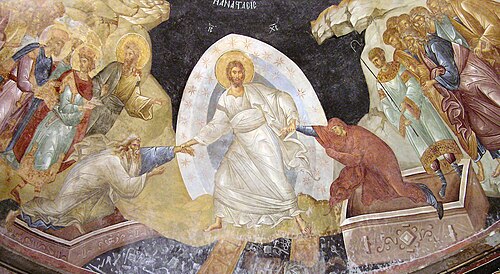
Anonymous Unknown author · Public domain · Chora Anastasis2.jpg
Easter is the central liturgical feast in Christianity that commemorates the resurrection of Jesus Christ from the dead, described in the New Testament as having occurred on the third day after his crucifixion by the Romans at Calvary.
1. Christian holiday of resurrection
It represents the culmination of the Passion of Jesus, preceded by Lent, a forty-day period of fasting, prayer, and penance.
1.1 Overview
As the most significant festival of the Christian church year, Easter establishes the foundational theological premise of Christian belief regarding eternal life, salvation, and the victory of Christ over sin and death. The holiday marks the end of the Holy Week, which includes Maundy Thursday, commemorating the Last Supper, and Good Friday, marking the Crucifixion. Because the event signifies a new beginning and spiritual rebirth, the joyful tone of Easter stands in stark contrast to the somber and reflective atmosphere of the preceding Lenten season.
1.2 Etymology and Nomenclature
The terminology used to denote this holiday varies significantly across different language families:
- Pascha-derived names: In most Latin-based, Slavic, and non-Germanic languages, the name for the holiday is derived from the Greek *Pascha*, which itself stems from the Hebrew *Pesach*, meaning Passover. This highlights the deep historical and theological link between the Jewish Passover and the Christian remembrance of Christ's resurrection as the ultimate Paschal lamb.
- Germanic names: The English term *Easter* and the German *Ostern* derive from Old English *Ēastre* or *Ēostre*. Historical sources, most notably the medieval monk Bede, suggest that this was the name of a Northumbrian goddess associated with spring and light, whose month corresponded to the time of the Christian celebration.[1]https://www.gutenberg.org/files/917/917-h/917-h.htm — Bede recorded the details regarding the goddess Ēostre in his eighth-century work De temporum ratione.
1.3 Date Determination
Unlike fixed-date holidays like Christmas, Easter is a movable feast, meaning its date changes annually on the Gregorian and Julian calendars.
The formula for determining the date was formally established by the First Council of Nicaea in 325 AD.[2]The council sought to unify the date of celebration across Christendom to avoid reliance on Jewish calendar calculations. Under this system, Easter is celebrated on the first Sunday following the first full moon that occurs on or after the vernal equinox. If the full moon falls on a Sunday, Easter is celebrated on the subsequent Sunday.
Furthermore, a divergence exists between Western Christianity (which uses the Gregorian calendar) and Eastern Orthodoxy (which uses the Julian calendar and requires that Easter must occur after Jewish Passover). Consequently, Eastern and Western churches frequently celebrate Easter on different dates, occasionally separated by several weeks.
1.4 Religious Significance and Observance
Within Christian theology, Easter is not merely a historical commemoration, but a perpetual reaffirmation of faith.
- Theological Meaning: The resurrection serves as validation of Jesus’ divine identity and his teachings. It fulfills Old Testament prophecies and offers believers the promise of their own resurrection and eternal life.
- Liturgical Practice: In Catholic, Orthodox, and high-church Protestant traditions, the celebrations begin on Holy Saturday evening with the Easter Vigil. This service often features the lighting of the Paschal candle, the reading of scripture chronicling salvation history, the baptism of new converts, and the first joyful proclamation of the *Alleluia*, which is omitted throughout Lent. On Easter Sunday, special festive Eucharistic services are conducted worldwide.
1.5 Folk Traditions and Cultural Customs
Over centuries, numerous secular and folk traditions have become intertwined with the religious celebration of Easter, many originating from ancient springtime rites of renewal:
- Easter Eggs: Eggs have long served as a universal symbol of new life and rebirth. Among Christians, the egg symbolizes the sealed tomb of Christ, while cracking the shell represents his emergence from the dead. Red-dyed eggs, particularly popular in Eastern European and Orthodox cultures, represent the blood of Christ shed on the cross.
- The Easter Bunny: Originating among German Lutherans as the "Easter Hare" (*Osterhase*), this legendary figure acts as a judge of children's behavior at the start of the Eastertide season, bringing baskets of colored eggs, candy, and toys to well-behaved children.[3]https://www.loc.gov/item/lcwa00096954 — Early German traditions depicted the hare carrying a basket to evaluate whether children had behaved well throughout the season.
- Easter Foods: The consumption of specific foods marks the breaking of the strict Lenten fast. Lamb is traditionally eaten as a main course, symbolizing Jesus as the Lamb of God. Special breads, such as hot cross buns in English-speaking nations and *Paska* or *Babka* in Slavic regions, are also widely prepared.
2. Chilean island in Pacific
Easter Island, known natively as Rapa Nui and in Spanish as Isla de Pascua, is a Chilean island located in the southeastern Pacific Ocean, renowned worldwide for its monumental stone statues called Moai. Situated at the easternmost point of the Polynesian Triangle, it stands as one of the most geographically isolated inhabited places on Earth. Despite its extreme remoteness, the island holds significant historical, archaeological, and cultural value, earning it a designation as a UNESCO World Heritage Site.
2.1 Overview and Geography
Easter Island is a volcanic high island formed by a series of eruptions from three extinct compound volcanoes: Terevaka, Poike, and Rano Kau. The resulting landmass features a distinct triangular shape with an area of approximately one hundred sixty-four square kilometers.[4]https://whc.unesco.org/en/list/715 — The three extinct volcanic cones located at the points of the island formed its characteristic triangular shape.
Administratively, the island is organized as a special territory and municipality within the Valparaíso Region of Chile. The island's sole major settlement and capital is Hanga Roa, situated on the southwestern coast, where the vast majority of the population resides. The landscape is characterized by rolling grassy hills, volcanic craters containing freshwater lakes, and steep ocean cliffs, lacking permanent rivers or streams. The local climate is subtropical maritime, featuring mild temperatures and moderate rainfall throughout the year.
2.2 History and Human Settlement
The human history of Easter Island began with the arrival of seafaring Polynesians, likely originating from the Gambier Islands or the Marquesas. Historical and radiocarbon estimates place this initial settlement period between the eighth and twelfth centuries. The early settlers established a thriving society based on agriculture, fishing, and sophisticated stone masonry.
Over time, the growing population led to intensive land use and severe deforestation, as trees were harvested for firewood, agriculture, and construction materials. This environmental transformation had profound consequences for the island's ecosystem and society. The loss of forest cover led to soil erosion, diminished crop yields, and an inability to build wooden ocean-going canoes, which severely restricted fishing capabilities and external contact.
The resulting resource shortages triggered a period of severe societal distress and conflict, leading to the collapse of the traditional socio-political system. During this era, the ancestor-worship cult associated with the Moai declined and was gradually replaced by the *Tangata Manu* (Birdman) cult centered around the ceremonial village of Orongo.
The first recorded European contact occurred on Easter Sunday in seventeen twenty-two, when Dutch navigator Jacob Roggeveen arrived at the island, giving it its popular Western name.[5]https://www.britannica.com/biography/Jacob-Roggeveen — Jacob Roggeveen sighted the isolated landmass on Easter Sunday and promptly recorded the date in his logbook. Subsequent foreign contact brought catastrophic consequences to the native population. In the nineteenth century, Peruvian slave raids forcibly removed a significant portion of the population, and introduced European diseases further decimated the remaining inhabitants. By the late nineteenth century, the indigenous population had plummeted to a critical low. Chile formally annexed the island in eighteen eighty-eight through a treaty signed with the local chiefs.
2.3 Monoliths and Archaeology
The defining feature of Easter Island's cultural heritage is its collection of nearly one thousand massive stone statues known as Moai. Sculpted primarily from compressed volcanic ash sourced from the Rano Raraku quarry, these statues represent deified ancestors who were believed to project their power over the living community.
Key characteristics of the archaeological landscape include:
- Ahu: Megalithic stone platforms that served as sacred places and foundations for the Moai. Most *Ahu* are positioned along the coast, with the mounted statues facing inland toward the villages to protect the residents.
- Moai Aesthetics: The statues are distinguished by their elongated heads, heavy brows, prominent noses, and long ears. Many were originally fitted with white coral eyes and topped with cylinder-shaped headpieces made of red scoria, known as *Pukao*.[6]https://whc.unesco.org/en/list/715 — The red stone cylinder headpieces known as pukao were quarried from a separate crater named Puna Pau.
- Rano Raraku: The central quarry site where statues were carved in various stages of completion. Unfinished Moai still embedded in the rock walls offer vital insights into ancient carving methodologies.
The transportation of these immense statues—some weighing tens of tons—from the quarry to distant coastal platforms remains a subject of extensive scientific study. Hypotheses include the use of wooden rollers and sledges, as well as upright "walking" techniques using ropes.
2.4 Culture and Modern Society
Modern Easter Island possesses a unique blend of indigenous Polynesian tradition and South American Chilean influence. The native Rapa Nui language, a Eastern Polynesian language, remains spoken alongside Spanish, which serves as the official language for administration and education.
Cultural preservation is a central focus for the modern population. The island hosts the annual *Tapati Rapa Nui* festival, a cultural celebration featuring traditional sports, music, dance, body painting, and storytelling aimed at maintaining and transmitting ancestral heritage to younger generations.
In the contemporary era, the local economy relies heavily on eco-tourism and government services. Managing the balance between preserving delicate archaeological sites, protecting fragile marine ecosystems, and supporting sustainable economic growth remains a primary challenge for the community.
3. Trivia
3.1 Etymology and Comparative Linguistics of the Holiday Name
In the vast majority of Germanic languages, the name for the resurrection holiday derives from the Old High German *\*ōstarūn* or Old English *Ēastre*. Cognates include the modern German *Ostern* and English *Easter*. Historically, this term is linked to the Proto-Germanic *\*Austrō*, meaning "dawn" or "east," and is widely believed by historical linguists to originate from the Proto-Indo-European dawn goddess *\*H₂éwsōs* (cognate with the Greek *Eos* and Roman *Aurora*).
Conversely, in most non-Germanic Christian traditions—including Romance, Slavic, Semitic, and Celtic languages—the holiday's name is derived directly from the Hebrew *Pesach* (Passover) via the Greek *Pascha* (Πάσχα). Examples include the French *Pâques*, Spanish *Pascua*, Italian *Pasqua*, Russian *Paskha*, and Arabic *Fiṣḥ*. This linguistic divide reflects two distinct historical trajectories of Christianization: one retaining pre-Christian vernacular seasonal vocabulary, and the other maintaining early Judeo-Christian liturgical terminology.
3.2 Computation of the Easter Date (Computus)
Unlike standard calendar holidays fixed to the solar calendar (such as Christmas on December 25), Easter is a moveable feast. Its date is determined through an astronomical-liturgical algorithm known historically as *Computus*. According to the decree of the First Council of Nicaea (325 AD), Easter is observed on the first Sunday following the full moon that occurs on or after the vernal equinox.
To ensure global liturgical uniformity without relying on local astronomical observations, the Church established a fixed clerical equinox date of March 21 and utilized the Metonic cycle to calculate an idealized "ecclesiastical full moon" (Paschal Full Moon).[7]https://www.vatican.va/content/vatican/en.html — The fixed date of March 21 was adopted for computational simplicity regardless of local astronomical observations. As a consequence of this system, Easter can fall on any date between March 22 and April 25 in the Gregorian calendar. Eastern Orthodox churches, which continue to use the Julian calendar alongside the historic lunar tables, frequently celebrate Pascha several weeks later than Western denominations.
3.3 Toponymy of Easter Island (Rapa Nui)
The South Pacific island of Rapa Nui received its common international designation, Easter Island (Spanish: *Isla de Pascua*; Dutch: *Paaseiland*), due to its documented European sighting on Easter Sunday, April 5, 1722. The Dutch explorer Jacob Roggeveen, commanding the vessel *Arend*, encountered the isolated landmass while searching for the hypothetical continent *Terra Australis Incognita* and recorded the discovery in his log using the liturgical date.[8]The expedition originally sought the southern landmass reported by earlier navigators before coming upon the island.
While the indigenous Polynesian population officially uses the name *Rapa Nui* ("Great Rapa") or *Te Pito o te Henua* ("The Navel of the World"), the European exonym persists in international cartography. Notably, the island's famous monolithic human figures, the *moai*, bear no historical or religious connection to the Christian resurrection holiday; their erection predated European contact by several centuries.
3.4 The Dual Easter-Resurrection Nomenclature in East Asian Languages
In standard Chinese, Japanese, and Korean, the holiday is rendered using literal descriptive compounds translated as "Festival of Resurrection":
- Chinese: 復活節 (*Huóhuó Jié*)
- Japanese: 復活祭 (*Fukkatsu-sai*)
- Korean: 부활절 (*Buhwal-jeol*)
Unlike Western languages, which employ either Germanic seasonal roots (*Easter*) or Hebraic sacrificial terms (*Pascha*), East Asian theological translations adopted direct semantic coinages focused exclusively on the core doctrine of the Christian faith. However, in modern Japanese secular culture, the transliterated loanword イースター (*Īsutā*) is frequently used in commercial contexts to market westernized Easter motifs such as rabbits and painted eggs, creating a pragmatic linguistic distinction between secular spring festivities and religious services.
3.5 The Liturgical Synchronization of the Egg Motif
The practice of decorating and presenting eggs during Easter is deeply intertwined with medieval Christian dietary regulations surrounding Lent. Historically, the Western and Eastern Christian churches prohibited the consumption of animal products—including meat, dairy, and eggs—throughout the 40-day Lenten fast.
Because hens continued to lay eggs during this period of forced abstinence, the surplus eggs were hard-boiled to preserve them until the conclusion of Lent.[9]Boiling the surplus eggs preserved them safely through the strict forty-day period of fasting. These preserved eggs were subsequently blessed by clergy, dyed red (symbolizing the blood of Christ in Eastern tradition), and consumed as the primary food item to break the fast on Easter Sunday. The modern commercial Easter egg industry, dominated by chocolate and synthetic plastic variants, evolved directly from this pragmatic medieval food preservation requirement.
Child documents of "Easter"
None yet.