Published page
FAFSA deadline


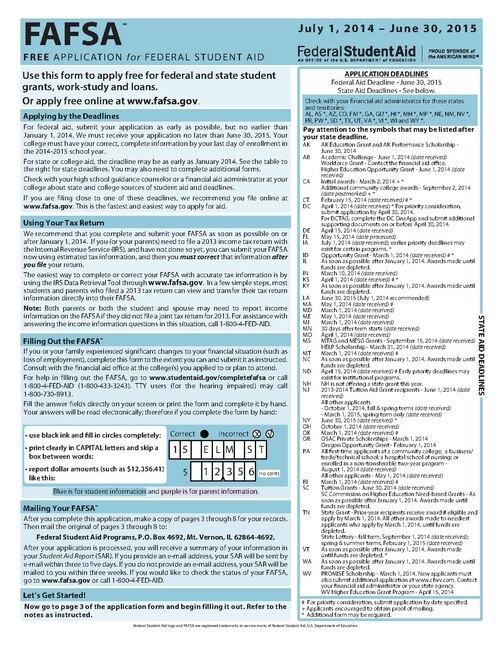
The FAFSA deadline (financial aid application deadline) refers to the ultimate cut-off date by which students in the United States must submit the Free Application for Federal…
FAFSA deadline
The FAFSA deadline (financial aid application deadline) refers to the ultimate cut-off date by which students in the United States must submit the Free Application for Federal…
US Federal Government · Public domain · FAFSA 2014–15.pdf
The FAFSA deadline (financial aid application deadline) refers to the ultimate cut-off date by which students in the United States must submit the Free Application for Federal Student Aid to qualify for federal, state, and institutional financial aid programs.
Admissions and financial support systems rely heavily on these strict cutoff dates to allocate finite resources, making adherence to these timelines one of the most critical steps in the higher education application process. Unlike a singular administrative due date, the application framework encompasses a multi-layered structure comprising federal, state, and individual college deadlines.
1. Overview and Significance
Filing the FAFSA is the prerequisite for accessing a wide spectrum of postsecondary funding, including federal grants, work-study funds, federal student loans, and many state- and college-specific scholarships. Missing a deadline does not merely result in late fees; it often leads to the complete forfeiture of non-repayable aid programs such as the Federal Pell Grant or state-funded tuition waivers. Because many financial aid programs operate on a first-come, first-served basis until allocated funds are exhausted, submitting the application well in advance of the final deadline is strongly advised by educational policy experts.
2. Structure of FAFSA Deadlines
The application timeline is divided into three distinct tiers, each governed by different administrative entities. Applicants must satisfy the earliest applicable deadline among these tiers to maximize their potential aid package.
- Federal Deadline: Established by the U.S. Department of Education, this deadline generally falls at the end of the academic award year (typically June 30). It acts as the absolute final date to process aid for the preceding academic period.
- State Deadlines: Every U.S. state and territory sets independent cutoff dates to determine eligibility for state grants and scholarships. These deadlines vary significantly; some states enforce strict early dates in the spring, while others operate on a rolling basis until funds run out.
- Institutional Deadlines: Individual colleges, universities, and career schools set their own financial aid deadlines. These are often aligned with admissions priority deadlines to allow financial aid administrators to build award packages alongside admission decisions.[1]https://studentaid.gov/apply-for-aid/fafsa/fafsa-deadlines — The June 30 federal cutoff gives applicants an entire extra year past the start of classes to clear lingering payments, making it effectively a retroactive administrative safety net.
3. Application Cycle and Priority Filing
The FAFSA traditional cycle opens on October 1 for the upcoming academic year, utilizing tax information from the prior-prior year (commonly referred to as "prior-prior tax data").[2]https://www.ed.gov/news/press-releases/fafsa-changes-will-benefit-millions-students — The transition to utilizing prior-prior year tax data was designed to eliminate the anxiety of waiting for current-year tax filings to clear before submitting aid applications. The period between the application launch date and a school's designated priority deadline represents the window during which applicants have the highest statistical chance of receiving discretionary grant aid.
While the federal deadline extends far beyond the start of the school year, relying solely on this date is considered a major misstep. Institutional and state grant pools are typically depleted within the first few months of the cycle opening, meaning students who apply close to the federal cutoff may only remain eligible for federal student loans rather than gift aid.
4. Consequences of Missing the Deadline
Failing to submit the FAFSA before specified cutoff dates carries several immediate administrative and financial repercussions. Students lose access to state and institutional grants that require timely submission. While federal direct loans and Pell Grants can sometimes be processed retroactively before the federal end date, delay in submission can result in delayed disbursement of funds, forcing students to pay out-of-pocket for tuition and housing costs while waiting for processing. For continuing students, missing an annual deadline can jeopardize their ability to maintain uninterrupted enrollment.
5. Trivia
5.1 Institutional Discrepancy and Priority Deadline Fallacy
While the Federal Student Aid office advertises a uniform federal deadline—typically June 30 following the academic year of application—this operates largely as a legal formality for residual pell grant adjustments. In real-world mechanics, the actionable deadlines are governed by state-level higher education authorities and individual institutional governance. State agencies often utilize "first-come, first-served" allocation models for state-funded grant pools. Consequently, applicants submitting near the federal deadline frequently find state and institutional aid reserves entirely exhausted, rendering the official federal deadline functionally obsolete for maximum aid optimization.
5.2 The October First Tradition and the 2024–2025 Structural Shift
Historically, the FAFSA cycle opened on January 1 of the attending academic year. The Higher Education Act amendments introduced the "Prior-Prior Year" (PPY) tax income model, shifting the opening launch date to October 1 of the preceding year. This five-month acceleration allowed students to receive financial aid packages alongside their college admission decisions. However, this established cycle experienced a major disruption during the 2024–2025 application cycle due to the FAFSA Simplification Act rollout. Systemic database bugs forced the Department of Education to delay the soft launch to December 30, triggering a domino effect of postponed state and university commit deadlines nationwide.[3]https://www.apnews.com/article/fafsa-financial-aid-college-delay-application-d4d0fd0c8b2a8d56b27e57c6b9bf7ff0 — The delayed rollouts and technical bugs during this revision forced numerous universities nationwide to push back their traditional May 1 decision day.
5.3 Leap Year Financial Aid Adjustments
In leap years, such as 2024, the structural alignment of state-level priority deadlines creates minor administrative anomalies. Several state programs enforce strict February 28 or March 1 cutoffs. Due to the leap day (February 29), automated processing engines at specific state agencies historically experienced validation errors regarding whether applications submitted on the 29th qualified for February priority status. Modern iterations of the Central Processing System (CPS) and the FAFSA Processing System (FPS) have largely patched these date-parser bugs, yet manual overrides remain necessary in select state-level state grant databases.
5.4 The Tax Transcript Synchronization Lag
A critical point of failure regarding deadline compliance is the asynchronous nature of the IRS Data Retrieval Tool (DRT)—rebranded as the Direct Data Exchange (DDX) under the FA-DDX protocol. Taxpayers who file tax returns close to the April 15 deadline encounter a 2-to-8 week data synchronization latency period before their information becomes accessible via the automated IRS interface. Applicants attempting to complete their FAFSA near state priority deadlines in late spring often face submission blocks or fall back on manual income entry, which dramatically elevates the probability of undergoing Income Verification audits.
5.5 Time-Zone Disparities and Midnight Central Time Hard Stop
The federal FAFSA portal enforces deadline cutoffs strictly synchronized to Central Time (CT), corresponding to the physical location of primary data centers servicing the Federal Student Aid infrastructure. As a result, applicants residing in the Pacific, Alaska, or Hawaii time zones effectively face a deadline several hours prior to midnight in their local time. An application submitted at 11:30 PM Pacific Time on a deadline date is logged by the system as 1:30 AM Central Time the following day, resulting in automated rejection from priority status tiers.[4]Applicants residing in Hawaii effectively experience an 8:00 PM local cutoff, resulting in frequent surprises for late-night filers expecting a local midnight deadline.
5.6 High-School-to-College Transition Friction in California
California’s Assembly Bill 469 established a mandatory structural link between secondary education completion and financial aid deadlines. The legislation requires local educational agencies (LEAs) to ensure all graduating high school seniors submit a FAFSA or the California Dream Act Application (CADAA) by the state priority deadline (typically March 2, extended to April 2 or May 2 during technical system delays). This converted a purely administrative financial application into a quasi-prerequisite for high school graduation metrics, placing unprecedented operational reliance on the state's March deadline.
Child documents of "FAFSA deadline"
None yet.