Published page
Flight cancellation and delay


Flight cancellation and delay refers to an operational disruption in air travel where a scheduled flight is either entirely called off or its departure and arrival times are postp…
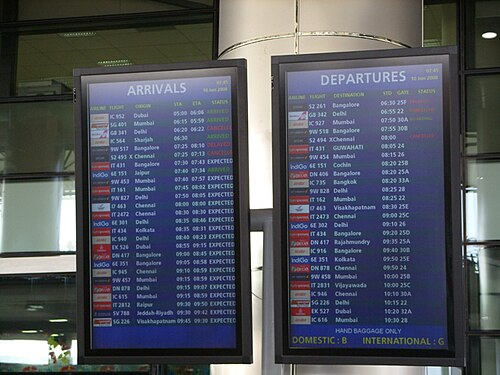
Flight cancellation and delay
Flight cancellation and delay refers to an operational disruption in air travel where a scheduled flight is either entirely called off or its departure and arrival times are postp…
Addd wiki ( talk ) · CC BY 3.0 · HYD board 2.jpg
Flight cancellation and delay refers to an operational disruption in air travel where a scheduled flight is either entirely called off or its departure and arrival times are postponed beyond the planned schedule.
Completely different from ground transportation, civil aviation is governed by strict international safety standards, complex airspace networks, and tight aircraft rotation schedules. Consequently, even a minor disruption in one sector can cause massive cascading delays worldwide, making schedule management a paramount concern for airlines, airport authorities, and passengers alike.
1. Overview
In the aviation industry, precise timing is not merely a service standard but a core component of operational safety and efficiency. A flight delay typically refers to a situation where an aircraft departs or arrives later than its scheduled time, often categorized internationally as a delay when the variance exceeds 15 minutes.[1]https://www.bts.gov/topics/airlines-and-airports/understanding-reporting-causes-flight-delays-and-cancellations — Standard industry metrics treat a flight as delayed only after the 15-minute grace period elapses. A flight cancellation occurs when an airline decides not to operate a planned flight altogether, requiring passengers to be rebooked on alternative flights or refunded.
Because aircraft operate on continuous, tightly coupled itineraries—often flying multiple legs a day across different countries—a disruption on a single route frequently impacts subsequent flights assigned to the same aircraft. This domino effect makes air travel particularly vulnerable to systemic delays compared to other modes of transportation.
2. Primary Causes
Schedule disruptions stem from a wide array of internal and external factors, ranging from unpredictable natural occurrences to complex logistics.
- Severe Weather Conditions: Adverse weather is the single most common cause of major flight disruptions. Heavy snow, freezing rain, typhoons, thick fog, and severe thunderstorms drastically reduce visibility and runway traction, forcing air traffic control to reduce airport capacity or suspend operations entirely for safety reasons.
- Air Traffic Control (ATC) Restrictions: Airspace capacity is strictly limited. When airspace becomes congested or when staffing shortages occur at control towers, ATC imposes flow management programs. Aircraft are held on the ground or placed in holding patterns, leading to widespread delays.
- Technical and Mechanical Issues: Prior to every departure, aircraft undergo rigorous safety checks. If a mechanical fault or instrument malfunction is detected, the aircraft cannot take off until the issue is fully resolved or a replacement aircraft is deployed.
- Crew Rotations and Duty Time Limitations: Aviation law strictly mandates maximum duty hours and minimum rest periods for pilots and cabin crew to prevent fatigue.[2]Pilots frequently refer to reaching these maximum legally allowable operational duty hours as 'timing out.' If an earlier delay causes a crew to exceed their legal duty limits, the airline must find replacement crew members, which often leads to further delays or cancellations.
- Operational and Supply Chain Disruptions: Delays during ground handling—such as baggage loading, refueling, aircraft cleaning, or late-arriving connecting passengers—can disrupt the departure slot assigned to the flight.
3. Systemic Effects and Cascading Delays
The aviation network functions much like a single interconnected organ. Major airlines operate on a "hub-and-spoke" system, where flights from various origin points converge at a central hub airport to transfer passengers and cargo before departing to final destinations.
Under this structure, if feeder flights arriving at the hub are delayed, the outbound flights must either wait for connecting passengers or depart without them, causing down-line complications. Furthermore, if an aircraft is unable to land at its destination due to weather, it must divert to an alternate airport, placing the airframe, crew, and passengers out of position for subsequent scheduled legs. Restoring normal operations after a major systemic disruption can take several days.
4. Passenger Rights and Compensation
When disruptions occur, airlines bear specific responsibilities to assist affected passengers, though the exact scope of protection varies greatly depending on jurisdiction and the nature of the delay.
- Extraordinary Circumstances vs. Airline Responsibility: Regulatory frameworks generally distinguish between uncontrollable events (such as extreme weather, political instability, or ATC strikes) and controllable events (such as mechanical issues or crew scheduling errors). Airlines are typically exempt from paying cash compensation for disruptions caused by extraordinary circumstances, though they remain obligated to provide basic care.
- Duty of Care: In many regions, airlines are required to provide meals, refreshments, and access to communication for delays exceeding a certain duration. If a cancellation or extended delay forces an overnight stay, the airline must arrange hotel accommodation and transport.
- Rerouting and Refunds: Passengers facing canceled flights or severe delays are generally entitled to choose between a full refund of the unused ticket portion or alternative transportation to their final destination at the earliest opportunity.
- Regional Legal Frameworks: The European Union's EU261 regulation sets a high global standard, mandating fixed financial compensation for long delays and cancellations within the airline's control.[3]https://eur-lex.europa.eu/legal-content/EN/TXT/?uri=CELEX%3A32004R0261 — The framework established clear financial compensation amounts ranging between 250 and 600 euros based on flight distance. Other jurisdictions, such as the United States and Canada, maintain their own distinct rules regarding passenger rights and mandatory disclosures.
5. Trivia
5.1 The Delay Propagation Effect (Ripple Effect)
The operational paradigm of commercial aviation relies heavily on continuous aircraft utilization, where a single frame performs multiple flight segments daily. Consequently, a primary disruption occurring during a morning segment induces cascading schedule impairments across subsequent operations. According to air traffic management analytics, a single 15-minute reactionary delay in a hub-and-spoke system can multiply exponentially, generating up to several hours of aggregate downtime for downstream flights operating the same registration tail number.
5.2 The 80/20 Slot Rule and "Ghost Flights"
Under international aviation regulatory frameworks—specifically enforced by the European Union and the Federal Aviation Administration (FAA)—airlines allocated departure and arrival slots at congested airports must maintain an 80% operational rate per season to retain historical slot rights. During periods of severe demand suppression, such as global crises or localized systemic disruptions, this requirement has historically forced carriers to operate unviable, empty segments—commonly termed "ghost flights"—solely to prevent the forfeiture of multi-million-dollar infrastructure access for subsequent seasons.[4]Airlines flew thousands of empty flights during global demand drops simply to retain their valuable airport slot rights.
5.3 The Eurocontrol Slot Allocation Engine (CTOT)
Within European airspace, air traffic flow management is centralized under Eurocontrol's Network Manager. When airspace capacity shrinks due to meteorological phenomena or military activity, the Computerized Flow Management System assigns a Calculated Time of Take-off (CTOT), colloquially known as an "ATC Slot." These slots grant a strict departure window of 15 minutes (5 minutes prior to 10 minutes post-CTOT). Failure to push back within this narrow margin results in immediate slot revocation, pushing the aircraft to the end of the queue and inflicting disproportionate delay times relative to the initial ground discrepancy.
5.4 Extraordinary Circumstances under Regulation EC 261/2004
European Union Regulation EC 261/2004 established a global benchmark for passenger rights, mandating standardized financial compensation for delays exceeding three hours at the final destination. However, the legal definition of "extraordinary circumstances"—events exempting carriers from monetary indemnification—remains a highly contested domain of aviation jurisprudence. While severe meteorological events and bird strikes are universally recognized as non-compensable force majeure, hidden manufacturing defects, wildcat labor strikes, and regional radar network failures trigger divergent interpretations across national enforcement bodies and appellate courts.
5.5 Tarmac Delay Regulations and the Cancellation Dilemma
Following high-profile incidents involving prolonged passenger confinement on airport ramps, regulatory authorities implemented strict temporal caps on tarmac delays (typically three hours for domestic and four hours for international operations in the United States). Upon reaching these thresholds, carriers are legally required to return to a gate to disembark passengers. Paradoxically, this consumer protection mechanism frequently incentivizes preemptive flight cancellations; if an aircraft's line-up sequence for departure threatens to breach the statutory limit, operational control centers will cancel the segment outright to avoid severe civil monetary penalties per passenger.[5]https://www.transportation.gov/briefing-room/us-department-transportation-issues-final-rule-tarmac-delays — Severe financial penalties for tarmac delay violations caused airlines to cancel flights rather than risk remaining on the taxiway.
5.6 Flight Crew Duty Time Limitations (FAR Part 117)
Disruptions are frequently exacerbated by mandatory safety standards governing Flight Duty Period (FDP) limits for crew members, such as FAA Part 117 or EASA ORO.FTL. Once a pilot or cabin crew member reaches their maximum allowable duty hours—a state colloquially referred to as "timing out"—they are legally prohibited from operating the aircraft. If a carrier's standby reserve pool at a given outstation is exhausted, a flight with fully functional equipment and favorable weather will suffer immediate cancellation due to the legal unavailability of a certified crew.
5.7 The Mechanics of Tactical Aircraft Swapping
To mitigate schedule decay, carrier System Operations Control (SOC) centers employ tactical equipment routing algorithms. When an inbound aircraft incurs a significant delay, flight dispatchers may perform an unscheduled operational swap, assigning a standby frame or re-routing an aircraft scheduled for a less time-sensitive route. This operational trade-off prioritizes high-yield, long-haul, or hub-connecting segments at the intentional expense of regional feeder flights, systematically concentrating cancellation probabilities onto low-density secondary routes.
Child documents of "Flight cancellation and delay"
None yet.