Published page
Groundhog Day


Groundhog Day is a traditional North American holiday celebrated annually on February 2, rooted in weather folklore that predicts the arrival of spring based on the behavior o…
Groundhog Day
Groundhog Day is a traditional North American holiday celebrated annually on February 2, rooted in weather folklore that predicts the arrival of spring based on the behavior o…
Anthony Quintano from Mount Laurel, United States · CC BY 2.0 · Punxsutawney Phil Groundhog Day 2022 Pennsylvania (51858203861).jpg
Groundhog Day is a traditional North American holiday celebrated annually on February 2, rooted in weather folklore that predicts the arrival of spring based on the behavior of a groundhog emerging from its burrow.
1. North American weather folklore holiday
According to custom, if the groundhog sees its shadow due to clear weather, it will become frightened and retreat back into its hole, indicating that winter weather will persist for six more weeks. Conversely, if cloudiness prevents the groundhog from seeing its shadow, the animal remains outside, signaling that spring will arrive early. While the holiday holds no scientific validity in modern meteorology, it remains a beloved cultural phenomenon characterized by festive civic gatherings, public performances, and widespread media coverage across the United States and Canada.
1.1 Overview and Customs
Groundhog Day takes place on February 2, a date that historically corresponds to the mid-point between the winter solstice and the vernal equinox.[1]https://www.census.gov/newsroom/stories/groundhog-day.html — The holiday aligns with the ancient cross-quarter day of Candlemas, marking the astronomical midpoint of the winter season. The central event of the holiday involves a designated groundhog—often given a grand, honorific name—acting as a rodent weather prognosticator before a crowd of onlookers and journalists.
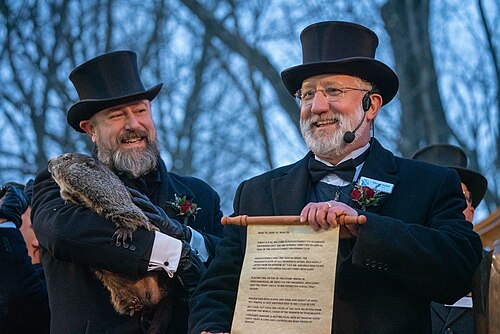
Local civic leaders, frequently dressed in formal attire such as top hats and tuxedos, manage the ceremonies. They retrieve the groundhog from a simulated natural habitat and pretend to converse with the animal in a secret dialect, after which they formally proclaim the weather forecast to the public. Beyond the central prediction ceremony, communities often host breakfasts, parades, music performances, and festival activities centered around the groundhog theme.
1.2 Historical Origins
The holiday's origins trace back to ancient European seasonal observances and the Christian tradition of Candlemas. On Candlemas, clergy blessed and distributed candles needed for the winter, and Christians believed that clear weather on this day portended an extended winter.
As these customs evolved in Germanic lands, early traditions began incorporating hibernating animals, such as badgers or bears, as weather predictors. German immigrants, known as the Pennsylvania Dutch, brought these traditions to North America during the eighteenth and nineteenth centuries. Finding a lack of badgers in their new environment, the settlers adapted the lore to the native groundhog (*Marmota monax*), an abundant burrowing mammal that hibernates throughout the winter season. The earliest recorded mention of Groundhog Day in the United States appears in a diary entry from 1840 in Pennsylvania.[2]https://www.loc.gov/item/today-in-history/february-02 — The entry was made by James L. Morris in Morgantown, Pennsylvania, marking the earliest known written reference to the tradition in America.
1.3 Famous Groundhogs and Observances
While hundreds of towns across North America observe Groundhog Day with local rodents, a few specific groundhogs have achieved international fame.
- Punxsutawney Phil: Hailing from Punxsutawney, Pennsylvania, Phil is the undisputed icon of the holiday. The town hosted its first official Groundhog Day trek to Gobbler's Knob in 1887.[3]https://www.groundhog.org/history — The inaugural trip was organized by local newspaper editor Clymer Freas, who persuaded residents and city leaders to join the trek. The event is orchestrated by the Punxsutawney Groundhog Club's "Inner Circle," who claim that Phil is immortal and gains his longevity from a secret "elixir of life."
- Wiarton Willie: Located in Wiarton, Ontario, Willie is Canada's most prominent weather-predicting groundhog. The town hosts the annual Wiarton Willie Festival, a major winter tourism event in the region.
- Staten Island Chuck: Residing at the Staten Island Zoo in New York City, Chuck serves as the city's official groundhog predictor and often engages in playful rivalries with the Mayor of New York during the annual ceremony.[4]During the 2014 ceremony, the groundhog bit Mayor Bill de Blasio, who dropped the animal; it tragically passed away from internal injuries a week later.
1.4 Modern Cultural Impact
In contemporary culture, Groundhog Day is recognized less for its meteorological accuracy and more as a lighthearted community celebration that breaks up the monotony of mid-winter. Studies conducted by climate organizations consistently show that groundhogs possess no actual predictive ability regarding seasonal transitions, with overall accuracy rates hovering around chance levels.
The phrase "Groundhog Day" gained a prominent place in global popular lexicon following the release of the 1993 comedy film *Groundhog Day*, directed by Harold Ramis and starring Bill Murray.[5]https://www.boxofficemojo.com/title/tt0107048 — The film grossed over seventy million dollars in North America during its initial theatrical release, solidifying its place in popular culture. In the film, a cynical television meteorologist finds himself trapped in a time loop, repeating the exact same day in Punxsutawney over and over. As a result of the film's massive success, the term "Groundhog Day" has become a widespread idiomatic expression used to describe a monotonous, repetitive situation that seems impossible to escape.
2. 1993 American comedy film
Groundhog Day is a 1993 American fantasy comedy film directed by Harold Ramis, starring Bill Murray as a cynical television weatherman who finds himself trapped in a time loop, forced to endlessly relive the same day in a small Pennsylvania town. Although initially met with moderate commercial success upon its release, the film has since achieved monumental critical acclaim and cultural significance. It is widely regarded as one of the greatest comedy films ever made, a masterpiece of modern narrative structure, and the definitive pop-culture codification of the "time loop" plot device.
2.1 Overview
Directed by Harold Ramis and co-written by Ramis and Danny Rubin, the film represents a quintessential peak in 1990s American cinema. While marketed primarily as a high-concept mainstream comedy, *Groundhog Day* possesses profound psychological, philosophical, and existential themes that elevate it far beyond standard genre fare.
The story follows Phil Connors, an arrogant and misanthropic Pittsburgh TV meteorologist assigned to cover the annual Groundhog Day festivities in Punxsutawney, Pennsylvania. Despising the small-town atmosphere and the assignment itself, Phil seeks to leave as quickly as possible, only to be trapped by a blizzard. Upon waking up the next morning, he discovers that it is February 2nd all over again. As the cycle repeats indefinitely, Phil experiences various psychological stages—ranging from hedonic exploitation and profound despair to self-reflection and ultimately, spiritual redemption.
2.2 Narrative and Themes
The narrative structure of *Groundhog Day* relies on a repeating temporal framework while allowing the protagonist's internal development to drive the plot forward. The film intentionally omits any sci-fi or magical explanations for *why* the time loop occurs, focusing entirely on Phil's emotional evolution.
- Egoism and Exploitation: Upon realizing that his actions carry no long-term consequences, Phil initially indulges his baseline desires. He drives recklessly, tricks local women into romantic encounters, steals money, and gorges on junk food. This phase highlights his fundamental narcissism.
- Despair and Existential Dread: The novelty of lawlessness eventually gives way to extreme boredom, isolation, and depression. Realizing he is trapped in a permanent purgatory, Phil attempts suicide through numerous creative methods. However, every attempt inevitably results in him waking up unharmed at 6:00 AM on February 2nd to the sound of Sonny & Cher's "I Got You Babe."[6]The classic pop duet was deliberately selected by the filmmakers because its bouncy, cheerful opening rhythm provided an intentionally annoying contrast to Phil's misery.
- Enlightenment and Altruism: After confiding in his producer, Rita Hanson, and spending a night explaining his plight to her, Phil shifts his perspective. He begins using his functional omniscience—gained from hundreds of repetitions—to help the townspeople. He learns French, masters the piano, saves lives, and performs countless acts of anonymous kindness.
Through genuine self-improvement and selfless love for others, Phil breaks the cycle, finally waking up on February 3rd alongside Rita.
2.3 Production and Behind the Scenes
The original script was written by Danny Rubin, who conceived the idea after contemplating human immortality and the repetition of daily routines. Harold Ramis subsequently reshaped the script to balance Rubin's darker, more esoteric tone with accessible Hollywood narrative beats.
- Cast: Bill Murray was cast as Phil Connors, delivering a career-defining performance that seamlessly blended his trademark acerbic sarcasm with deep vulnerability. Andie MacDowell co-starred as Rita Hanson, serving as the moral anchor of the film. Chris Elliott played the cheerful cameraman Larry, and Stephen Tobolowsky gave a memorable performance as the persistent insurance salesman Ned Ryerson.
- Filming Location: Although set in Punxsutawney, Pennsylvania, the film was primarily shot in Woodstock, Illinois.[7]https://www.woodstockil.gov/435/Groundhog-Days — Woodstock was chosen primarily because its central town square possessed the timeless, picturesque small-town aesthetic the producers desired. The town square provided the compact, walkable environment necessary for the film's repeated spatial beats.
- Behind-the-Scenes Tension: The production was marked by a strain in the long-standing creative partnership between Harold Ramis and Bill Murray. Ramis wanted to focus on the philosophical and romantic elements of the story, whereas Murray wanted to emphasize the darker, existential aspects. This creative friction, combined with personal troubles Murray was facing at the time, led to a rift between the two that lasted for over a decade.
2.4 Cultural Impact and Legacy
Over the decades following its release, *Groundhog Day* transcended its status as a simple cinematic release to become a permanent fixture in the global lexicon.
- Linguistic Influence: The phrase "Groundhog Day" has entered the English language as a common idiom used to describe a monotonous, unpleasant, and seemingly repetitive situation.
- Narrative Archetype: While time loop stories existed prior to 1993, this film popularized the trope to such an extent that virtually all subsequent media utilizing a repeating temporal structure—such as *Edge of Tomorrow*, *Russian Doll*, *Happy Death Day*, and various television episodes—are explicitly compared to or labeled as "Groundhog Day" scenarios.
- Philosophical and Religious Analysis: The film is frequently analyzed by theologians and philosophers. Buddhists interpret Phil's journey as a metaphor for *samsara* (the cycle of rebirth) and the path to enlightenment. Christians see it as a story of purgatory and grace, while existentialists view it as an illustration of Nietzsche's concept of the "eternal recurrence."
- Preservation: In 2006, the film was selected for preservation in the United States National Film Registry by the Library of Congress for being "culturally, historically, or aesthetically significant."
2.5 Trivia
- Duration of the Loop: The exact amount of time Phil Connors spends trapped in the time loop is never explicitly stated in the film. While early drafts of the script suggested he was trapped for thousands of years, Harold Ramis later estimated that Phil spent roughly 10 years in the loop, though fan calculations often range from 8 to 30 years based on the skills he acquired (such as ice sculpting and professional-level piano playing).
- The Alarm Clock Song: The song played on the radio every morning at 6:00 AM is "I Got You Babe" by Sonny & Cher. Its cheerful, repetitive brass intro became iconic as the auditory marker of Phil's daily reset.
- Groundhog Bites: During the filming of the scene where Phil steals Punxsutawney Phil the groundhog and drives off a cliff, Bill Murray was bitten by the groundhog twice.[8]The rodent handler had to pull the animal off the actor, and the bites were severe enough to require immediate rabies prophylaxis. Murray reportedly had to get rabies shots as a result.
3. 2016 stage musical adaptation
Groundhog Day is a stage musical featuring music and lyrics by Tim Minchin and a book by Danny Rubin, based on the 1993 fantasy comedy film of the same name. The production centers on Phil Connors, an arrogant and cynical Pittsburgh television meteorologist who finds himself trapped in a time loop, forced to endlessly relive February 2nd in the small town of Punxsutawney, Pennsylvania. While retaining the dark comedy and philosophical undertones of the original film, the musical adaptation expands upon the internal psychological journeys of its characters and uses complex theatrical staging to recreate the repetitive nature of the time loop live on stage.
3.1 Overview
The musical is the result of a creative collaboration between writer Danny Rubin, who co-wrote the original film's screenplay, and Australian composer-lyricist Tim Minchin, following his critical and commercial success with *Matilda the Musical*. The production was directed by Matthew Warchus, with choreography by Peter Darling and set and costume design by Rob Howell.
Unlike conventional musical adaptations that replicate their source material beat-for-beat, *Groundhog Day* reinterprets the film's premise through a heightened, introspective lens. The music spans a wide array of genres—including pop, rock, jazz, and country—tailored to reflect the shifting emotional states of the protagonist and the eccentricities of the townspeople. The production gained particular acclaim for its seamless illusion work, revolving stage mechanics, and intricate lyrical pacing designed to convey the monotony, despair, and ultimate redemption associated with living the exact same day indefinitely.
3.2 Synopsis
Phil Connors, a self-centered weather presenter, travels with his new associate producer Rita Hanson and cameraman Larry to Punxsutawney to cover the annual Groundhog Day festivities. Phil makes no attempt to hide his disdain for the town and its inhabitants. After completing the broadcast, a sudden blizzard prevents the crew from leaving, forcing Phil to spend another night at the local bed and breakfast.
Upon waking the following morning at 6:00 AM to the sound of Sonny & Cher's "I Got You Babe," Phil realizes that it is February 2nd all over again. As the days repeat endlessly, Phil moves through distinct psychological phases. Initially bewildered, he transitions into reckless hedonism, realizing that his actions carry no long-term consequences. When indulgence fails to bring satisfaction, he succumbs to severe depression and attempts suicide in numerous ways, only to wake up harmlessly at 6:00 AM every single time.
Eventually, through a series of conversations with Rita and a profound shift in perspective, Phil abandons his cynicism. He begins using his knowledge of the day to perform selfless acts, learn various skills, and help the townspeople overcome their personal struggles. By genuine self-improvement and learning to appreciate the present moment, Phil breaks the cycle, finally waking up to February 3rd alongside Rita.
3.3 Development and Production History
The idea of adapting *Groundhog Day* into a musical originated with Danny Rubin shortly after the release of the 1993 film, but the project gained momentum years later when director Matthew Warchus and composer Tim Minchin joined the creative team. The production aimed to preserve the original film's spiritual depth while utilizing the unique storytelling capabilities of live theater.
- Old Vic Theatre (London): The musical premiered at The Old Vic in London on August 16, 2016, following previews from July 11.[10]The production generated massive box-office demand and earned critical praise prior to its transfer to Broadway. Andy Karl originated the role of Phil Connors, with Carlyss Peer starring as Rita Hanson. The London run was a massive critical success, earning glowing reviews for its direction, score, and Karl's physically demanding performance.
- Broadway Production: The show transferred to Broadway at the August Wilson Theatre, opening on April 17, 2017. Andy Karl reprised his role as Phil Connors alongside Barrett Doss as Rita. Despite Karl sustaining an knee injury during a preview performance shortly before opening night, he performed through the pain to unanimous praise.[9]https://www.nytimes.com/2017/04/18/theater/andy-karl-groundhog-day-opening-night.html — Despite tearing his knee ligament during a preview performance, Karl received a standing ovation after performing on opening night with a heavy knee brace. The Broadway run closed on September 17, 2017, after 176 regular performances.
- London Revival: The production returned to The Old Vic for a strictly limited revival run from May 20 to August 25, 2023, with Andy Karl returning once again to play the lead role alongside Tanisha Spring as Rita Hanson.
- Other International Productions: The musical made its Australian debut at the Princess Theatre in Melbourne in February 2024, continuing the show's international presence.
3.4 Musical Numbers
- Act I
- "There Will Be Sun" – Company
- "Day One" – Phil, Rita, Larry, Townspeople
- "Day Two" – Phil, Townspeople
- "Day Three" – Phil, Townspeople
- "Stuck" – Phil, Healers
- "Nobody Cares" – Phil, Ralph, Gus
- "Philanthropy" – Phil, Townspeople
- "Punxsutawney Phil" – Townspeople
- "One Day" – Rita, Townspeople
- Act II
- "Playing Nancy" – Nancy, Townspeople
- "Hope" – Phil, Townspeople
- "If I Had My Time Again" – Phil, Rita
- "Everything About You" – Phil
- "Night Will Come" – Ned Ryerson
- "Philanthropy (Reprise)" – Phil, Townspeople
- "Seeing You" – Phil, Rita, Townspeople
3.5 Principal Roles and Original Casts
| Character | Original London Cast (2016) | Original Broadway Cast (2017) |
| :--- | :--- | :--- |
| Phil Connors | Andy Karl | Andy Karl |
| Rita Hanson | Carlyss Peer | Barrett Doss |
| Ned Ryerson | Andrew Langtree | John Sanders |
| Nancy Taylor | Georgina Hagen | Taylor Iman Jones |
| Larry | Eugene McCoy | Vishal Vaidya |
| Mrs. Lancaster | Eve McKeown | Heather Ayers |
| Buster Green | Leo Andrew | Raymond J. Lee |
3.6 Critical Reception and Awards
*Groundhog Day* received widespread acclaim from theater critics, particularly for Tim Minchin's sharp, emotionally complex lyrics and Matthew Warchus's inventive staging. Andy Karl's performance was universally lauded as a tour de force of comedic timing, vocal strength, and physical endurance.
The production was nominated for seven Olivier Awards in 2017, winning two major categories: Best New Musical and Best Actor in a Musical for Andy Karl.
During its Broadway run, the musical received seven Tony Award nominations, including Best Musical, Best Original Score, Best Book of a Musical, and Best Actor in a Musical for Karl. Additionally, Andy Karl won the Drama Desk Award and the Outer Critics Circle Award for Outstanding Actor in a Musical.
3.7 Trivia and Characteristics
- The physical staging of the time loop is achieved through a combination of four concentric stage turntables, hidden trap doors, and clever optical illusions designed by illusionist Paul Kieve.
- The Act II opener, "Playing Nancy," is notable for breaking away from the main narrative to give a voice to a minor female character, examining the trope of the disposable romantic interest in media.
- During the Broadway previews, lead actor Andy Karl tore his anterior cruciate ligament (ACL) during a scene involving a turntable. Demonstrating immense dedication, he returned to perform on opening night with a knee brace after missing only a few preview shows.
- Tim Minchin's score intentionally utilizes repetitive musical motifs and lyrical callbacks to structurally mirror the repetitive nature of Phil Connors' predicament.
4. Trivia
4.1 Punxsutawney Phil's Alleged Immortality and the "Elixir of Life"
According to the inner circle of the Punxsutawney Groundhog Club, the forecaster groundhog known as "Punxsutawney Phil" is not a succession of different animals, but rather a single individual who has been making predictions since 1887. The club maintains the official lore that Phil's longevity—far exceeding the average wild groundhog lifespan of two to three years—is sustained by drinking a secret concoction known as the "Groundhog Elixir" (or "Eixir of Life") during the annual Groundhog Picnic each summer. A single sip of this elixir reportedly extends Phil's life by seven years.
4.2 Statistical Accuracy and Climate Data Divergence
Despite the high cultural visibility of the ceremony, meteorological evaluations by the National Oceanic and Atmospheric Administration (NOAA) indicate that Punxsutawney Phil's predictions possess no statistical skill. Historical analyses of the groundhog's forecasts reveal an overall accuracy rate hovering around 39% to 40%.[11]Statistical evaluations confirmed that relying on the groundhog's shadow yielded results no better than a random coin toss. Climatologists note that the prompt for "six more weeks of winter" is statistically favored regardless of the groundhog's shadow, given that astronomical spring routinely begins in late March across North America.
4.3 The Original Script's Temporal Scope and Dark Tones
The initial screenplay for the 1993 film *Groundhog Day*, written by Danny Rubin, featured a significantly different structure and tone compared to the final cinematic release. Rubin's original draft began *in media res* with Phil Connors already trapped in the time loop for an indeterminate period, omitting the initial establishing day. Furthermore, the draft explicitly established that Phil remained trapped in Punxsutawney for approximately 10,000 years, a duration indicated by his meticulous reading of every book in the local library one page per day.[12]Writer Danny Rubin calculated that spending a single day on every book in a local library would realistically trap the protagonist for thousands of years. The film's director, Harold Ramis, later estimated the finalized on-screen loop to be between 10 years and 30 years.
4.4 Production Location Divergence: Woodstock, Illinois
Although set in Punxsutawney, Pennsylvania, the 1993 film was shot almost entirely in Woodstock, Illinois. The producers selected Woodstock due to Punxsutawney's lack of a centralized, camera-ready town square suitable for filming. Today, the city of Woodstock heavily leverages this historical association, featuring commemorative plaques embedded in the sidewalks at specific filming locations, including the site where Bill Murray's character repeatedly stepped into a water-filled pothole and the opera house from which he jumped.
4.5 Rupture of the Murray-Ramis Collaboration
The production of the 1993 film marked the end of the long-standing creative partnership between lead actor Bill Murray and director Harold Ramis, who had previously collaborated on successful comedy projects such as *Caddyshack* (1980) and *Ghostbusters* (1984). Creative disagreements over the film's tone—Murray desired a more philosophical and melancholic direction, while Ramis favored comedic elements—were exacerbated by Murray's personal stress at the time. The conflict resulted in an estrangement that lasted over two decades, only resolving shortly before Ramis's death in 2014.[13]The long-standing estrangement was finally resolved when Murray paid a surprise visit to Ramis shortly before his death.
4.6 Structural Variations in the Stage Musical Adaptation
The 2016 stage musical adaptation, featuring music and lyrics by Tim Minchin and a book by original screenwriter Danny Rubin, intentionally alters the narrative perspective to heighten the theatrical medium. Unlike the film, which strictly adheres to Phil Connors' point of view, the musical incorporates ensemble numbers that explore the existential psychological state of the residents of Punxsutawney, who are unknowingly caught in the repeated day. Additionally, the musical introduces a non-linear arrangement of the repeated song "There Will Be Sun," contrasting the film's iconic reliance on Sonny & Cher's "I Got You Babe."
4.7 Psychological and Philosophical Integration into Lexicon
Following the release of the 1993 film, the term "Groundhog Day" entered the English vernacular as a formal noun phrase denoting a tedious, monotonous, or repetitive situation that appears impossible to alter. The concept has been widely adopted in academic contexts, particularly within philosophical discussions of Nietzsche's concept of eternal recurrence, existentialist theology, and military psychological studies concerning operational burnout during prolonged deployments.
Child documents of "Groundhog Day"
None yet.