Published page
Health insurance


Health insurance covering medical expenses is a private insurance product designed to compensate the policyholder for actual out-of-pocket medical costs incurred due to illness or…
Health insurance
Health insurance covering medical expenses is a private insurance product designed to compensate the policyholder for actual out-of-pocket medical costs incurred due to illness or…
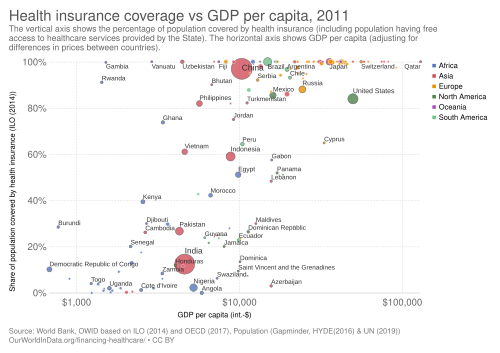
Our World In Data · CC BY 3.0 · Health insurance coverage vs GDP per capita, OWID.svg
Health insurance covering medical expenses is a private insurance product designed to compensate the policyholder for actual out-of-pocket medical costs incurred due to illness or injury.
Often referred to as "Actual Loss Health Insurance" or simply "Silbi" in certain regional markets, it functions as a critical secondary safety net that complements public universal healthcare systems by mitigating the individual financial burden of non-covered procedures, co-payments, and advanced treatments.
1. Overview
Unlike fixed-benefit indemnity insurance, which pays a pre-determined lump sum upon the diagnosis of a specific disease regardless of the actual cost, medical expense health insurance operates strictly on the principle of indemnity. It reimburses the policyholder for the actual financial losses suffered, up to a specified policy limit.
Because medical expenses can vary drastically based on hospital tier, treatment complexity, and duration of care, this type of insurance is widely considered a foundational element of personal financial planning. It acts as a financial buffer against catastrophic health expenditures that could otherwise lead to severe economic distress for an individual or household.
2. Underlying Principles and Mechanics
The operational structure of medical expense coverage relies on several core economic and legal principles:
- Principle of Indemnity: The insurer compensates only the actual amount of financial loss sustained by the insured. A policyholder cannot profit from a claim; the objective is merely to restore the individual to the financial position they occupied prior to the loss.
- Deductibles and Co-payments: To prevent moral hazard—such as unnecessary medical utilization—policies incorporate out-of-pocket deductibles and percentage-based co-payments.[1]The term moral hazard originated in 17th-century fire insurance, where insurers feared that policyholders might intentionally allow insured property to burn down. The insured must bear a portion of the bill, while the insurer covers the remainder up to the policy limit.
- Pro-rata Contribution: If an individual holds multiple medical expense policies from different insurers, the companies do not pay double. Instead, they divide the actual bill proportionally based on their respective coverage limits to ensure the total payout does not exceed the real medical bill.
3. Scope of Coverage
Medical expense insurance generally divides care into covered expenditures and explicit exclusions to manage risk pools effectively.
- Covered Items
- Inpatient Care: Hospital room fees, surgical procedures, nursing care, laboratory tests, and prescription medications administered during a hospital stay.
- Outpatient Care: Physician consultations, minor diagnostic tests, and prescription drugs filled at retail pharmacies following a clinic visit.
- Emergency Services: Transportation and immediate intervention costs during acute medical crises.
- Advanced Diagnostics: High-cost imaging such as Magnetic Resonance Imaging (MRI), Computed Tomography (CT) scans, and specialized therapies, subject to specific sub-limits or endorsements.
- Standard Exclusions
- Cosmetics and Elective Procedures: Treatments aimed at aesthetic enhancement, such as double eyelid surgery, rhinoplasty, or elective dermatological procedures, rather than functional restoration.[2]https://www.ncbi.nlm.nih.gov/pmc/articles/PMC2825128 — Elective cosmetic procedures remain one of the few medical sectors operating entirely on market pricing, as insurers strictly exclude them from standard coverage policies.
- Unproven or Alternative Therapies: Experimental treatments not recognized by official health authorities, as well as certain non-standard alternative medicine modalities.
- Routine Care: General health checkups, routine vaccinations, and over-the-counter vitamins or supplements.
- Intentional Harm and Extreme Risk: Injuries resulting from deliberate self-harm, criminal acts, or participation in extreme professional sports, depending on policy terms.
4. Structural Evolution and Policy Types
The terms and financial structures of medical expense health insurance undergo periodic regulatory updates to balance consumer accessibility with the long-term solvency of insurance risk pools.
early-generation policies offered comprehensive coverage with minimal or zero deductibles, covering up to one hundred percent of medical bills. While highly favorable to consumers, this structure led to systemic overutilization of medical services and significant premium inflation across the broader policyholder base.
Modern standard policies employ a tiered framework featuring higher mandatory co-payment ratios and separate operational pools for high-cost treatments such as manual therapy, non-covered injections, and advanced imaging. Under modern standardized models, premiums are periodically recalculated based on age, economic conditions, and, in some systems, individual claims history—rewarding non-claimants with discounted rates while levying surcharges on heavy users of non-essential treatments.
5. Relationship with Universal Public Healthcare
In nations utilizing a single-payer or universal public healthcare framework, private medical expense insurance serves a supplemental role. Public health systems typically set a base level of coverage, leaving patients responsible for partial co-payments and the full cost of non-covered (out-of-plan) items.
Private medical expense insurance specifically targets these financial gaps. It reimburses the co-payment portion mandated by the public system as well as eligible non-covered items, effectively minimizing out-of-pocket friction for patients seeking specialized care, private hospital rooms, or innovative treatments not yet adopted by national health programs.
6. Considerations for Policyholders
Securing and maintaining medical expense coverage requires careful consideration of long-term risk factors:
- Duty of Disclosure: Applicants are legally obligated to accurately disclose past medical history, current treatments, and pre-existing conditions. Failure to disclose may lead to claim denials or contract cancellation.
- Premium Volatility: Because these policies often utilize dynamic risk pricing, premiums generally increase with age and overall loss ratios of the underlying insurance pool.
- Pre-existing Condition Clauses: Individuals with chronic illnesses or prior major diagnoses may face exclusions, higher premiums, or acceptance restricted to specialized "simplified issue" policies with reduced benefits.
7. Trivia
7.1 Bismarckian Health Insurance System
The world's first modern state-sponsored health insurance system was established in the German Empire under Chancellor Otto von Bismarck. The Health Insurance Bill of 1883 was not enacted primarily out of humanitarian benevolence, but rather as a pragmatic political strategy.[3]https://www.ssa.gov/history/ottovb.html — Otto von Bismarck famously referred to social insurance programs as a practical tactic to turn working-class citizens into state-dependent conservatives. Bismarck sought to appease the rising industrial working class and undermine the electoral appeal of the Marxist Social Democratic Party. Funding was derived from joint contributions by employers and employees, establishing the foundational prototype for the social health insurance model currently utilized in several European and East Asian nations.
7.2 The Employer-Sponsored Health Insurance Paradigm
The dominance of employer-sponsored health insurance in the United States originated as an unintended consequence of World War II economic policies. The Stabilization Act of 1942 imposed strict wage controls on American businesses to prevent wartime inflation.[4]https://www.archives.gov/historical-docs/todays-doc/?dod-date=1002 — The 1942 legislation created an accidental tax shelter that fundamentally reshaped American healthcare financing for the following century. Forbidden from offering higher monetary salaries to attract scarce labor, private enterprises began offering non-wage benefits, including employer-paid health insurance coverage. In 1943, the Internal Revenue Service declared these fringe benefits tax-exempt, permanently institutionalizing the linkage between employment status and medical coverage in the American healthcare ecosystem.
7.3 Actuarial Selection and the Medical Death Spiral
In competitive private insurance markets, the dynamic of adverse selection creates a phenomenon known in insurance economics as the "death spiral." This occurs when high-risk individuals (those with pre-existing or chronic conditions) purchase health insurance at higher rates than healthy individuals. As the pool's risk profile escalates, insurers raise premium prices to maintain solvency. The premium hikes prompt healthier policyholders to drop coverage, further concentrating the risk pool. Without regulatory intervention—such as individual mandates or community rating regulations—the cycle continues until the market collapses due to unsustainable costs.
7.4 The Chargemaster Variance Phenomenon
In the United States medical billing system, a "chargemaster" is a comprehensive, confidential master price list utilized by hospitals to set baseline rates for every medical procedure, service, and supply.[5]https://www.healthaffairs.org/doi/10.1377/hlthaff.25.1.45 — Hospital chargemasters are historically treated as proprietary commercial secrets, leading to massive price variations for identical procedures across neighboring facilities. These prices are often arbitrarily inflated up to several hundred percent above actual operational costs. The charged rates rarely reflect the actual prices paid by insurance companies, which negotiate steep, confidential discounts. Consequently, uninsured individuals or out-of-network patients are often billed the full chargemaster rates, creating a paradox where the least financially protected individuals face the highest nominal medical prices.
7.5 Socialized Medicine vs. Social Health Insurance
Comparative health systems analysis distinguishes between the Beveridge Model ("Socialized Medicine") and the Bismarck Model ("Social Health Insurance"). Under the Beveridge Model—named after British economist William Beveridge and exemplified by the United Kingdom's National Health Service (NHS)—healthcare is provided and financed by the government through general taxation, with most facilities owned by the state. Conversely, the Bismarck Model relies on mandatory, non-profit "sickness funds" financed jointly by employers and employees, operating largely with private healthcare service providers.
7.6 Moral Hazard and Cost-Sharing Mechanisms
The economic concept of "moral hazard" in health insurance refers to the propensity of individuals to consume more healthcare services when the out-of-pocket cost is mitigated by insurance coverage. To counter overutilization, insurers implement structural financial friction:
- Deductible: The fixed out-of-pocket sum a policyholder must expend annually prior to insurer liability.
- Copayment: A flat fee assessed per individual medical encounter or prescription.
- Coinsurance: A contractually defined percentage of medical costs born by the policyholder post-deductible.
7.7 Medical Debt as a Vector of Bankruptcy
Unlike most developed economies where health coverage mitigates personal financial catastrophe, medical debt represents a major driver of personal insolvency in the United States. Empirical studies in economic sociology indicate that medical issues, catastrophic illness, and associated unpaid bills contribute to more than 60% of individual consumer bankruptcies nationwide.[6]https://www.amjmed.com/article/S0002-9343(09)00404-5/fulltext — A landmark 2009 study led by researchers at Harvard Law School identified medical bills as a primary contributor to personal bankruptcy filings in the United States. Notably, a significant majority of individuals filing for medical-related bankruptcy possessed formal health insurance at the onset of their qualifying illness, highlighting structural gaps such as high deductibles and coverage exclusions.
Child documents of "Health insurance"
None yet.