Published page
Lunar eclipse


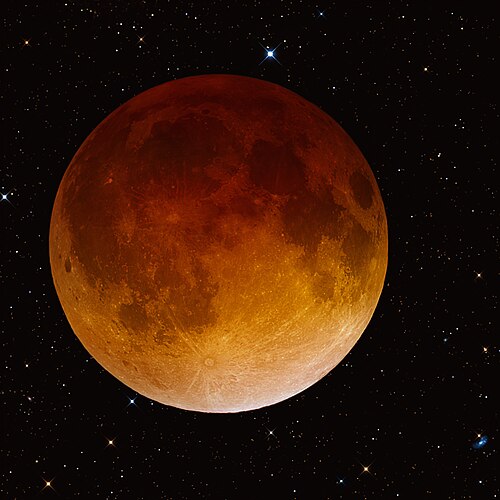
A lunar eclipse is a celestial event that occurs when the Moon passes directly behind Earth and into its shadow, happening only when the Sun, Earth, and Moon are exactly or very c…
Lunar eclipse
A lunar eclipse is a celestial event that occurs when the Moon passes directly behind Earth and into its shadow, happening only when the Sun, Earth, and Moon are exactly or very c…
Robert Jay GaBany · CC BY-SA 3.0 · Lunar eclipse 04-15-2014 by R Jay GaBany.jpg
A lunar eclipse is a celestial event that occurs when the Moon passes directly behind Earth and into its shadow, happening only when the Sun, Earth, and Moon are exactly or very closely aligned with Earth between the other two.
1. Overview
A lunar eclipse is one of the most prominent astronomical phenomena observable from Earth without specialized equipment. Unlike a solar eclipse, which can only be viewed from a relatively small area of the world, a lunar eclipse is visible from anywhere on the night side of Earth.
The event takes place exclusively during a full moon. However, because the orbital plane of the Moon around Earth is inclined by about 5 degrees relative to the orbital plane of Earth around the Sun (the ecliptic), a lunar eclipse does not occur every month.[1]https://eclipse.gsfc.nasa.gov/lunar.html — This slight orbital tilt prevents a monthly cosmic alignment, keeping eclipses relatively rare events. It happens only when the Moon is near one of the two intersection points of these orbital planes, known as nodes.
2. Types of Lunar Eclipses
Lunar eclipses are categorized into three main types depending on the alignment of the Sun, Earth, and Moon, which determines how the shadow falls upon the lunar surface.
- Total Lunar Eclipse: This occurs when the entire Moon enters the umbra, the darkest central part of Earth's shadow. During a total lunar eclipse, the Moon does not go completely dark; instead, it assumes a striking reddish hue often referred to as a "Blood Moon."
- Partial Lunar Eclipse: This happens when only a portion of the Moon enters Earth's umbral shadow. The part of the Moon inside the shadow appears dark, while the remainder remains bright, making it look as though a bite has been taken out of the Moon.
- Penumbral Lunar Eclipse: This takes place when the Moon passes through Earth's penumbra, the lighter, outer portion of the shadow. The dimming of the Moon's surface during a penumbral eclipse is very subtle and often difficult to detect with the naked eye unless the Moon is close to the umbral boundary.
3. Physical Mechanism and the Red Moon
The characteristic red coloration of the Moon during a total lunar eclipse is caused by Rayleigh scattering and atmospheric refraction. As sunlight travels through Earth's atmosphere, shorter wavelengths of light, such as blue and violet, are scattered in all directions by gas molecules.
Longer wavelengths, specifically red and orange light, pass through the atmosphere with less scattering. Earth's atmosphere acts like a lens, bending (refracting) this remaining red sunlight and projecting it into the umbral shadow zone onto the Moon's surface. The exact shade of red depends on the amount of dust, clouds, and volcanic ash present in Earth's atmosphere at the time of the eclipse.[2]https://science.nasa.gov/moon/eclipses — Major volcanic eruptions on Earth often cause subsequent eclipses to appear significantly darker due to lingering stratospheric dust.
4. Phases of a Total Lunar Eclipse
A complete total lunar eclipse unfolds over several distinct stages:
- Penumbral Contact (P1): The Moon enters Earth's penumbra. Visual changes are almost imperceptible at this stage.
- Partial Eclipse Begins (U1): The Moon touches the edge of Earth's umbra, marking the start of the visible shadow covering the lunar disc.
- Total Eclipse Begins (U2): The Moon completely enters Earth's umbral shadow, turning notably reddish.
- Greatest Eclipse: The peak moment of the eclipse, where the Moon is closest to the center of Earth's shadow.
- Total Eclipse Ends (U3): The Moon begins to move out of Earth's umbra.
- Partial Eclipse Ends (U4): The Moon completely exits the umbral shadow, returning to the penumbra.
- Penumbral Eclipse Ends (P2): The Moon leaves the penumbral shadow entirely, concluding the event.
5. Observation and Safety
Observing a lunar eclipse requires no protective eye gear, unlike solar eclipses, because the reflected light from the Moon is completely safe to view directly. The phenomenon can be readily enjoyed with the naked eye, though binoculars or small telescopes can enhance the view of detail on the lunar surface as the shadow moves across craters and Maria.
6. Trivia
6.1 Tetrad and the Red Heifer Prophecy
A sequence of four consecutive total lunar eclipses without any intervening partial eclipses—a phenomenon known as a "Tetrad"—occurs with irregular periodicity throughout history. During the 21st century, there are eight scheduled tetrads; however, between 1582 and 1908, not a single tetrad occurred.[3]Astronomical calculations confirmed that the three-century period preceding 1909 experienced a complete drought of lunar tetrads. Throughout various esoteric traditions and religious eschatology, particularly within Christian dispensationalism and Jewish messianism, tetrads coinciding with major Jewish holy days (Passover and Sukkot) have been interpreted as omens of pivotal geopolitical shifts, often linked to events such as the 1492 expulsion of Jews from Spain, the 1948 establishment of the State of Israel, and the 1967 Six-Day War.
6.2 The Selenelion Phenomenon
A selenelion (or selenehelion) refers to an astronomical paradox wherein both the fully eclipsed Moon and the Sun can be observed simultaneously above the horizon. Geometrically, a lunar eclipse requires a 180-degree syzygy, making such an observation theoretically impossible from a given viewpoint. However, atmospheric refraction bends the light from both celestial bodies, elevating their apparent positions and allowing observers situated near the horizon to witness the setting Sun and the rising eclipsed Moon concurrently during the exact moment of alignment.
6.3 Danjon Scale and Volcanism
The visual appearance and luminosity of a total lunar eclipse are quantified using the Danjon Scale, ranging from $L=0$ (very dark, almost invisible) to $L=4$ (bright copper-red or orange).[4]French astronomer André-Louis Danjon devised this five-point visual brightness scale in 1921. The primary variable determining this value is not lunar geometry, but the concentration of volcanic aerosols suspended in the Earth's stratosphere. Major volcanic eruptions—such as those of Mount Pinatubo in 1991 or Krakatoa in 1883—inject massive quantities of sulfur dioxide into the upper atmosphere, blocking Rayleigh scattering and causing subsequent total lunar eclipses to appear abnormally dark, sometimes rendering the Moon entirely unperceivable to the naked eye.
6.4 Historical Geodesy and Longitude Determination
Before the invention of the marine chronometer, lunar eclipses served as one of the few global synchronized events capable of determining terrestrial longitude. Because a lunar eclipse occurs simultaneously for all observers on the night side of the Earth, comparing the local solar time at which the eclipse began at two distinct geographical locations yielded their precise difference in longitude (with one hour corresponding to 15 degrees). Hipparchus and Ptolemy utilized this methodology, and later, Ptolemy's inaccurate calculations of global longitude via eclipse timing significantly led Christopher Columbus to underestimate the circumference of the Earth.
6.5 The Columbus "Blood Moon" Deception
During his fourth voyage in 1504, Christopher Columbus stranded his crew on the island of Jamaica, facing starvation as the indigenous Taíno population ceased supplying provisions due to the Spaniards' exploitative behavior. Utilizing the astronomical tables of Regiomontanus (*Ephemerides*), Columbus anticipated the total lunar eclipse of February 29, 1504.[5]The famous trick worked because Regiomontanus's mathematical tables accurately predicted the event decades prior. He informed the native leaders that the Christian God was angered by their non-cooperation and would inflame the Moon in wrath. The subsequent darkening and reddening of the lunar disc induced severe panic, prompting the Taíno to immediately restore supplies in exchange for Columbus's successful "intercession."
6.6 Thermal Shock and Lunar Dust Degradation
During a total lunar eclipse, the surface of the Moon undergoes extreme thermodynamic stress. As the Earth's shadow sweeps across the lunar surface, temperatures drop rapidly from approximately $380\text{ K}$ ($107^\circ\text{C}$) to around $100\text{ K}$ ($-173^\circ\text{C}$) in a span of less than an hour. This severe, instantaneous thermal shock induces micro-fracturing within the lunar regolith and exposed boulders. Measurements taken during the Apollo missions revealed that this phenomenon causes measurable seismic activity—termed "thermal quakes"—and accelerates the physical weathering rate of lunar rocks.
Child documents of "Lunar eclipse"
None yet.