Published page
Medicare


Medicare is a national health insurance program administered by the federal government of the United States, primarily providing coverage for individuals aged 65 and older, as…
Medicare
Medicare is a national health insurance program administered by the federal government of the United States, primarily providing coverage for individuals aged 65 and older, as…
RCraig09 · CC BY-SA 4.0 · 2025 Medicare plans - US.svg
Medicare is a national health insurance program administered by the federal government of the United States, primarily providing coverage for individuals aged 65 and older, as well as certain younger people with disabilities or specific end-stage diseases.
1. American federal health insurance
Standardized under Title XVIII of the Social Security Act, it operates as a single-payer system for hospital and medical services, functioning alongside Medicaid, which serves low-income individuals.
1.1 Overview
Medicare was signed into law on July 30, 1965, by President Lyndon B. Johnson to address the widespread lack of health coverage among elderly Americans. Over the decades, the program has expanded beyond senior citizens to include people under 65 receiving Social Security Disability Insurance (SSDI) and individuals suffering from End-Stage Renal Disease (ESRD) or Amyotrophic Lateral Sclerosis (ALS).
Unlike Universal Health Care systems found in some European nations, Medicare does not cover all medical costs or all citizens. Instead, it operates through a combination of public funding and beneficiary contributions, consisting of premiums, deductibles, and coinsurance. Beneficiaries often utilize supplementary private insurance policies to cover out-of-pocket gaps.[1]President Lyndon B. Johnson signed the legislation at the Harry S. Truman Presidential Library in Independence, Missouri, symbolically honoring the former president's early efforts toward national hea
1.2 Program Structure
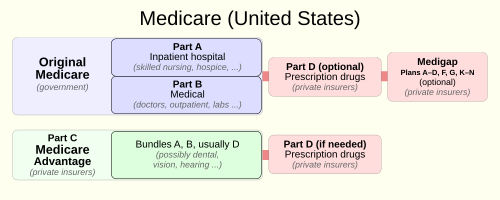
The program is organized into four distinct components, commonly referred to as "Parts." Each part covers specific aspects of medical care and is funded through different revenue streams.
- Part A (Hospital Insurance)
Part A covers inpatient hospital stays, care in a skilled nursing facility, hospice care, and limited home health care.[2]https://www.medicare.gov/basics/costs/medicare-costs — Care under Part A is structured around benefit periods, which begin the day an individual is admitted to a hospital or skilled nursing facility and end when they have not received inpatient care for 6 Most individuals do not pay a monthly premium for Part A if they or their spouse paid Medicare payroll taxes for at least ten years (40 quarters). However, beneficiaries remain responsible for deductibles and coinsurance per benefit period.
- Part B (Medical Insurance)
Part B covers medically necessary services such as outpatient care, doctor visits, preventive services, durable medical equipment, and select home health care. Part B requires a monthly premium, which is standard for most beneficiaries but increases for higher-income individuals under the Income-Related Monthly Adjustment Amount (IRMAA). Part B includes an annual deductible and typically requires a twenty percent coinsurance for covered services.
- Part C (Medicare Advantage)
Part C offers an alternative pathway to receive Medicare benefits through Medicare-approved private insurance companies. These plans combine Part A and Part B coverage, and usually include Part D prescription drug coverage. Medicare Advantage plans often operate as HMOs or PPOs and may offer additional benefits such as basic dental, vision, and hearing coverage, though they generally restrict care to specific provider networks.
- Part D (Prescription Drug Coverage)
Part D provides coverage for self-administered prescription drugs. Delivered exclusively through private insurance plans that contract with Medicare, Part D requires beneficiaries to pay a separate monthly premium.[3]https://www.cms.gov/Medicare/Prescription-Drug-Coverage/PrescriptionDrugCovGenIn — Private insurance plans offering Part D coverage are required to maintain basic standard benefits set by federal guidelines, though individual plan formularies differ. Drug coverage lists (formularies), copayments, and coverage limits vary significantly depending on the selected plan.
1.3 Eligibility and Enrollment
Eligibility for Medicare is primarily determined by age, citizenship, and work history. United States citizens and permanent legal residents who have lived in the country continuously for at least five years become eligible upon turning 65.
Automatic enrollment occurs for individuals already receiving Social Security retirement benefits upon reaching their eligibility age. Individuals under 65 become eligible after receiving Social Security Disability Insurance benefits for twenty-four months, or immediately upon a formal diagnosis of ALS or ESRD requiring dialysis or a transplant. Those who do not enroll during their Initial Enrollment Period may face lifetime financial penalties in the form of increased monthly premiums for Part B and Part D.
1.4 Funding and Administration
Medicare is administered by the Centers for Medicare & Medicaid Services (CMS), an agency within the United States Department of Health and Human Services (HHS).[4]https://www.cms.gov/About-CMS/Agency-Information/History — The agency now known as CMS was originally created in 1977 as the Health Care Financing Administration (HCFA) before being renamed in 2001. The financial administration relies on two primary trust funds held by the United States Treasury:
- Hospital Insurance (HI) Trust Fund: Primarily finances Part A through dedicated payroll taxes collected under the Federal Insurance Contributions Act (FICA) and the Self-Employment Contributions Act (SECA).
- Supplementary Medical Insurance (SMI) Trust Fund: Finances Part B and Part D through funds appropriated by Congress from general federal revenues, alongside monthly premiums paid by enrolled beneficiaries.
1.5 Issues and Controversies
Medicare remains a central topic in American political and economic discourse. Key areas of discussion include:
- Financial Sustainability: Demographic shifts, notably the aging Baby Boomer generation, combined with rising healthcare costs, place increasing stress on the HI Trust Fund, leading to ongoing legislative debates regarding solvency and structural reform.
- Coverage Gaps: Traditional Medicare (Parts A and B) does not set a maximum out-of-pocket limit for beneficiaries and excludes routine dental care, vision care, and long-term custodial care. This necessitates the purchase of private Medigap (Medicare Supplement Insurance) policies or transition to Medicare Advantage.
- Privatization Debates: The rapid growth of Medicare Advantage (Part C) has generated debate regarding public versus private management of healthcare benefits, focusing on provider network limitations, pre-authorization hurdles, and federal overpayment concerns to private insurers.
2. Australian universal healthcare system
Medicare is Australia's publicly funded universal healthcare system, designed to provide access to free or subsidized medical, hospital, and allied health services for all Australian citizens and permanent residents. Established in its current form in 1984 under the Hawke Labor Government, the system operates on the principle that equitable access to quality healthcare should be guaranteed regardless of an individual's financial standing.[5]https://www.aph.gov.au/About_Parliament/Parliamentary_Departments/Parliamentary_Library/pubs/rp/rp1314/Medicare — The introduction of the Australian Medicare card in 1984 provided citizens with a single identifier for accessing subsidized clinical services across all states and territories. It serves as the primary pillar of the Australian national health framework, functioning alongside a regulated private healthcare sector.
2.1 Overview and Core Philosophy
Medicare operates under a universal coverage model, seeking to minimize out-of-pocket medical expenses for the populace. The system is administered by Services Australia, a government executive agency. Through Medicare, eligible individuals receive free treatment as a public patient in public hospitals, as well as subsidies for out-of-hospital medical services, such as visits to general practitioners, specialists, and specific diagnostic tests.
The underlying philosophy reflects a social democratic commitment to universal social welfare. While private health insurance exists to offer additional choices, shorter wait times for elective procedures, and coverage for ancillary services like dental and optical care, Medicare acts as the mandatory safety net ensuring no resident is left without access to essential clinical care.
2.2 Funding Mechanism
The funding for Medicare is integrated directly into the federal taxation system. The primary financial sources include:
- The Medicare Levy: A basic tax levied on most Australian taxpayers, calculated as a fixed percentage of their taxable income.
- The Medicare Levy Surcharge: An additional tax imposed on higher-income earners who choose not to hold an appropriate level of private hospital insurance.[6]https://www.ato.gov.au/Individuals/Medicare-and-private-health-insurance/Medicare-levy-surcharge — The Medicare Levy Surcharge was introduced in 1997 as a policy lever to divert higher-income individuals toward private health coverage and relieve pressure on public hospital systems. This mechanism is intentionally designed to encourage individuals with higher financial means to enter the private system, thereby reducing pressure on public healthcare infrastructure.
- General Government Revenue: As the proceeds from the Medicare Levy do not fully cover the total operational costs of the healthcare system, the remaining balance is subsidized directly from general federal budget revenues.
2.3 Coverage and Benefits
Services covered under Medicare are formally cataloged in the Medicare Benefits Schedule, a comprehensive database detailing the standard fees and subsidy rates set by the Australian Government for various clinical procedures.
- Primary and Specialist Care: Patients visiting a general practitioner or specialist may have their consultation fully covered through a practice known as "bulk billing," where the medical provider accepts the standard government benefit as full payment. If a provider charges more than the scheduled fee, the patient pays the difference, known as the "gap payment."
- Public Hospital Treatment: Eligible individuals admitted to public hospitals as public patients receive complete care, accommodation, and treatment by hospital-appointed doctors at no personal cost.
- Pharmaceutical Benefits Scheme: While technically a distinct program, Medicare operates in close conjunction with the Pharmaceutical Benefits Scheme, which heavily subsidizes the cost of necessary prescription medications.
- Safety Nets: To protect individuals and families requiring frequent medical intervention, Medicare incorporates "Safety Nets." Once an individual's out-of-pocket expenditure reaches a specified annual threshold, the government significantly increases the subsidy rate for subsequent medical services for the remainder of the calendar year.
2.4 Eligibility and Reciprocal Agreements
Eligibility for Medicare is primarily determined by residency status. Australian citizens, permanent residents, and certain visa holders undergoing the permanent residency application process are entitled to full enrollment.
Furthermore, Australia maintains Reciprocal Health Care Agreements with select foreign nations, including the United Kingdom, New Zealand, and several European countries.[7]https://www.servicesaustralia.gov.au/reciprocal-health-care-agreements — Australia's reciprocal healthcare agreements cover essential treatments for temporary visitors, though they generally exclude planned elective surgeries and private hospital care. Under these bilateral treaties, visitors from signatory nations are granted access to medically necessary treatment under Medicare during their temporary stay in Australia, while Australian residents receive comparable emergency healthcare benefits when traveling in those partner countries.
3. Canadian informal healthcare system
Medicare refers to the informal, overarching term for Canada's publicly funded, universal health care system, which provides all eligible Canadian residents with access to medically necessary hospital and physician services without paying out-of-pocket at the point of delivery. Instead of operating as a single, unified national healthcare plan, it functions as an aggregate system composed of thirteen distinct provincial and territorial health insurance plans bound together by federal standards.
3.1 Overview and Structure
Canada's healthcare system operates under a decentralized model of governance dictated by the country's constitutional framework, which assigns the primary responsibility for delivering personal health services to the individual provinces and territories. The federal government's role is largely financial and regulatory, contributing funds to provincial programs through the Canada Health Transfer (CHT) and enforcing national quality and equity criteria.
Under this framework, private insurance companies are generally prohibited from offering coverage for services already insured by the public system, such as core physician treatments and essential hospital stays. Consequently, the vast majority of primary and specialized medical care delivered by doctors is paid for by the state, while physicians typically operate as independent contractors who bill their respective provincial insurance bodies directly on a fee-for-service basis.
3.2 The Canada Health Act
The foundational pillar of modern Canadian Medicare is the Canada Health Act (CHA), enacted by the federal parliament in 1984.[8]https://www.canada.ca/en/health-canada/services/health-care-system/canada-health-care-system-medicare/canada-health-act.html — The Canada Health Act established national standards to prevent provinces from imposing direct costs on patients for essential medical care. To qualify for full financial contributions from the federal government, each provincial and territorial health plan must strictly adhere to the five core principles set out in the Act:
- Public Administration: The health care insurance plans must be operated on a non-profit basis by a public authority accountable to the provincial government.
- Comprehensiveness: The plans must insure all medically necessary services provided by hospitals, medical practitioners, and dentists (where hospital care is required).
- Universality: All insured residents of a province or territory are entitled to registered health insurance coverage on uniform terms and conditions.
- Portability: Residents moving between provinces or travelling abroad remain covered by their home province's plan for a specified period, ensuring continuous protection throughout the country.
- Accessibility: Eligible residents must be given reasonable access to insured health services without financial, geographic, or other barriers. Extra-billing by doctors or user fees by hospitals for covered services are strictly barred.
3.3 History and Development
The origin of public health insurance in Canada is deeply tied to the province of Saskatchewan. In 1947, under the leadership of Premier Tommy Douglas and the Co-operative Commonwealth Federation (CCF), Saskatchewan introduced the continent's first universal hospital insurance plan. Following its success, the province expanded the coverage in 1962 to include comprehensive physician services, overcoming significant resistance, including a landmark doctor strike.[9]The 1962 Saskatchewan doctors' strike lasted for 23 days before an agreement known as the Saskatoon Agreement resolved the dispute between physicians and the provincial government.
Recognizing the effectiveness of the Saskatchewan model, the federal government under Prime Minister Lester B. Pearson passed the *Medical Care Act* in 1966, offering to split the costs of provincial medical insurance plans fifty-fifty, provided the provincial plans met specific basic criteria. By 1972, all Canadian provinces and territories had implemented universal medical insurance schemes, officially solidifying the cross-country system known today as Medicare. The 1984 *Canada Health Act* later consolidated previous hospital and medical care legislation into a single law to combat emerging trends in private user fees.
3.4 Funding and Exclusions
Canadian Medicare is funded through general tax revenues collected at both the federal and provincial levels, rather than a dedicated national health insurance fund. While the public system covers essential hospital visits and doctor consultations completely, it is not an all-encompassing health care plan. Services outside the primary mandate of the Canada Health Act often require private insurance or personal out-of-pocket payments. Common exclusions from public coverage include:
- Outpatient prescription drugs (though subsidized for seniors and low-income groups in many provinces)
- Routine dental care
- Optometry and vision care for adults
- Physiotherapy, chiropractic care, and psychological counseling outside of hospital settings
- Medical equipment and home-care services
To bridge these gaps, a majority of Canadians maintain supplementary private health insurance, frequently obtained through employer-sponsored benefit plans.
3.5 System Strengths and Contemporary Challenges
Medicare remains a central element of Canadian national identity and enjoys strong public support due to its commitment to equitable access based on need rather than the ability to pay. The system ensures that catastrophic illness does not lead to individual personal bankruptcy, a major concern in non-universal healthcare models.
However, the modern Canadian healthcare landscape faces substantial strain. Ongoing challenges include long wait times for specialized surgeries and diagnostic imaging, overcrowded emergency departments, and acute shortages of family physicians, particularly in rural and northern communities. Furthermore, an aging demographic profile, rising pharmaceutical costs, and the debate over integrating universal pharmacare and dental care into the public framework continue to drive intense political and policy discussions surrounding the future evolution of Medicare.
4. Trivia
4.1 The Cross-Border Nomenclature Parallel
The moniker "Medicare" represents a rare tri-national convergence of public policy nomenclature, functioning as the official designation for three distinct healthcare frameworks within the English-speaking world: the United States, Australia, and Canada.[10]Despite sharing the same name, the three systems arose from separate legislative histories and operate under entirely different funding frameworks. While sharing an identical linguistic root, these systems diverge radically in structural execution. The United States utilizes "Medicare" to denote a age- and disability-gated social insurance program; Australia operates a single-payer universal care model under the name; and Canada employs the term as an informal umbrella designation for its decentralized, province-administered health insurance framework officially established under the *Canada Health Act*.
4.2 The Pre-Implementation Civil Suit of 1966
Following the passage of the Social Security Amendments of 1965 in the United States, the American Medical Association (AMA) mounted intense institutional opposition, characterizing the program as the onset of "socialized medicine." This ideological resistance culminated in a legal challenge filed by a group of physicians attempting to enjoin the federal government from implementing Medicare Part A and Part B. The litigation was ultimately dismissed, paving the way for the program's official launch on July 1, 1966. The structural compromise to mollify the medical lobby resulted in the preservation of private, fee-for-service physician reimbursement, deeply shaping the modern financial architecture of American healthcare.
4.3 The Truman Enrollments
President Harry S. Truman, who had unsuccessfully championed a national health insurance scheme during his presidency in 1945, was symbolically honored by President Lyndon B. Johnson during the signing ceremony of the Medicare bill on July 30, 1965, in Independence, Missouri. Truman was registered as the very first recipient of U.S. Medicare, receiving Medicare Card No. 1, while his wife, Bess Truman, received Card No. 2. The ceremonial gesture acknowledged Truman's early legislative groundwork, despite the 1965 policy differing substantially from his original universal coverage vision.[11]Former President Harry S. Truman was presented with the first physical Medicare card during the 1965 ceremony.
4.4 Medibank and the 1974 Joint Sitting Resolution
The origins of Australian Medicare trace back to "Medibank," introduced by the Whitlam Labor Government in 1975. The foundational legislation (*Health Insurance Act 1973*) faced unprecedented opposition from the Conservative-controlled Senate, resulting in repeated rejections that served as part of the trigger for the historic 1974 double dissolution of Parliament. The legislation was ultimately passed during the subsequent Joint Sitting of the Parliament of Australia—the only such joint sitting ever held under Section 57 of the Australian Constitution. Medibank was later dismantled by the Fraser Government, only to be resurrected and rebranded as "Medicare" by the Hawke Government in 1984.
4.5 The Saskatchewan Medical Care Insurance Act of 1961
Canadian "Medicare" originated not at the federal level, but within the province of Saskatchewan under the leadership of Premier Tommy Douglas. The passage of the *Saskatchewan Medical Care Insurance Act* in 1961 provoked the 1962 Saskatchewan Doctors' Strike, a 23-day shutdown of medical services by physicians opposing public single-payer administration. The successful resolution of the crisis and the subsequent popularity of the provincial system catalyzed the federal *Medical Care Act of 1966*, establishing the national matching-fund framework that dictates modern Canadian public healthcare policy.
4.6 The Desegregation Mechanism of Title VI
The administrative rollout of American Medicare in 1966 acted as one of the most rapid and effective tools for civil rights enforcement in United States history. Under Title VI of the Civil Rights Act of 1964, institutions receiving federal funds were prohibited from practicing racial discrimination. Because victory for Medicare meant American hospitals required federal certification to receive Medicare reimbursements, over 7,000 hospitals were forced to fully desegregate their facilities, staff, and patient wards within a matter of months prior to the July 1, 1966 deadline to remain financially viable.[12]https://www.hhs.gov/civil-rights/for-individuals/nondiscrimination/index.html — Federal inspectors were deployed across the United States in early 1966 to verify that hospitals had desegregated their rooms, medical staff, and waiting areas prior to receiving Medicare funds.
4.7 The Original Exclusion of Prescription Drugs
Despite the comprehensive design of U.S. Medicare at its inception in 1965, out-patient prescription drugs were intentionally excluded from coverage options due to cost containment concerns and pharmaceutical industry opposition. This structural void persisted for nearly four decades until the passage of the *Medicare Prescription Drug, Improvement, and Modernization Act of 2003* under President George W. Bush. The law created "Medicare Part D," introducing a privatized benefit model that notably contained a statutory prohibition against the federal government directly negotiating drug prices—a clause partially repealed decades later via the 2022 Inflation Reduction Act.
Child documents of "Medicare"
None yet.