Published page
Memorial Day


Memorial Day is a federal holiday in the United States dedicated to honoring and mourning the military personnel who died while serving in the United States Armed Forces.
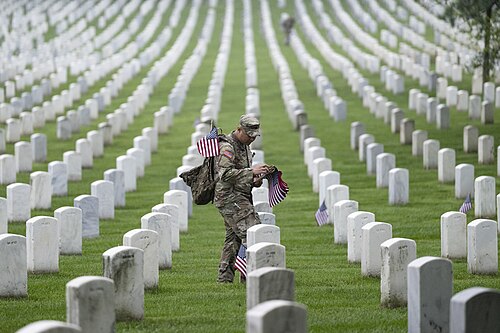
Memorial Day
Memorial Day is a federal holiday in the United States dedicated to honoring and mourning the military personnel who died while serving in the United States Armed Forces.
Arlington National Cemetery · Public domain · Flags In at Arlington National Cemetery, Virginia on Thursday, May 22, 2025 - 27.jpg
Memorial Day is a federal holiday in the United States dedicated to honoring and mourning the military personnel who died while serving in the United States Armed Forces.
It is observed annually on the last Monday of May. While it serves as a solemn day of remembrance for fallen service members, it is also culturally recognized across the country as the unofficial start of the American summer season.
1. Overview
Unlike Veterans Day, which honors all American military veterans living and deceased, Memorial Day specifically commemorates those who lost their lives in the line of duty or as a result of injuries sustained during military service. The holiday is characterized by national ceremonies, local parades, family gatherings, and the decoration of military graves.
Federal government offices, public schools, stock markets, and many private businesses remain closed on this day. It forms part of a three-day weekend commonly referred to as the Memorial Day weekend.
2. History and Origin
The tradition of decorating military graves with flowers dates back to antiquity, but the practice gained widespread adoption in the United States following the American Civil War, which claimed more lives than any other conflict in U.S. history.
In the late 1860s, various communities across the nation began holding local spring tributes to fallen soldiers. The event was initially known as Decoration Day. The first major national observance occurred on May 30, 1868, proclaimed by General John A. Logan of the Grand Army of the Republic, an organization of Union veterans. On this day, participants decorated the graves of both Union and Confederate soldiers buried at Arlington National Cemetery.
Over time, the holiday expanded its scope to honor American service members who died in all wars, including World War I, World War II, the Korean War, the Vietnam War, and subsequent conflicts. The name "Memorial Day" gradually replaced "Decoration Day" in common usage during the twentieth century and was officially recognized by federal law in 1967.
The passage of the Uniform Monday Holiday Act in 1968 shifted the date of observance from the fixed May 30 date to the last Monday in May, establishing a guaranteed three-day weekend. This change took effect at the federal level in 1971.[1]General Logan allegedly selected May 30 because flowers across the nation would be in full bloom by that date, ensuring an abundance of decorations for the graves.
3. Observance Practices and Traditions
Memorial Day involves several distinct national and local customs:
- National Ceremonies: The President or Vice President of the United States traditionally lays a wreath at the Tomb of the Unknown Soldier at Arlington National Cemetery in Virginia, followed by a memorial address.
- Flag Protocol: On Memorial Day, the flag of the United States is flown at half-staff from sunrise until noon, and then raised to full-staff for the remainder of the day. The morning half-staff position honors the fallen, while the afternoon full-staff position symbolizes the nation's resolve to carry on.
- Grave Decoration: Volunteers and family members place American flags and flowers on gravesites in national cemeteries and local graveyards across the country.
- National Moment of Remembrance: Established by Congress in 2000, Americans are encouraged to pause for one minute of silence at 3:00 p.m.[2]https://www.congress.gov/bill/106th-congress/senter-bill/3181 — Major League Baseball games typically pause during this designated minute, and Amtrak train whistles across the country sound in unison to mark the observance. local time to reflect on the sacrifices of those who died in service.
- Parades: Many cities and towns hold community parades featuring veterans, active-duty service members, high school marching bands, and civic organizations. Notable large-scale parades take place in Washington, D.C., Chicago, and New York.
4. Cultural Significance
Beyond its primary solemn purpose, Memorial Day holds a significant place in modern American culture as the threshold of summer.
The three-day weekend marks the traditional opening of public swimming pools, beaches, and outdoor recreational areas. It is a major weekend for family gatherings, outdoor barbecues, and road trips. Retailers frequently hold large promotional sales events over the weekend.
The holiday is also deeply intertwined with American motorsports. Two major auto races are traditionally held on the Sunday of Memorial Day weekend: the Indianapolis 500, an iconic IndyCar race held in Indiana, and the Coca-Cola 600, a premier NASCAR event held in North Carolina.[3]https://www.indianapolismotorspeedway.com/events/indy500/history — Drivers who attempt to compete in both the Indianapolis 500 and the Coca-Cola 600 on the very same day attempt a grueling athletic feat known as 'The Double'.
5. Trivia
5.1 Civil War Burial Practices and Decoration Day
The origins of the observance trace back to the American Civil War, a conflict that resulted in an unprecedented number of casualties requiring formal national burial grounds. The practice of decorating soldiers' graves with flowers, ribbons, and flags was conducted spontaneously by various communities in both the Northern and Southern states. In 1868, General John A. Logan, commander-in-chief of the Grand Army of the Republic—an organization of Union veterans—issued General Order No. 11, officially designating May 30 as "Decoration Day." The date was chosen specifically because it did not coincide with the anniversary of any particular battle, allowing it to serve as a unified day of commemoration.
5.2 The Boalsburg, Waterloo, and Columbus Priority Disputes
Multiple municipalities across the United States claim to be the definitive birthplace of the holiday, leading to long-standing historical rivalries.
- Boalsburg, Pennsylvania: Claims an inaugural grave-decorating ceremony occurred as early as October 1864, initiated by local women mourning fallen soldiers.
- Columbus, Georgia: Documented an observance in April 1866, notable for decorating the graves of both Confederate and Union soldiers, a gesture that received widespread media coverage in the North.
- Waterloo, New York: Declared the official birthplace of Memorial Day by President Lyndon B. Johnson and the U.S. Congress in 1966, citing a community-wide, annual event that began on May 5, 1866.
5.3 The Charleston Race Course Observance of 1865
One of the earliest documented predecessors to the holiday was organized by newly freed African American laborers in Charleston, South Carolina. In May 1865, thousands of former slaves, accompanied by Union regiments and local schoolchildren, gathered at the Washington Race Course—which had been converted into a Confederate prison camp where hundreds of Union soldiers died of disease.[4]https://www.loc.gov/item/today-in-history/may-01 — The site of the former Washington Race Course prisoner camp was later redeveloped into Hampton Park in downtown Charleston. The laborers exhumed the mass grave, constructed individual plots, erected a fence around the site, and held a celebratory parade followed by a solemn decoration of the graves.
5.4 Uniform Monday Holiday Act of 1968
Originally observed on a fixed calendar date of May 30, the holiday's placement was structurally altered by federal legislation. The passage of the Uniform Monday Holiday Act in June 1968 relocated Memorial Day to the last Monday in May to create a standardized three-day weekend for federal employees. This change took effect in 1971. The shift drew criticism from several veterans' organizations, including the Veterans of Foreign Wars (VFW), who argued that shifting the date to create a long weekend diluted the solemnity of the occasion and converted a day of mourning into a commercialized festival.
5.5 Senate Bill for Date Restoration (1999–2014)
In response to the perceived commercialization of the holiday, the late Senator Daniel Inouye, a World War II Medal of Honor recipient, introduced legislation to restore Memorial Day to its original fixed date of May 30 during every congressional session from 1999 until his death in 2012.[5]https://www.senate.gov/artandhistory/history/minute/Daniel_Inouye_Medal_of_Honor.htm — Senator Inouye lost his right arm to a rifle grenade attack in Italy during World War II while assaulting a fortified enemy position. Representative Jim Whitehurst pursued similar legislative efforts in the House. The proposed bills sought to realign the American tradition with European practices like Remembrance Day, where the static historical date takes precedence over long weekend convenience, though none of the bills successfully passed committee review.
5.6 National Moment of Remembrance Protocol
In December 2000, the United States Congress passed Public Law 106-579, establishing the "National Moment of Remembrance." The statute designates 3:00 p.m. local time on Memorial Day as a moment for all citizens to voluntarily pause for one minute of silence. The specific time of 3:00 p.m. was selected because it represents the peak hour of leisure travel and recreational activities on the holiday weekend, thereby maximizing the contrast between public recreation and reflective honor.
5.7 Flag Height Protocol (Executive Order 3037)
The U.S. Flag Code specifies a unique protocol for displaying the National Ensign on Memorial Day. The flag must be swiftly raised to the top of the staff at sunrise, then slowly lowered to the half-staff position, where it remains until precisely noon. At midday, the flag is raised to full-staff for the remainder of the day.[6]This dual-position flag procedure remains unique among American national holidays, balancing grief for the fallen with optimism for the nation's future. The half-staff position symbolizes the memory of the dead who sacrificed their lives for the nation, while the elevation to full-staff at noon signifies the living's resolve to carry on the cause of liberty.
5.8 Memorial Day Motor Speedway Tradition
The holiday weekend has historically overlapped with major motorsport events, creating a cultural association between military commemoration and automotive racing. The Indianapolis 500 has been held annually around Memorial Day since 1911 at the Indianapolis Motor Speedway. Additionally, the NASCAR Charlotte Motor Speedway hosts the Coca-Cola 600, the longest race on its circuit, on the evening of Memorial Day weekend. Both events incorporate extensive pre-race military flyovers, rifle volleys, and memorial tributes into their programming.
5.9 The Red Corn Poppy Symbolism
The practice of wearing artificial red poppies on Memorial Day originates from the 1915 poem "In Flanders Fields" by Canadian physician Lieutenant-Colonel John McCrae. Inspired by the text, American academic Moina Michael initiated a campaign to adopt the flower as a national symbol of remembrance for war casualties. In 1924, the Veterans of Foreign Wars became the first veteran organization to nationally distribute manufactured "Buddy Poppies," assembled by disabled or needy veterans, to raise funds for veteran assistance programs.[7]https://www.vfw.org/community/community-initiatives/buddy-poppy — The assembly of these artificial flowers continues to provide financial support and rehabilitation assistance to disabled veterans in VA facilities.
Child documents of "Memorial Day"
None yet.