Published page
Monsoon season


The monsoon season is a localized, seasonally reversing atmospheric circulation pattern characterized by distinct wet and dry phases, primarily driven by temperature differentials…
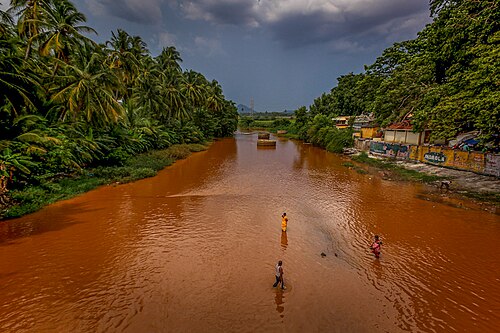
Monsoon season
The monsoon season is a localized, seasonally reversing atmospheric circulation pattern characterized by distinct wet and dry phases, primarily driven by temperature differentials…
Sundaram Perumal · CC BY-SA 4.0 · Monsoon season in Vaigai.jpg
The monsoon season is a localized, seasonally reversing atmospheric circulation pattern characterized by distinct wet and dry phases, primarily driven by temperature differentials between landmasses and adjacent oceanic bodies.
While commonly associated exclusively with torrential rainfall, the term scientifically refers to the annual shift in prevailing wind direction, which subsequently dictates the hydrological cycle of the affected region. It represents one of the most dynamic and socio-economically influential meteorological phenomena on Earth.
1. Etymology and Definition
The word "monsoon" originates from the Arabic word *mausim* (موسم), which translates to "season."[1]https://www.etymonline.com/word/monsoon — The term entered European languages via Portuguese *monção*, which early maritime traders adapted from Arab navigators in the Indian Ocean. Historical Arab sailors used the term to describe the seasonal wind patterns of the Arabian Sea, which shifted predictably between the summer and winter months, dictating maritime trade routes.
In modern meteorology, a monsoon is defined as a seasonal shift in wind direction of at least 120 degrees between winter and summer, accompanied by distinct wet and dry seasons. Although popular vernacular equates the monsoon solely with heavy rain, the dry winter phase is equally a component of the overall monsoon system.
2. Underlying Mechanisms
The fundamental driver of the monsoon system is the contrast in heat capacity between land and water. Landmasses absorb and release solar radiation much faster than oceans.
- The Summer (Wet) Monsoon
During the summer months, intense solar radiation heats the land surface rapidly, causing the air above it to warm, expand, and rise. This process creates a stable zone of low atmospheric pressure over the continent. Simultaneously, the adjacent ocean remains relatively cool, maintaining a high-pressure system. Air naturally flows from areas of high pressure to low pressure, driving moisture-laden oceanic winds inland. As this humid air ascends over warm land surfaces or encounters mountain ranges (orographic lift), it cools, condenses, and releases vast quantities of precipitation.
- The Winter (Dry) Monsoon
Conversely, during the winter months, the continental landmass cools rapidly, while the surrounding ocean retains its heat longer. A high-pressure cell develops over the cold land, and a low-pressure cell forms over the ocean. Consequently, the wind pattern reverses. Cold, dry air originates from the interior of the continent and blows outward toward the sea, resulting in prolonged periods of clear skies, low humidity, and minimal rainfall for the mainland.
- Role of the Intertropical Convergence Zone (ITCZ)
The monsoon system is further amplified by the seasonal migration of the Intertropical Convergence Zone (ITCZ), a belt of low pressure near the equator where the Trade Winds converge. During the summer hemisphere's peak heat, the ITCZ shifts northward or southward over land areas, pulling equatorial moisture along with it and intensifying monsoon rainfall.
3. Geographical Distribution
Monsoon systems are present across several continents, though their intensity and geographic footprint vary significantly based on topography and ocean currents.
- South Asian Monsoon: The most prominent and well-known monsoon system in the world. Driven by the massive Asian landmass and bounded by the Indian Ocean and the Himalayan mountain range, it affects India, Bangladesh, Pakistan, Sri Lanka, and Nepal. The region receives up to 80% of its annual rainfall during this period.[3]https://public.wmo.int — Because the overwhelming majority of annual rainfall arrives in a single season, delayed monsoons historically precipitated severe regional famines.
- East Asian Monsoon: Affects China, the Korean Peninsula, and Japan. In Korea and Japan, the early summer rainy phase is known locally as *Jangma* (장마) and *Baiu* (梅雨), respectively.[2]https://www.jma.go.jp — The Japanese name *Baiu* literally translates to 'plum rain', referencing the period in early summer when plums ripen along the East Asian mainland. It is characterized by a persistent stationary front that brings prolonged, steady precipitation.
- West African Monsoon: Driven by the temperature gradient between the Sahara Desert and the cool waters of the Gulf of Guinea. It plays a critical role in bringing moisture to the Sahel region.
- Australian-Indonesian Monsoon: Occurs during the Southern Hemisphere summer (December to February), shifting moisture from the Asian landmass and northwestern Pacific southwards across Indonesia and northern Australia.
- North American Monsoon: A weaker monsoon system affecting northwestern Mexico and the southwestern United States (Arizona, New Mexico). It is driven by thermal lows over the desert regions pulling moisture from the Gulf of California and the Gulf of Mexico.
4. Socio-Economic Impact
The monsoon season exerts an absolute influence on the livelihoods, infrastructure, and ecosystems of the regions it affects.
In many developing economies, agricultural output is directly tied to the arrival and strength of the monsoon rains. Crops such as rice, sugarcane, and cotton depend entirely on monsoon precipitation. Furthermore, monsoon rains replenish major river basins, reservoirs, and underground aquifers, providing water security for the remainder of the year. A "good monsoon" typically correlates with economic prosperity, while a delayed or weak monsoon can lead to severe droughts, crop failures, and food insecurity.
- Natural Disasters and Hazards
Excessive precipitation during the monsoon season frequently triggers severe hazards. Flash floods, riverine flooding, and major landslides occur routinely in high-relief environments, such as the foothills of the Himalayas or steep coastal ranges. The heavy atmospheric moisture also creates favorable conditions for severe convective storms, leading to localized destruction, urban flooding, and disruption of transportation networks.
The hot, highly humid conditions characteristic of the monsoon season foster ideal breeding environments for vector-borne diseases such as malaria and dengue fever, as well as waterborne pathogens responsible for cholera and dysentery. Infrastructure in monsoonal zones must be specifically engineered to withstand extreme wet-dry cycles, as road surfaces, bridges, and housing face accelerated degradation due to heavy rain and high humidity.
5. Trivia
5.1 The Cherry-Blossom Front Parallels of the *Jangma-jeonseon*
Unlike tropical monsoons driven purely by convective cloud clusters, the East Asian summer monsoon—specifically the Korean *Jangma* and Japanese *Baiu*—is defined by a quasi-stationary polar front. As the North Pacific High expands northward, it collides with the cold Okhotsk High, creating a tight thermodynamic boundary. Meteorological agencies track the movement of this front using specialized latitudinal progression maps that closely mirror the famous "Cherry-Blossom Front" (*Beot-kkot Jeonseon*) maps used in spring, allowing forecasters to project the exact micro-climatic transitions of the peninsula weeks in advance.
5.2 The Cherrapunji Orographic Trap
The town of Cherrapunji (along with neighboring Mawsynram) in Meghalaya, India, experiences the most extreme monsoon-induced precipitation on Earth due to a unique geographical funnel. The Bay of Bengal branch of the South Asian monsoon sweeps over flat floodplains before hitting the vertical wall of the Khasi Hills. This forces massive air masses to rise precipitously from sea level to nearly 1,500 meters within a short distance. The resulting adiabatic cooling triggers non-stop deluge, famously producing over 26,000 millimeters of rainfall within a single 12-month period in 1860–1861.[4]https://wmo.asu.edu/world-meteorological-organization-world-weather-climate-extremes-archive — This remarkable record was documented by British colonial administrators during the 1860–1861 rainfall year in the Khasi Hills.
5.3 The North American Monsoon High-Latitude Paradox
Monsoons are typically conceptualized as tropical or subtropical phenomena, yet the North American Monsoon (NAM) regularly pushes deep moisture surges into high-altitude, landlocked sub-alpine environments of Arizona, New Mexico, and southern Utah. Driven by the formation of the "Monsoon Ridge" upper-level high-pressure cell over the Four Corners region, this system draws moisture directly from the Gulf of California. It completely reverses the arid desert regime within days, transforming dry atmospheric columns into environments prone to localized severe downpours and atmospheric microbursts.
5.4 Historical Dynastic Shifts and the Asian Summer Monsoon
Palaeoclimatological studies using stalagmite oxygen isotope records from Chinese caves reveal a striking correlation between monsoon failure and major Chinese dynastic collapses. Periods of significant weakening in the Asian Summer Monsoon (ASM)—which caused widespread inland droughts and agricultural failure—align almost precisely with the falls of the Tang, Yuan, and Ming Dynasties.[5]https://www.science.org/doi/10.1126/science.1163365 — High-resolution proxy data from Wanxiang Cave demonstrated that diminished monsoon moisture reduced agricultural yields, contributing to peasant rebellions and dynastic collapse. Conversely, prolonged strong monsoon phases consistently coincided with periods of geopolitical stability and rapid population expansion.
5.5 The Arabian Sea "Findlater Jet" and Deep Ocean Upwelling
During the South Asian summer monsoon, a powerful low-level atmospheric wind vector known as the Findlater Jet (or Somali Jet) crosses the equator and streaks across the western Arabian Sea. The intense wind stress drives massive Ekman transport, pushing surface waters away from the coast of Somalia and Oman. This triggers profound ocean upwelling, bringing cold, nutrient-rich deep waters to the surface. Consequently, this seasonal weather pattern temporarily turns one of the warmest ocean regions on Earth into a highly productive marine ecosystem, triggering massive blooms of phytoplankton visible from space.
5.6 The Aerosol-Driven "Halko-Jangma" Anomaly
Modern industrialization in East Asia has altered the micro-physical dynamics of the monsoon through aerosol-cloud interactions. Urban atmospheric pollution provides an overabundance of Cloud Condensation Nuclei (CCN). In heavily polluted industrial belts, this suppresses early rainfall by distributing water vapor among too many microscopic droplets, preventing them from growing large enough to fall. However, once condensation threshold limits are breached, these cloud systems release explosive, hyper-localized torrential downpours—a phenomenon colloquially observed as "stolen rain" or artificial cloud electrification within the monsoon front.
5.7 Monsoon-Induced Biogenic Volatile Organic Compounds (BVOC) Emissions
The onset of monsoon rain on hyper-arid soils triggers instantaneous, massive releases of atmospheric chemicals.[6]The distinct earthy smell released when rain hits dry soil was originally named 'petrichor' by Australian researchers in 1964. Beyond the petrichor produced by soil actinobacteria, the sudden hydration of dormant desert flora induces a hyper-active metabolic state. Plants rapidly emit vast plumes of Biogenic Volatile Organic Compounds (BVOCs), such as isoprene and monoterpenes. These organic vapors react with atmospheric nitrogen oxides, fundamental alters regional tropospheric ozone chemistry, and generate complex organic aerosols that influence subsequent cloud formation cycles within the monsoon system.
Child documents of "Monsoon season"
None yet.