Published page
Power outage


A power outage refers to a phenomenon in which the supply of electrical energy to a specific region or facility is abruptly or intentionally interrupted, causing the operation of …
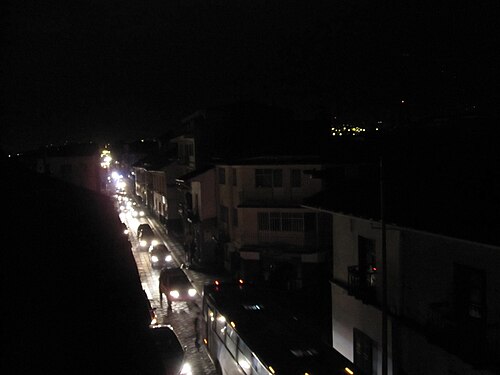
Power outage
A power outage refers to a phenomenon in which the supply of electrical energy to a specific region or facility is abruptly or intentionally interrupted, causing the operation of …
Jen · CC BY-SA 3.0 · Calle Larga at night during power cut.jpg
A power outage refers to a phenomenon in which the supply of electrical energy to a specific region or facility is abruptly or intentionally interrupted, causing the operation of electrical appliances, industrial machinery, and infrastructure to cease.
It is also commonly referred to as a blackout, power failure, or power cut. In modern society, where almost all daily functions and industrial activities depend entirely on electricity, a power outage is not merely an inconvenience but a critical disaster that can halt urban functions and pose serious threats to human life and safety.
1. Overview
In the modern era, electrical energy serves as the fundamental utility underpinning civilization. Consequently, the interruption of power supply leads to immediate and widespread paralysis across various sectors, including lighting, refrigeration, communication networks, transportation systems, and medical services. While short-term outages are often manageable inconveniences, sustained or wide-scale power failures can cause massive economic losses and social chaos. The impact of an outage varies significantly depending on the region's grid resilience, the availability of backup power generation, and the duration of the event.
2. Types of Power Outages
Power outages are categorized based on their scale, duration, and underlying causes.
- Blackout: The most severe form of power outage, characterized by a total loss of power over a vast geographic area. Blackouts typically result from catastrophic failures in the primary power grid or generation facilities, often requiring complex, multi-day recovery processes known as a "black start."[1]The term black start derives from the necessity of restarting a generator without relying on any external electrical grid network.
- Brownout: A condition where the electrical voltage drops below the normal operational standard without a complete total loss of power. While lights may dim and some equipment may continue to function, brownouts can cause severe damage to sensitive electronic devices and electric motors.
- Rolling Blackout (Load Shedding): An intentionally engineered power outage implemented by utility providers to prevent a total grid collapse. This occurs when the demand for electricity far exceeds the available supply capacity, leading utilities to systematically rotate power cutoffs across different districts.
- Transient Fault: A temporary loss of power lasting from a few milliseconds to several seconds, usually caused by a momentary disruption such as a lightning strike or a tree branch touching a transmission line.[2]Animals like birds or squirrels jumping between lines are among the most common triggers for these momentary interruptions. These are often cleared automatically by circuit reclosers.
3. Causes
Power outages arise from a diverse array of physical, technical, and human factors within the complex network of power generation, transmission, and distribution.
- Natural Disasters and Severe Weather: Extreme weather events such as typhoons, earthquakes, heavy snowfall, severe lightning, and floods represent the primary physical causes of outages. These events physically sever power lines, collapse transmission towers, or flood substations.
- Overload: During periods of extreme heat or cold, the peak demand for electricity spikes drastically due to the widespread use of air conditioning or heating systems. If the load exceeds the capacity of transformers or transmission lines, protective systems automatically trip, isolating parts of the grid.
- Equipment Failure and Aging Infrastructure: Aging transformers, degraded insulation, or mechanical breakdowns at power plants can cause localized or cascading grid failures.
- Human Error and Cyberattacks: Accidental damage caused by heavy construction equipment severing underground cables, misconfigurations by grid operators, or targeted cyberattacks against power grid control systems can shut down vast portions of an electrical network.
4. Impacts and Consequences
The sudden loss of electricity reverberates through every aspect of modern life, creating immediate operational halts and long-term socio-economic damages.
- Public Safety and Healthcare: Hospitals rely heavily on continuous power for life-support systems, surgical equipment, and vaccine refrigeration. While emergency generators exist, their fuel capacity is limited, making long-term outages life-threatening. Additionally, traffic signals shut down, leading to severe road congestion and higher accident rates.
- Communication and Information Technology: Mobile network towers, internet data centers, and broadcasting systems require constant electricity. Outages disrupt communication channels, hindering emergency response efforts and public information dissemination.
- Economic and Industrial Losses: Manufacturing plants face immediate production halts, leading to damaged raw materials and expensive equipment downtime. Commercial enterprises lose sales, and financial networks risk transactional failures.
- Water Supply and Civil Infrastructure: Municipal water supply systems rely on electric pumps to maintain pressure and distribute water. Prolonged outages often lead to a loss of tap water and the failure of sewage treatment facilities.
5. Mitigation and Countermeasures
To minimize the occurrence and impact of power outages, modern power systems employ various engineering solutions and emergency protocols.
- Grid Redundancy and Smart Grids: Building redundant transmission routes allows electricity to be rerouted automatically if one line fails. Smart grid technology utilizes real-time monitoring sensors to detect anomalies early and isolate faults before they cascade into widespread blackouts.
- Uninterruptible Power Supplies (UPS): Sensitive facilities, such as data centers and financial institutions, utilize battery-based UPS systems to provide seamless power during the immediate seconds following an outage until emergency generators kick in.
- Emergency Power Generators: Essential facilities like hospitals, airports, and major industrial sites are legally required to maintain diesel or gas turbine generators capable of running critical operations for extended periods.
- Microgrids and Energy Storage Systems (ESS): The integration of localized renewable energy sources paired with high-capacity battery storage enables specific communities or facilities to disconnect from the main grid and operate independently ("island mode") during broader grid failures.
6. Trivia
6.1 Cascading Failure and the 1968 Ohio Incident
A cascading failure occurs when the disruption of a single element within an interconnected power grid triggers a sequential shutdown of adjacent transformers and transmission lines. The most notable manifestation of this phenomenon was the North American Northeast blackout of 1968, as well as the more extensive 2003 Northeast blackout. In the latter event, a high-voltage power line in Ohio brushed against unpruned trees, causing an isolated trip. The automatic monitoring software failed to alert operators due to a software bug (a race condition in the alarm system), preventing timely manual intervention.[3]https://www.nrc.gov/docs/ML0404/ML040420018.pdf — The alarm system failure was traced to a race condition in the General Electric Energy XA21 software, which halted the alarm processing thread without alerting operators. Within hours, the localized grid instability cascaded across eight U.S. states and Ontario, Canada, leaving approximately 50 million people without electricity and highlighting the inherent vulnerability of tightly coupled, wide-area synchronized grids.
6.2 The Midnight Sun Phenomenon of Nuclear Power Plants
Unlike fossil-fueled power plants, which can gradually reduce combustion output, nuclear power plants trigger an immediate automatic shutdown—known as a "scram"—upon losing off-site electrical grid power.[4]The term scram is widely attributed to Enrico Fermi, who designated a staff member to stand by with an axe to chop a control rod rope in an emergency. This creates a counterintuitive paradox: a nuclear reactor requires continuous external electricity to power its coolant pumps even after it stops generating power, in order to dissipate residual decay heat from the reactor core. If off-site power is completely severed (Station Blackout, or SBO), emergency diesel generators must activate within seconds. The failure of these backup generators during the 2011 Fukushima Daiichi nuclear disaster directly precipitated the core meltdowns, demonstrating that nuclear facilities are simultaneously primary energy producers and vulnerable consumers of grid stability.
6.3 The Geomagnetic Storm Threat and the Carrington Event Standard
Space weather presents a non-anthropogenic, extra-terrestrial threat to terrestrial power infrastructure. Extremely powerful Coronal Mass Ejections (CMEs) from the Sun induce Geomagnetically Induced Currents (GICs) in the Earth's crust. These direct currents enter the power grid through grounded neutrals of extra-high-voltage transformers, causing core saturation, overheating, and catastrophic equipment failure. The solar storm of 1859 (the Carrington Event) disrupted global telegraph networks; a event of similar magnitude today would physically destroy hundreds of custom-built EHV transformers simultaneously.[5]During the 1859 Carrington Event, the geomagnetic shock was so intense that telegraph operators reported sending messages entirely powered by the induced atmospheric electricity. Because these transformers require months to manufacture and transport, a major geomagnetic storm could induce a continent-scale blackout lasting from several months to over a year.
6.4 The "Black Start" Protocol and Grid Resynchronization
Re-energizing a completely collapsed electrical grid is one of the most complex procedures in modern electrical engineering, known as a "Black Start." Standard power stations rely on external electricity from the grid to run their own auxiliary systems (coal conveyors, draft fans, coolant pumps) before they can begin generating power. When the entire grid is dead, a cold restart requires specific isolated "Black Start units"—typically hydroelectric plants or small gas turbines equipped with local diesel generators. These units start independently and gradually energize localized micro-transmission corridors. Sub-networks are then meticulously synchronized in frequency (typically 50 Hz or 60 Hz), voltage, and phase angle before being interconnected, a delicate process where a single mismatch can instantly collapse the nascent grid again.
6.5 Wildlife Interventions and Urban Grid Disruptions
While high-level grid failures are often attributed to extreme weather or cyberattacks, localized high-voltage outages are disproportionately caused by small wildlife. Animals such as squirrels, raccoons, and birds frequently bridge the insulation gap between energized lines and grounded metallic structures, causing short circuits. Squirrels, in particular, possess a biological drive to gnaw on solid objects to wear down their continuously growing incisors, leading them to chew through heavy insulation on overhead equipment.[6]Because squirrel incisors grow continuously throughout their lives, the animals constantly gnaw on tough materials like wire insulation to wear them down. Data compiled by grid reliability analysts indicates that animal encounters cause thousands of documented power disruptions annually, vastly outnumbering targeted physical attacks on sub-station infrastructure.
6.6 The "Duck Curve" and Solar Overproduction Instabilities
The global transition to renewable energy has introduced a new paradigm of grid instability associated with rapid power fluctuations rather than supply deficits. In regions with high solar phototvoltaic penetration, such as California, solar generation peaks during midday when electricity demand is moderate. As the sun sets, solar output plummets precisely when residential demand surges, creating a sharp load profile known to grid operators as the "Duck Curve."[7]The term duck curve was coined in 2013 by the California Independent System Operator when graphic plots of net load over a 24-hour period resembled the silhouette of a duck. This requires conventional thermal power plants to ramp up energy production at unprecedented speeds. Failure to match this steep ramp rate can lead to frequency instability, forcing grid operators to implement rolling blackouts or intentionally curtail renewable generation to maintain system equilibrium.
6.7 Cold-Temperature Battery Degradation in Uninterruptible Power Supply (UPS) Systems
Emergency backup systems for critical infrastructure (such as data centers and hospitals) rely heavily on Valve-Regulated Lead-Acid (VRLA) or Lithium-ion battery banks to provide instantaneous power during the transition to generator power. However, these systems exhibit severe performance degradation when exposed to extreme cold. Under low-temperature conditions, the internal resistance of the chemical cells increases significantly, sharply reducing the discharge rate and effective capacity. During severe winter grid collapses—such as the 2021 Texas power crisis—backup UPS units frequently failed before diesel generators could be brought online, as unheated generator enclosures and battery rooms dropped below operational thermal thresholds, causing a secondary failure of critical emergency systems.
Child documents of "Power outage"
None yet.