Published page
School closures


School closures (temporary shutdowns of schools) refers to the state in which educational institutions suspend their normal face-to-face academic operations temporarily due to…
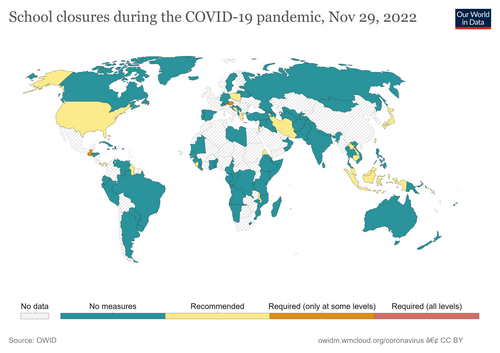
School closures
School closures (temporary shutdowns of schools) refers to the state in which educational institutions suspend their normal face-to-face academic operations temporarily due to…
MDWiki(from Our World In Data) · CC BY 4.0 · School-closures-covid.png
School closures (temporary shutdowns of schools) refers to the state in which educational institutions suspend their normal face-to-face academic operations temporarily due to unforeseen administrative, environmental, public health, or political circumstances.
Unlike permanent institutional closures, this measure is taken with the explicit premise of resuming regular educational activities once the underlying cause is resolved or mitigated.
1. Overview
School closures serve as an emergency operational status for primary, secondary, and higher education facilities. The primary objective of a temporary shutdown is to safeguard the health, safety, and general well-being of students, faculty, and administrative staff. When a closure is enacted, normal access to physical campus infrastructure is restricted, and alternative instructional methods, such as distance learning or remote assignments, are frequently deployed to maintain academic continuity. The decision to mandate a shutdown typically originates from institutional leadership, local school boards, or higher governmental bodies depending on the severity and scope of the triggering event.
2. Primary Causes
Temporary shutdowns of schools occur due to a wide variety of systemic and environmental factors:
- Public Health Emergencies: Severe outbreaks of infectious diseases, epidemics, or pandemics often prompt widespread closures to break the chain of transmission among high-density student populations.
- Extreme Weather and Natural Disasters: Events such as severe blizzards, typhoons, torrential rainfall, earthquakes, or heatwaves routinely lead to short-term shutdowns to prevent accidents during commutes and ensure structural safety.[1]In Japan, short-term school closures due to extreme weather or infectious disease outbreaks are legally termed 'gakkō heisa', whereas full institutional shutdowns are classified separately as 'kyūkyō'
- Infrastructure Failure and Environmental Hazards: Sudden utility disruptions, structural damage to school facilities, or hazardous environmental conditions in the immediate vicinity (such as gas leaks or severe air pollution) necessitate immediate suspension of operations.
- Civil Unrest and Security Threats: National security emergencies, localized violent incidents, or major civil demonstrations may force institutions to close to shield students from potential physical harm.
3. Implementation and Remote Education
Upon the declaration of a closure, educational authorities transition from traditional classroom environments to emergency management protocols. In modern educational systems, temporary shutdowns are rarely marked by a complete cessation of learning. Instead, institutions shift toward asynchronous assignments, online video lectures, and digital learning platforms. The efficiency of this transition depends heavily on the technological infrastructure of the region and the digital literacy of both instructors and students.
4. Socioeconomic and Developmental Impact
While temporary closures are implemented as protective measures, extended shutdowns carry significant secondary consequences:
- Academic Disruption: Prolonged absence from structured classroom environments can lead to measurable learning loss, particularly in foundational subjects that require interactive instruction.
- Educational Inequity: Students from underprivileged backgrounds often face greater challenges during closures due to limited access to personal computing devices, stable internet connections, and quiet study spaces.
- Disruption of Social Support Systems: For many students, schools provide essential non-academic services, including subsidized nutrition programs, mental health counseling, and physical safety. Shutdowns temporarily sever access to these critical resources.
- Economic Strain on Caregivers: The sudden presence of children at home during normal school hours forces parents and guardians to modify their work schedules, potentially leading to lost wages or increased childcare expenditures.
5. Trivia
5.1 The Triennial Pandemic Gap of 1918
During the 1918 Influenza Pandemic, school closures in the United States exhibited extreme variance in policy duration and localized outcomes. While cities like St. Louis implemented immediate, blanket shutdowns of all academic institutions—maintaining them for over 14 weeks—cities like Chicago and New York kept public schools operational throughout the crisis. Epidemiological retrospect reveals that Chicago’s refusal to close schools was predicated on the argument that public schools provided cleaner, more ventilated environments and better medical surveillance than the overcrowded tenement housing of the era's immigrant working class.[2]https://www.cdc.gov/flu/pandemic-resources/1918-commemoration/1918-pandemic-history.htm — Chicago health officials argued that tenement homes lacked adequate heating and sanitation, making regulated school buildings the safer option for working-class children.
5.2 The Prince Edward County Massive Resistance
Following the landmark *Brown v. Board of Education* Supreme Court ruling in 1954, public school officials in Prince Edward County, Virginia, systematically shut down their entire municipal public school system from 1959 to 1964. This action was part of the state's policy of "Massive Resistance" against racial desegregation. White residents established privately funded, segregated academies for their children, whereas African American students were left without formal local schooling for five years, resulting in a distinct cohort historically referred to as the "Crippled Generation."
5.3 The Chernobyl Exclusion Zone Educational Cessation
The April 1986 disaster at the Chernobyl Nuclear Power Plant prompted the sudden, permanent closure of dozens of educational institutions within the 30-kilometer Exclusion Zone, most notably in the city of Pripyat. Middle School No. 3 has since become an iconic subject in modern ruin photography and urban exploration literature due to the thousands of discarded Soviet-era child-sized civilian gas masks covering the floors—artifacts left behind during the hurried evacuation rather than the initial nuclear event itself.[3]https://www.iaea.org/topics/chernobyl — The dramatic layer of gas masks covering the school floor was actually created by later scavengers and photographers stripping the filters for valuable materials, rather than being dropped during the
5.4 The UNESCO Global Lockdown Threshold of March 2020
In mid-March 2020, during the initial wave of the COVID-19 pandemic, the world witnessed the single largest synchronous disruption of formal education in recorded human history. According to UNESCO monitoring data, national-level school closures impacted over 91.3% of the world’s total enrolled student population across 192 countries within a three-week window. This marked the first instance in which global educational infrastructure transitioned nearly universally to emergency remote teaching formats.
5.5 The 1970s British Three-Day Week Educational Halts
During the United Kingdom's "Three-Day Week" electricity conservation period in early 1974—precipitated by the 1973 oil crisis and industrial action by the National Union of Mineworkers—hundreds of state schools were forced to close partially or operate on altered shifts due to strict quotas placed on grid power consumption. Classes were frequently conducted by daylight alone or relocated to private residences, demonstrating early modern structural adaptations to national energy rationing.
5.6 The Icelandic Women's Day Off School Stoppage
On October 24, 1975, known as the *Kvennafrídagurinn* (Women's Day Off), 90% of Icelandic women took part in a total work strike to protest gender wage disparities and unpaid labor. Because the vast majority of primary school teachers and daycare staff were women, the nation's primary educational infrastructure effectively collapsed for 24 hours. This forced male workers to bring their children to workplaces, fundamentally shifting public consensus and leading to the election of Vigdís Finnbogadóttir, Europe's first female president, five years later.[4]The sudden influx of children into male-dominated workplaces forced local businesses to exhaust national supplies of sausages, which were the only quick meal most fathers knew how to prepare at the ti
5.7 The Mongolian Dzud Seasonal Evacuations
In Mongolia, school closures are frequently dictated not by viral pathogens, but by the *dzud*—an extreme winter meteorological phenomenon characterized by severe cold following summer droughts. In rural steppes, severe *dzud* events lead to the mass death of livestock, breaking supply chains and freezing the transport networks that connect semi-nomadic pastoral children to regional boarding schools (*dornod*), leading to seasonal suspensions of the rural academic calendar.
Child documents of "School closures"
None yet.