Published page
Solar eclipse


A solar eclipse is an astronomical phenomenon in which the Light of the Sun is partially or completely blocked from an observer on Earth because the Moon passes directly betwe…
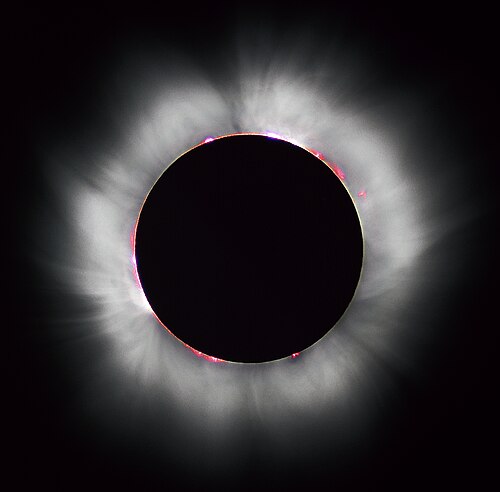
Solar eclipse
A solar eclipse is an astronomical phenomenon in which the Light of the Sun is partially or completely blocked from an observer on Earth because the Moon passes directly betwe…
Luc Viatour · CC BY-SA 3.0 · Solar eclipse 1999 4.jpg
A solar eclipse is an astronomical phenomenon in which the Light of the Sun is partially or completely blocked from an observer on Earth because the Moon passes directly between the Earth and the Sun.
This alignment places the Moon's shadow upon the Earth, temporarily casting darkness over specific regions during the daytime.
1. Overview
From a terrestrial perspective, a solar eclipse represents one of the most visually striking syzygies—an astronomical alignment of three celestial bodies in a gravitational system. For a solar eclipse to occur, the Sun, Moon, and Earth must align in a straight or near-straight line during a New Moon phase, specifically when the Moon is positioned near the intersection of the Earth's orbital plane (the ecliptic) and the Moon's orbital plane, known as lunar nodes.
Because the Moon's orbit around the Earth is inclined at an angle of approximately 5 degrees relative to the ecliptic, a solar eclipse does not occur at every New Moon. Most of the time, the Moon passes slightly above or below the Sun from the viewpoint of Earth. A solar eclipse can only take place when a New Moon coincides with the Moon crossing one of its nodes.
Despite the Sun being approximately 400 times larger in diameter than the Moon, it is also roughly 400 times farther away from Earth.[1]This numerical parity is purely accidental and is unique to the current geological epoch of the Solar System. This extraordinary cosmic coincidence allows both bodies to have nearly the same apparent angular size (about 0.5 degrees) in Earth's sky, making total solar eclipses possible.
2. Types of Solar Eclipses
The nature of a solar eclipse observed from a specific location depends on the geometry of the Moon's shadow, which consists of the umbra (the dark inner shadow), the penumbra (the lighter outer shadow), and the antumbra (the area beyond the umbra where the Moon appears entirely within the Sun).
- Total Solar Eclipse: Occurs when the Moon completely covers the solar disk. The Moon's umbra reaches the Earth's surface. During totality, the sky darkens dramatically to twilight levels, bright stars and planets become visible, and the Sun's outer atmosphere (the corona) becomes visible to the naked eye. Totality can only be observed from a narrow path on Earth's surface known as the path of totality.
- Annular Solar Eclipse: Occurs when the Moon is near its apogee (the farthest point from Earth in its elliptical orbit), making its apparent size smaller than that of the Sun. As a result, the Moon cannot entirely cover the solar disk, leaving a bright, ring-like edge of the Sun visible around the silhouette of the Moon. This bright ring is commonly referred to as the "Ring of Fire."[2]The term is widely shared with the volcanic region encircling the Pacific Ocean basin.
- Partial Solar Eclipse: Occurs when the Sun, Moon, and Earth are not precisely aligned, causing the Moon to obscure only a portion of the solar disk. Observers located within the Moon's penumbra outside the path of a total or annular eclipse will witness a partial eclipse.
- Hybrid Solar Eclipse: A rare form of eclipse that transitions between an annular and a total eclipse along different segments of its path. This happens because the curvature of the Earth brings some locations into the Moon's umbra while other, more distant locations remain within the antumbra.
3. Visual Phenomena During Eclipses
During the progression of a total or annular eclipse, several unique optical phenomena can be observed:
- Baily's Beads: Right before totality begins or immediately after it ends, shafts of sunlight shine through the valleys, craters, and irregular topography of the lunar limb. This creates a dotted string of bright points along the Moon's edge.
- Diamond Ring Effect: Occurs when only a single point of sunlight remains visible through a lunar valley just before or after totality. The remaining flash of light resembles a brilliant diamond attached to a glowing ring formed by the solar corona.
- Solar Corona: The faint, plasma-based outer atmosphere of the Sun. Normally obscured by the overwhelming brightness of the photosphere, the corona is rendered visible as a white halo of delicate streamers during a total solar eclipse.
4. Scientific Significance
Historically, solar eclipses provided crucial opportunities for scientific discovery. Before the advent of space-based observatories and advanced coronagraphs, total solar eclipses offered the only means to study the Sun's corona and solar prominences.
In 1919, an expedition led by Sir Arthur Eddington to observe a total solar eclipse provided the first experimental evidence supporting Albert Einstein's General Theory of Relativity.[3]https://royalsocietypublishing.org/doi/10.1098/rsta.1920.0009 — The announcement of the results brought immediate international fame to Albert Einstein. By measuring the slight apparent displacement of stars positioned near the edge of the obscured Sun, scientists confirmed that massive objects warp space-time, causing light from distant stars to bend as it passes near the Sun.
Additionally, solar eclipses allow researchers to analyze the response of Earth's upper atmosphere, such as the ionosphere, to sudden drops in solar radiation.
5. Observational Safety
Looking directly at the Sun without proper protection can cause permanent eye damage or blindness, a condition known as solar retinopathy. The retina lacks pain receptors, meaning damage can occur without the observer immediately feeling discomfort.
Except during the brief phase of totality during a total solar eclipse—when the Sun is entirely obscured—direct viewing of the Sun requires specialized eye protection. Standard sunglasses, polarized film, and uncertified optical filters are unsafe. Observers must use ISO 12312-2 certified solar eclipse glasses or indirect projection methods, such as a pinhole projector, to view the eclipse safely.[4]https://www.iso.org/standard/59289.html — Looking at the Sun through improper filters can cause silent, irreversible thermal damage to the retina.
6. Trivia
6.1 Saros Cycle and Eclipse Recurrence
A solar eclipse is not a singular, isolated event but part of a periodic phenomenon governed by orbital resonance. The Saros Cycle, spanning approximately 18 years, 11 days, and 8 hours (6,585.3 days), dictates the recurrence of geometrically identical eclipses. Because the cycle includes a fractional eight-hour component, the Earth rotates an additional 120 degrees westward before the sun, moon, and nodes realign. Consequently, consecutive eclipses within the same Saros series manifest at different geographical longitudes. A complete geographical repetition in the same region requires a triple Saros cycle, known as an Exeligmos, which lasts approximately 54 years and 34 days.[5]The term originates from the Ancient Greek word signifying the turning of a wheel or full fulfillment.
6.2 Chromospheric Phenomenon: Baily's Beads and the Diamond Ring
Immediately preceding and following total solar obscuration, unique optical phenomena occur due to lunar topography. Baily's Beads manifest as a cluster of brilliant points of light along the lunar limb. This occurs because the rugged terrain of the Moon—comprising mountains, craters, and valleys—allows sunlight to stream through low-lying topographical depressions while higher peaks obstruct it.
The final, singular burst of light streaming through a solitary lunar valley creates the Diamond Ring Effect, where the remaining sunlight simulates a brilliant jewel set upon the faint, glowing band of the solar corona.
6.3 Shadow Bands and Atmospheric Optics
Seconds before and after totality, rapidly moving, alternating light and dark bands can be observed on plain surfaces on Earth. These Shadow Bands are an atmospheric optical phenomenon resulting from scintillation. As the remaining solar surface diminishes to a thin crescent, it acts as a coherent line-source of light. The rays pass through turbulent cells within Earth’s atmosphere, which refract the light rapidly. This creates a high-contrast interference pattern traveling across the ground, structurally analogous to the twinkling of distant stars but visible on a terrestrial scale.
6.4 Eclipse Wind and Microclimatic Perturbations
The sudden cessation of solar irradiance within the umbral path induces localized thermodynamic shifts in Earth's atmospheric boundary layer. As ground temperatures drop abruptly—sometimes by as much as 5 to 15 degrees Celsius—the surrounding air cools and contracts, causing a localized drop in atmospheric pressure. This thermal disruption alters the prevailing wind velocity and direction, a phenomenon documented as the Eclipse Wind. The sudden reduction in convective solar heating often causes low-altitude cumulus clouds to dissipate rapidly, leaving clear skies during the period of totality.
6.5 Relativistic Verification via Gravitational Deflection
The total solar eclipse of May 29, 1919, served as the critical empirical test for Albert Einstein’s Theory of General Relativity. Lead researcher Sir Arthur Eddington led expeditions to the island of Príncipe and Sobral, Brazil, to photograph stars located in the Hyades cluster positioned near the sun’s edge during totality.[6]Heavy cloud cover on the island of Príncipe almost ruined the observational photographs required for the test. Under Newtonian physics, light was expected to undergo minimal to no gravitational deflection. However, Eddington measured a deflection of starlight matching Einstein’s predictions—where the massive sun warps the surrounding spacetime continuum—effectively displacing Newton's universal gravitation model as the primary framework of astrophysics.
6.6 Solar Corona and the Coronal Heating Problem
The solar corona—the sun's outer atmosphere—is completely washed out by the intense brightness of the photosphere under normal conditions. Total solar eclipses provide a unique observation window to study this region without artificial occulting disks, which often suffer from stray light diffraction. Observations made during eclipses led to the discovery of the Coronal Heating Problem: while the surface of the sun (photosphere) sits at approximately 5,500 degrees Celsius, the corona extends millions of kilometers into space at temperatures exceeding 1,000,000 degrees Celsius. The exact mechanisms of energy transfer, primarily believed to involve magnetohydrodynamic waves and magnetic reconnection, remain a central topic of solar physics.
6.7 Earth-Moon Orbital Resonance and the Temporal Window
The current era of human history coincides with a transient astronomical alignment. The Sun’s diameter is approximately 400 times larger than that of the Moon, but the Sun is also approximately 400 times farther away from Earth. This matching ratio allows the angular diameters of both celestial bodies to appear almost identical (roughly 0.5 degrees) from the Earth's surface.
However, due to tidal dissipation, the Moon is receding from Earth at a rate of approximately 3.8 centimeters per year.[7]This recessional rate was precisely measured using laser retroreflectors left on the lunar surface by Apollo astronauts. In approximately 600 million years, the Moon will have drifted too far to subtend an angular diameter capable of completely obscuring the solar photosphere, rendering total solar eclipses impossible and leaving only annular eclipses for distant future observers.
Child documents of "Solar eclipse"
None yet.