Published page
Thanksgiving


Thanksgiving is a major annual national holiday celebrated primarily in the United States and Canada, traditionally dedicated to expressing gratitude for the blessings of the harv…
Thanksgiving
Thanksgiving is a major annual national holiday celebrated primarily in the United States and Canada, traditionally dedicated to expressing gratitude for the blessings of the harv…
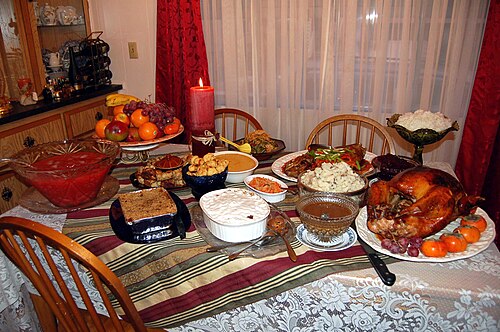
Ms Jones from California, USA · CC BY 2.0 · Our (Almost Traditional) Thanksgiving Dinner.jpg
Thanksgiving is a major annual national holiday celebrated primarily in the United States and Canada, traditionally dedicated to expressing gratitude for the blessings of the harvest and the preceding year.
1. annual national holiday Thanksgiving
Traditional customs center around gathering with family and friends, partaking in an elaborate festive feast, and reflecting upon the positive aspects of life. While rooted in religious and cultural traditions of giving thanks to a higher power, the holiday has largely evolved in modern times into a secular cultural event characterized by regional parades, American football broadcasts, and the informal commencement of the winter holiday shopping season.
1.1 Overview
In contemporary Western culture, particularly in North America, Thanksgiving holds a status of paramount importance alongside Christmas. It serves as a pivotal cultural marker that emphasizes familial reunion, hospitality, and communal unity. The core philosophy of the holiday revolves around the concept of communal gratitude, where individuals set aside daily grievances to appreciate their health, prosperity, and social bonds.
Although the foundational narrative is deeply tied to European settlement in the New World, the holiday today transcends its historic religious origins. It is celebrated by people of various ethnic and religious backgrounds who interpret the day as a time for universal appreciation, charity, and social connection. In both the United States and Canada, the holiday manifests as a multi-day weekend, significantly impacting national transit networks, consumer behavior, and media programming.
1.2 Historical Origins
The modern holiday traces its ancestry to a combination of European harvest festivals and Christian services of thanksgiving. European settlers brought traditions of setting aside specific days to give thanks for favorable weather, bountiful crops, and survival through harsh conditions.
The historically recognized foundation of the American tradition occurred in autumn 1621 at Plymouth Colony in present-day Massachusetts. Following a successful growing season facilitated by the guidance of Tisquantum (Squanto) and the Patuxet tribe, the English Pilgrims shared a three-day harvest feast with the Wampanoag people, led by Sachem Massasoit.[1]The original three-day feast included venison provided by the Wampanoag, along with wild fowl, though there is no historic mention of pumpkin pie being served. This event, often referred to as the "First Thanksgiving," established an early precedent of inter-cultural cooperation and shared sustenance, though the relationship between native populations and European settlers subsequently deteriorated in later decades.
In Canada, the historical roots are frequently traced back to 1578, when English explorer Martin Frobisher held a formal ceremony in present-day Nunavut to give thanks for surviving his long voyage in search of the Northwest Passage. Other historical influences include the early seventeenth-century French settlers under Samuel de Champlain, who established the Order of Good Cheer to boost morale and share food among local French inhabitants and Indigenous peoples.
1.3 Observance by Country
In the United States, Thanksgiving is celebrated on the fourth Thursday of November, a schedule officially standardized by federal legislation under President Franklin D. Roosevelt in 1941. The holiday forms part of a broader four-day weekend, prompting one of the busiest travel periods of the year across the nation. American traditions heavily feature the Presidential Turkey Pardon, massive street spectacles such as the Macy's Thanksgiving Day Parade in New York City, and a full schedule of National Football League games, which have been an integral part of the holiday's television culture since the mid-twentieth century.[2]https://www.macys.com/s/parade — The iconic parade originally featured live animals from the Central Park Zoo before large character balloons were introduced in 1927.
In Canada, Thanksgiving is celebrated on the second Monday of October. This earlier date is primarily due to Canada's geographic location further north, resulting in an earlier harvest season compared to its southern neighbor. It was officially declared a national holiday by the Canadian Parliament in 1879, and the modern date was fixed by royal proclamation in 1957. While sharing many culinary customs with the American observance, Canadian Thanksgiving is generally marked by a quieter, one-day statutory holiday focus on family meals and autumn leisure activities without the associated commercial scale of American sports and shopping events.
Variations of thanksgiving celebrations exist globally, though they operate independently of the North American holiday. The Republic of Liberia, influenced by African American colonization, officially celebrates Thanksgiving on the first Thursday of November. Norfolk Island celebrates on the last Wednesday of November, a legacy left by visiting American whaling ships in the nineteenth century.[3]American whalers introduced the holiday along with traditional recipes like cornbread and pumpkin pie, which remain staple island traditions. Additionally, Germany, Austria, and Switzerland celebrate *Erntedankfest* (Harvest Thanksgiving Festival) in early autumn, which remains predominantly a religious church-based observance.
1.4 Food Culture and Traditions
The Thanksgiving meal is the definitive center of the holiday's material culture, characterized by rich, heavy dishes derived primarily from foods indigenous to North America. The menu has remained remarkably consistent across households, forming a standardized culinary repertoire.
- Roast Turkey: Serves as the central centerpiece of the meal, often stuffed with a seasoned bread mixture. The prominence of the bird is so absolute that the holiday is colloquially referred to as "Turkey Day."[4]The slang name became so popular that it eventually turned into a standard informal moniker across television broadcasts and print media.
- Cranberry Sauce: A sweet and tart condiment made from native North American berries, served alongside the savory meat.
- Side Dishes: Commonly includes mashed potatoes with gravy, sweet potatoes or yams (often baked with marshmallows or brown sugar), green bean casserole, and buttered corn.
- Desserts: Traditional autumn pies dominate the meal's conclusion, with pumpkin pie being the most iconic, alongside pecan pie, apple pie, and sweet potato pie.
Beyond the dinner table, modern traditions extend into the post-meal period. The day immediately following American Thanksgiving is known as "Black Friday," marking the dramatic start of the retail holiday shopping season, characterized by deep corporate discounts and intense consumer activity.
1.5 Modern Perspectives and Controversies
While Thanksgiving is widely embraced as a positive celebration of gratitude, its historical narrative faces significant re-examination in contemporary public discourse.
For many Native American and Indigenous communities, the holiday is viewed not as a celebration of harmony, but as a solemn reminder of the colonization of North America, the displacement of indigenous peoples, and the subsequent loss of tribal lands and culture. Since 1970, the United American Indians of New England have organized a "National Day of Mourning" on Thanksgiving Day at Plymouth Rock to honor indigenous ancestors and protest historical injustice.[5]http://www.uaine.org — Participants gather at Cole's Hill overlooking Plymouth Rock to march, fast, and speak out against systemic injustice.
In response to these critical perspectives, modern educational and cultural institutions increasingly emphasize a more nuanced approach to the holiday. This involves recognizing the complex history of Euro-Indigenous relations, highlighting authentic Indigenous history, and reframing the holiday's core focus away from idealized myths toward a universal theme of shared humanity, intercultural respect, and reflection.
2. formal public prayer Thanksgiving
Thanksgiving, in the context of formal public prayer, refers to an officially decreed or traditionally instituted religious service of gratitude offered by a government, monarch, or national religious body to give thanks to a deity for specific divine favors, national deliverance, military victories, or general prosperity. while modern popular culture often associates the term primarily with the North American harvest holiday, the historical and ecclesiastical practice of formal public prayer Thanksgiving represents a distinct tradition of civic-religious ritual with deep roots in Western liturgical history and political theology.
2.1 Overview
A formal public prayer Thanksgiving is a ritualistic event that bridges the gap between statecraft and theology. Unlike private expressions of gratitude or routine liturgical prayers, a formal Thanksgiving is characterized by its public, solemn, and often episodic nature. These services were typically proclaimed by a sovereign authority—such as a king, parliament, president, or governor—or called by high ecclesiastical officials in direct response to monumental contemporary events.
Historically, Western societies viewed national fortunes, natural disasters, epidemics, and war outcomes through a providential lens. Consequently, when a nation survived a crisis or achieved a major victory, it was considered a moral and religious obligation to offer collective, official thanks to God to acknowledge divine intervention and maintain heavenly favor.
2.2 Historical Origins and Evolution
The practice originates in ancient Judeo-Christian traditions of public vows and sacrifices of thanksgiving following divine rescue, as frequently documented in the Old Testament. During the Middle Ages and the Reformation, these practices evolved into formalized Christian liturgies within both Catholic and Protestant traditions.
In early modern Europe, particularly in Post-Reformation England, public Thanksgiving days were regularly declared alongside days of Fasting and Humiliation. While Days of Fasting were proclaimed during times of plague, famine, or military defeat to appease divine wrath, Days of Thanksgiving were declared to celebrate positive turnarounds. Notable historical examples include national services held after the defeat of the Spanish Armada in 1588 and the frustration of the Gunpowder Plot in 1605.
As European powers expanded globally, these traditions were transported to the New World. English settlers in North America carried the dual practices of solemn Fasts and joyous Thanksgivings with them, applying them to the harsh realities of colonial survival, harvest yields, and conflicts with indigenous populations or rival colonial powers.
2.3 Liturgical and Civic Structure
The execution of a formal public prayer Thanksgiving historically followed a standardized protocol:
- Official Proclamation: The head of state or governing council issued a document explicitly detailing the reasons for the Thanksgiving, the date of observance, and the expected behavior of the populace.
- Cessation of Servile Labor: Citizens were often commanded to abstain from ordinary business and labor, turning the day into a holy day (sabbath-like observance).
- Liturgical Assembly: Communities gathered in local churches or central cathedrals to hear sermons tailored specifically to the occasion, sing dedicated hymns of praise (such as the *Te Deum* in Catholic and Anglican traditions), and recite special prayers written for the event.
- Public Celebration: Following the religious service, the public aspect often extended into civil festivities, including the ringing of church bells, firing of artillery salutes, illuminations, and public feasts.
2.4 Transition to Modern National Holidays
Over time, the episodic, event-driven tradition of public prayer Thanksgiving began to codify into fixed annual occurrences.
In the United States, early presidential proclamations by George Washington and his successors were sporadic and tied to specific events, such as the ratification of the Constitution or the end of the War of 1812. It was not until the American Civil War that President Abraham Lincoln established an annual, uniform national Day of Thanksgiving, explicitly calling upon the American people to offer prayers of gratitude and supplication to God despite the ongoing conflict.
In Canada, a similar trajectory occurred, with sporadic proclamations celebrating military victories or the recovery of royal figures eventually consolidating into an annual national holiday focused on general blessings and the harvest.
In modern times, while the civic holiday versions of Thanksgiving in North America have largely secularized into family-oriented cultural celebrations focused on dining and recreation, the underlying formal public prayer aspect remains intact through official executive proclamations that continue to invoke divine gratitude, as well as through specialized church services maintained by traditional religious denominations worldwide.
3. Trivia
3.1 Sarah Josepha Hale and the Seventy-Year Campaign
The institutionalization of Thanksgiving as a fixed national holiday in the United States was largely the result of a persistent decades-long campaign by Sarah Josepha Hale, an influential editor and author best known for writing the nursery rhyme *Mary Had a Little Lamb*.[6]Hale believed a single national holiday would help bridge the growing political rift between the Northern and Southern states. Beginning in 1827, Hale published numerous editorials and penned personal letters to five consecutive U.S. presidents—John Tyler, James K. Polk, Zachary Taylor, Millard Fillmore, and Abraham Lincoln—advocating for a unified national day of prayer and thanksgiving to heal political and cultural divisions. Her efforts culminated in October 1863, when President Lincoln issued a presidential proclamation establishing the final Thursday of November as a national holiday, intentionally designed to foster national unity during the height of the American Civil War.
3.2 The Great Turkey Pardon Mythos and Executive Clemency
While popular culture often attributes the origin of the presidential turkey pardon to Harry S. Truman in 1947, historical records indicate that Truman merely accepted turkeys presented by the Poultry and Egg National Board for culinary consumption. The unofficial practice of sparing presentation turkeys traces back to Abraham Lincoln, who informally pardoned a live turkey intended for Christmas dinner in 1863 at the request of his son, Tad. John F. Kennedy was the first president recorded sending a presentation turkey back to a farm in 1963, remarking, "We'll just let this one grow." The ceremony was formally institutionalized as an official annual White House tradition by George H. W. Bush in 1989.[7]https://www.jfklibrary.org/asset-viewer/archives/JFKWHA/1963/JFKWHA-246-010/JFKWHA-246-010 — Despite the sign hanging around the turkey's neck reading 'Good Eating, Mr. President,' Kennedy chose to spare the bird just days before his assassination.
3.3 The 1939 "Franksgiving" Calendar Controversy
In 1939, President Franklin D. Roosevelt altered the traditional timing of the holiday by moving it from the last Thursday of November (November 30) to the penultimate Thursday (November 23). Driven by retail lobbying during the Great Depression, the decision aimed to extend the Christmas shopping season to bolster the sagging economy. The unilateral shift caused severe logistical chaos, disrupting college football schedules, academic calendars, and holiday travel plans. Opponents derisively labeled the altered date "Franksgiving."[8]Critics hated the calendar shift so much that some state governors refused to issue proclamations for the revised date. For two years, the nation maintained a bifurcated calendar, with twenty-three states observing Roosevelt's date, twenty-two observing the traditional date, and three observing both. Congress resolved the issue in December 1941 by passing a joint resolution fixing Thanksgiving permanently on the fourth Thursday of November.
3.4 The Frozen TV Dinner Innovation
The creation of the commercial frozen TV dinner by Swanson & Company in 1953 was the direct result of a massive supply chain miscalculation during Thanksgiving.[9]https://www.smithsonianmag.com/history/post-thanksgiving-turkey-mishap-led-invention-tv-dinner-180981162 — The company had to keep the refrigerated train cars continuously running to prevent 520,000 pounds of turkey from spoiling. An executive overordered turkey stock, leaving the company with approximately 260 tons of unsold frozen turkeys sitting in ten refrigerated train cars. Gerry Thomas, a Swanson salesman, devised a solution inspired by prepared airline meals. The company sliced the surplus turkey, paired it with cornbread stuffing, peas, and sweet potatoes, and packaged the meal in segmented aluminum trays designed to be heated in an oven. Swanson sold over 10 million units in the first full year of production, permanently altering American food consumption habits.
3.5 NFL Thanksgiving Day Games Tradition
The association between professional American football and Thanksgiving originated long before the establishment of the National Football League (NFL). The Intercollegiate Football Association (IFA) held its championship game on Thanksgiving Day starting in 1876, establishing a major sporting tradition. The NFL's continuous Thanksgiving tradition began in 1934, when George A. Richards, owner of the Detroit Lions, arranged a holiday game against the Chicago Bears to attract local fan interest. To maximize viewership, Richards leveraged his connections as an affiliate of the NBC Radio Network to broadcast the game nationwide across 94 stations. The broadcast success established the Detroit Lions—and later the Dallas Cowboys in 1966—as permanent host franchises for the annual holiday games.
3.6 The Continental Congress Proclamations of 1777–1783
The modern civil holiday evolved from early religious observances mandated by government bodies. During the American Revolutionary War, the Continental Congress issued eight separate national proclamations of thanksgiving between 1777 and 1783. The primary historic document, known as the *First National Proclamation of Thanksgiving*, was drafted by Samuel Adams and signed by Henry Laurens on November 1, 1777.[10]https://www.loc.gov/item/2008577059 — The Continental Congress published the proclamation on broadside sheets so ministers could read the text aloud to their congregations. The proclamation called for a solemn day of public prayer and thanksgiving on December 18, 1777, specifically commemorating the Continental Army's strategic victory over British forces at the Battle of Saratoga.
3.7 International Variants and Canadian Thanksgiving
The holiday is not exclusive to the United States and developed along a separate historical trajectory in Canada. Canadian Thanksgiving traces its roots to 1578, when English explorer Sir Martin Frobisher held a ceremony of thanksgiving in present-day Nunavut for surviving his Arctic expedition in search of the Northwest Passage—predating the Plymouth settlement by 43 years. Canadian Thanksgiving was officially declared a national holiday by Parliament in 1879 and was moved to the second Monday in October in 1957. The timing aligns with the earlier completion of the agricultural harvest period in northern latitudes compared to the United States.
Child documents of "Thanksgiving"
None yet.