Published page
Voter registration


Voter registration is a mandatory or elective administrative procedure in which eligible citizens must enroll on an official electoral roll prior to exercising their right to …
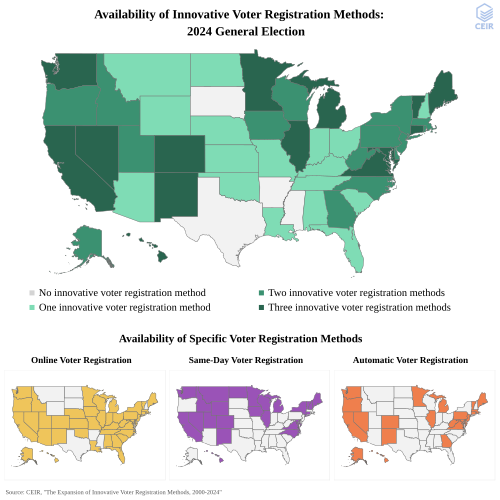
Voter registration
Voter registration is a mandatory or elective administrative procedure in which eligible citizens must enroll on an official electoral roll prior to exercising their right to …
CEIR Research Team · CC BY-SA 4.0 · Voter Registration Methods for 2024 U.S. Election.svg
Voter registration is a mandatory or elective administrative procedure in which eligible citizens must enroll on an official electoral roll prior to exercising their right to vote in a public election.
Although the fundamental right to vote is guaranteed by modern democratic constitutions, most legal systems do not permit citizens to simply arrive at a polling station on election day to cast a ballot. Instead, governments utilize voter registration as a prerequisite filter to verify identity, confirm residential qualification, and prevent duplicate voting.
1. Overview
In the framework of modern representative democracy, voter registration serves as the bridge between constitutional suffrage and the practical administration of an election. While citizenship and legal age form the theoretical basis for voting eligibility, registration is the process by which an individual is legally recognized as a qualified elector within a specific voting district.
The primary administrative objective of this requirement is electoral integrity. By compiling a precise list of voters—commonly referred to as an electoral roll, voter list, or poll book—election authorities can ensure that each citizen votes only once, casts their ballot in the correct administrative division, and meets all legal criteria established by national or local electoral laws. Depending on the jurisdiction, voter registration can be either a seamless, state-managed background process or a complex, self-initiated burden placed entirely on the individual citizen.
2. Systems and Classification
Global voting systems generally categorize voter registration into two distinct operational models based on who holds the primary responsibility for maintaining the voter list.
- Automatic (State-Led) Registration: In this system, the government automatically compiles the electoral roll using existing public databases, such as civil registries, national identity systems, tax records, or housing databases. Citizens do not need to submit separate applications to vote; their eligibility is updated continuously by the state. This system is prevalent in most European nations, East Asian democracies such as South Korea and Japan, and Latin American countries with centralized civil registries.
- Voluntary (Individual-Led) Registration: Under this model, the responsibility to register rests entirely on the eligible citizen. Individuals must actively submit an application containing personal details and proof of residence to local electoral authorities before a designated deadline. If a citizen fails to register, moves to a new jurisdiction without updating their records, or misses the registration deadline, they lose their right to vote in that specific election cycle. The most prominent example of this system is the United States.
Additionally, some legal frameworks enforce Compulsory Registration, where citizens are legally mandated to register upon reaching the age of majority, regardless of whether actual voting is compulsory.
3. Legal and Administrative Mechanics
The registration process requires an individual to satisfy several standard criteria defined by statutory law:
- Identity Verification: Applicants must provide official proof of identity, such as a national identity card, passport, driver's license, or social security designation.
- Residency Requirements: Because elections are structured around geographic constituencies, voters must establish legal residence in the district where they intend to cast a ballot. This prevents "carpetbagging" or the strategic manipulation of voter distribution across competitive districts.[1]The term historically originated in the post-Civil War United States to describe Northern politicians who traveled South with cheap carpetbag luggage to exploit local political turmoil.
- Disqualification Filters: Electoral registries systematically cross-reference law enforcement and administrative databases to exclude individuals who have lost their civil rights through criminal convictions or legal incapacity, depending on the constitutional framework of the country.
Once approved, the voter's name is placed on the active voter list assigned to a specific precinct or polling location. On election day, poll workers verify the voter's presence on this document before issuing a ballot.
4. Debate and Controversies
The institutional requirement of voter registration is a frequent subject of legal and political debate, primarily centered on the tension between election security and voter participation.
Proponents of strict, voter-initiated registration argue that formal registration procedures are vital for maintaining public confidence in election outcomes. They contend that robust verification standards, advance registration deadlines, and voter ID requirements protect the integrity of the ballot box by mitigating administrative errors, preventing voter impersonation, and maintaining clear records for legal audits.
Conversely, critics and voting rights advocates argue that cumbersome registration systems operate as an artificial barrier to democratic participation. In voluntary systems, strict registration deadlines and complex paperwork disproportionately disenfranchise young voters, low-income citizens, racial minorities, and highly mobile populations who may lack stable housing or standard documentation. This debate has led to various reform movements aimed at modernizing the process, such as Same-Day Registration (SDR), automatic registration at government service agencies (often called "Motor Voter" laws), and online registration portals.
5. Trivia
5.1 Automatic Voter Registration and the Nordic Model
In many European countries, particularly within the Nordic region (such as Sweden, Denmark, and Finland), voter registration as a separate administrative step does not exist. Instead, the state utilizes centralized civil registration databases (such as Sweden's *Folkbokföring*).[2]The Swedish population register has operated continuously since the 17th century, when local parish priests of the Church of Sweden were charged with recording all births, moves, and deaths. Citizens are automatically added to the electoral roll upon reaching the legal voting age based on their official address of residence. This system yields voter registration rates approaching 100% of eligible citizens without requiring individual initiative, standing in stark contrast to voluntary registration models.
5.2 The National Voter Registration Act of 1993 ("Motor Voter")
Enacted in the United States to increase political participation, the National Voter Registration Act (NVRA) mandated that state governments offer voter registration opportunities at designated public agencies. The most prominent mechanism requires state departments of motor vehicles (DMVs) to integrate voter registration into the driver's license application and renewal process. This administrative coupling led to the common moniker "Motor Voter."[3]https://www.justice.gov/crt/national-voter-registration-act-1993-nvra — President Bill Clinton signed the legislation using the historic pens used by President Lyndon B. Johnson to sign the Voting Rights Act of 1965. The law also mandated registration availability at public assistance offices and military recruitment centers.
5.3 The Oregon Automatic Voter Registration Pioneer
In 2015, Oregon became the first U.S. jurisdiction to implement an "opt-out" Automatic Voter Registration (AVR) system. Under this policy, eligible citizens who interact with the Driver and Motor Vehicle Services Division are automatically registered to vote unless they explicitly decline via a mailed postcard within a designated timeframe. This reversed the traditional burden of registration from the individual to the state, prompting numerous other states and the District of Columbia to adopt similar agency-based opt-out frameworks.
5.4 Historical Disenfranchisement via Literacy Tests and Poll Taxes
Following the Reconstruction era in the Southern United States, voter registration mechanisms were strategically manipulated to disenfranchise African American voters without explicitly violating the Fifteenth Amendment. State laws introduced subjective "literacy tests," complex constitutional interpretation requirements, and poll taxes as prerequisites for registration. Local registrars held absolute discretion, often passing illiterate white applicants under "grandfather clauses" while failing highly educated Black applicants.[4]https://www.ourdocuments.gov/doc.php?flash=false&doc=100 — Grandfather clauses exempted citizens from voting restrictions if their ancestors had the right to vote prior to 1867, effectively insulating white voters while disenfranchising Black citizens. These systemic barriers were dismantled by the federal Voting Rights Act of 1965.
5.5 Civil Death and Felony Disenfranchisement Laws
The intersection of criminal justice and voter registration varies drastically across international jurisdictions. In the United States, state policies on "civil death" create a complex patchwork regarding the voting rights of individuals convicted of felonies. Certain jurisdictions (such as Maine, Vermont, and Washington, D.C.) allow incarcerated individuals to register and vote by mail.[5]Incarcerated individuals in these jurisdictions maintain their voting status by registering using their last permanent home address prior to imprisonment. Conversely, other states require a formal executive pardon or a statutory post-sentence waiting period before an individual can apply for reinstatement of registration rights.
5.6 Same-Day Voter Registration (SDR)
Traditional election administration requires a "cutoff date"—often 15 to 30 days prior to Election Day—to compile and verify the physical or digital voter rolls. However, Same-Day Registration (SDR), also known as Election Day Registration (EDR), allows eligible individuals to register and cast a ballot simultaneously on Election Day. Introduced by Maine, Minnesota, and Wisconsin in the 1970s, this system requires robust real-time database verification or conditional (provisional) balloting to prevent dual voting across precincts.
5.7 International Bipartisan Boundary Regimes and Voter Rolls
In jurisdictions such as the United Kingdom, Canada, and Australia, voter registration is managed by independent, non-partisan national electoral commissions (e.g., Elections Canada, the Australian Electoral Commission).[6]Elections Canada was established in 1920, making it one of the oldest independent non-partisan electoral agencies in the world. These agencies actively maintain the electoral roll through continuous data-matching agreements with tax authorities, postal services, and local councils. This centralized model eliminates the precinct-level administrative variations common in decentralized federal systems like the United States, where registration rules can differ by county.
5.8 Third-Party Voter Registration Drives and Regulatory Friction
Non-governmental organizations frequently conduct voter registration drives to mobilize underrepresented demographics. However, the legal environment surrounding third-party registration is subject to intense regulatory friction. Several U.S. states have enacted strict administrative penalties, short submission deadlines (sometimes within 48 to 72 hours of collecting an application), and heavy fines for minor clerical errors made by registration volunteers, leading to legal challenges regarding Freedom of Speech and Association under the First Amendment.
Child documents of "Voter registration"
None yet.