Published page
Bank holidays


A Bank holiday is a public holiday in the United Kingdom, its Crown Dependencies, British Overseas Territories, and the Republic of Ireland, officially designated as a day whe…
Bank holidays
A Bank holiday is a public holiday in the United Kingdom, its Crown Dependencies, British Overseas Territories, and the Republic of Ireland, officially designated as a day whe…
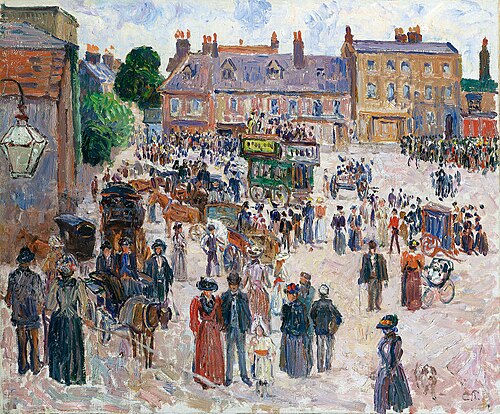
Camille Pissarro · Public domain · 'Bank Holiday, Kew' by Camille Pissarro, 1892.jpg
A Bank holiday is a public holiday in the United Kingdom, its Crown Dependencies, British Overseas Territories, and the Republic of Ireland, officially designated as a day when banking institutions are closed for business.
Over time, these days have evolved into general public holidays where the majority of the population is granted time off work, and most non-essential businesses, government offices, and educational institutions suspend their operations.
1. Overview
The term originates from the historical practice where commercial banks would close, making it impossible for other businesses to conduct financial transactions, thereby effectively halting general commerce. Although the term is specific to the British Isles and its historical territories, it is often used colloquially in Commonwealth nations to refer to any official public holiday.
Unlike traditional public holidays derived from religious festivals or royal decrees, modern bank holidays are formally established by statute or royal proclamation. On these days, financial markets close, and automated clearing services undergo deferred settlement schedules. While essential services such as healthcare, emergency response, and public transport continue to operate, they frequently run on reduced or Sunday schedules.
2. History
Before the late nineteenth century, the Bank of England observed over forty religious holidays and anniversaries each year.[1]The Bank of England originally observed 47 distinct saints' days and royal anniversaries before the list was dramatically trimmed down. However, as industrialization accelerated, the number of observed holidays was drastically reduced to ensure continuous economic output. By the mid-nineteenth century, only a handful of days, including Good Friday and Christmas Day, remained as standard non-working days.
To address the lack of standardized statutory leisure time for workers in the industrial era, Sir John Lubbock, a banker, politician, and polymath, introduced the Bank Holidays Act 1871 in the Parliament of the United Kingdom. The act designated specific days when banks were legally mandated to close, shielding merchants from penalties for failing to make payments on those dates. The legislation was met with widespread public approval, leading to the early nickname "St Lubbock's Days" in honor of its proponent.[2]https://www.parliament.uk/about/living-heritage/transformingsociety/private-lives/leisure/overview/bankholidays — Sir John Lubbock was so beloved by cricket enthusiasts and working people for creating statutory holidays that cricket matches on those days were fondly dedicated to his name.
The legal framework was subsequently updated by the Banking and Financial Dealings Act 1971, which remains the legal basis for bank holidays in the United Kingdom today. This act established the modern calendar of holidays and granted the reigning monarch the authority to declare exceptional bank holidays for special national observances or to alter existing dates via royal proclamation.
3. Observance by Region
The designation of bank holidays varies across the constituent countries of the United Kingdom, reflecting regional traditions and legislative autonomy.
- England and Wales: Standard observances include New Year's Day, Good Friday, Easter Monday, Early May Bank Holiday, Spring Bank Holiday, Summer Bank Holiday, Christmas Day, and Boxing Day.
- Scotland: Bank holidays in Scotland are officially set by Scottish Ministers. Scotland observes unique holidays such as 2 January and St Andrew's Day.[3]Scotland's January 2nd holiday was formally introduced to allow citizens an extra day to recover from the traditionally intense Hogmanay celebrations. While Good Friday and Easter Monday are recognized, their practical observance differs from England, with many Scottish commercial banks adhering to local business schedules instead.
- Northern Ireland: In addition to standard UK bank holidays, Northern Ireland observes St Patrick's Day and Battle of the Boyne (Orangemen's Day).
In the Republic of Ireland, official public holidays are officially referred to as statutory public holidays under the Organisation of Working Time Act 1997, though the term "bank holiday" remains in common colloquial usage. Ireland observes ten public holidays annually, including St Patrick's Day, Easter Monday, and specific Mondays in May, June, August, and October.
4. Modern Practice and Significance
In contemporary society, bank holidays serve as major cultural and economic events. Because most statutory bank holidays are scheduled on Mondays, they create extended three-day weekends. This structure significantly boosts domestic tourism, retail, and hospitality sectors, as families travel for leisure or undertake home improvement projects.
When a standard bank holiday falls on a Saturday or Sunday, a substitute weekday—typically the immediately following Monday—is officially designated as a bank holiday to preserve the total number of non-working days.[4]https://www.gov.uk/bank-holidays — These designated substitute days are officially termed 'substitute days' in legal schedules to ensure workers do not lose their holiday total during weekend overlaps. While employers in the UK are not legally required to grant paid leave on bank holidays, many contracts of employment include them as part of an employee's annual leave entitlement.
5. Trivia
5.1 The Lubbock Precedent and the 1871 Act
The formalization of bank holidays originated through the Bank Holidays Act 1871, orchestrated by Sir John Lubbock, a Liberal politician, polymath, and banker. Prior to this legislation, the Bank of England recognized over forty religious and royal observances annually; however, this number had collapsed to just four by 1834. Lubbock’s primary rationale was to alleviate the severe working conditions of financial clerks without triggering economic instability. Public gratitude for the legislation was so profound that early bank holidays were colloquially dubbed "St. Lubbock's Days."
5.2 Royal Prerogative and Statutory Mechanics
Unlike public holidays in other jurisdictions, bank holidays in the United Kingdom are not strictly permanent calendar fixtures. They are governed by the Banking and Financial Dealings Act 1972, which replaced the 1871 framework. Under this statute, the reigning monarch holds the legal authority to proclaim one-off bank holidays or shift existing dates via a Royal Proclamation. This mechanism is frequently invoked to mark significant national events, such as royal weddings, jubilees, or state funerals, as well as to adjust dates that conflict with weekends.
5.3 Legal Distinction Between Bank and Public Holidays
A common misconception is the absolute legal equivalence between "bank holidays" and "public holidays." Strictly speaking, bank holidays are statutory closures specified by the 1972 Act, originally intended to suspend financial transactions and clearings. Public holidays—such as Good Friday and Christmas Day in England, Wales, and Northern Ireland—exist under common law and historical custom. While the practical effect for the general populace is identical, the legal foundations governing employment obligations, contract performance, and banking operations differ based on this distinction.
5.4 The Whit Monday Realignment
Historically, the late spring bank holiday was tied to the moveable feast of Pentecost (Whit Monday). This created considerable unpredictability for British commercial planning and school terms due to the sliding lunar calendar. In 1965, the Wilson government initiated an experimental decoupling of the holiday from the ecclesiastical calendar, establishing a fixed slot on the last Monday of May.[5]https://www.legislation.gov.uk/ukpga/1971/80/enacted — The trial period moving Whit Monday away from its moveable religious date began in 1965 after persistent complaints from holiday resorts about weather unpredictability. This temporary measure was permanently codified under the Banking and Financial Dealings Act 1972, ending centuries of religious calendar reliance for secular leave.
5.5 Regional Asymmetry Within the Realm
The distribution and total count of statutory bank holidays vary significantly across the constituent countries of the United Kingdom:
- England and Wales: Generally observe eight statutory/public holidays per year.
- Scotland: Observes nine statutory bank holidays, including a unique statutory holiday on January 2nd (to extend New Year celebrations) and St. Andrew’s Day (November 30).
- Northern Ireland: Enjoys ten statutory bank holidays, incorporating St. Patrick’s Day (March 17) and the Battle of the Boyne / Orangemen's Day (July 12).
This legislative fragmentation means that financial institutions in Edinburgh may operate normally on days when the City of London is entirely shuttered, and vice versa.
5.6 Absence of Mandatory Employee Entitlement
Under United Kingdom employment law, workers do not possess an automatic statutory right to paid leave on bank holidays. The Working Time Regulations 1998 mandate a minimum of 5.6 weeks (28 days for a full-time worker) of paid annual leave, but employers retain complete legal discretion over whether bank holidays are included within this baseline count or required as active working days.[6]https://www.gov.uk/holiday-entitlement-rights — The statutory minimum of 28 days explicitly reflects the standard 20 days of annual leave combined with the 8 traditional bank holidays in England and Wales. Consequently, the operational status of retail, hospitality, and essential services on these dates relies entirely on individual employment contracts rather than overarching statutory mandate.
5.7 Financial and Market Liquidity Dynamics
Because London serves as one of the world's primary global financial centers, UK bank holidays exert a distinct influence on international foreign exchange (FX) and debt markets. On these days, the settlement of spot foreign exchange transactions for currency pairs involving the British Pound (GBP) is suspended. The absence of London liquidity often results in reduced market depth globally, leading to either suppressed trading volumes or heightened price volatility in foreign financial markets operating simultaneously.
Child documents of "Bank holidays"
None yet.