Published page
First day of spring


The first day of spring, scientifically identified as the Vernal Equinox in the Northern Hemisphere, is an astronomical event that occurs when the Sun crosses the celestial equato…
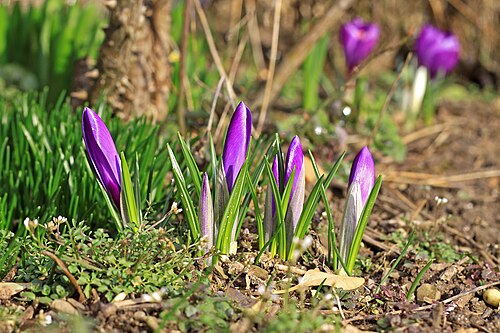
First day of spring
The first day of spring, scientifically identified as the Vernal Equinox in the Northern Hemisphere, is an astronomical event that occurs when the Sun crosses the celestial equato…
Thomas Wolf ( Der Wolf im Wald ) · CC BY-SA 3.0 · Krokusse violett.jpg
The first day of spring, scientifically identified as the Vernal Equinox in the Northern Hemisphere, is an astronomical event that occurs when the Sun crosses the celestial equator from south to north, marking the official transition from winter to spring.
1. Vernal equinox in March
1.1 Overview
The Vernal Equinox, traditionally recognized as the first day of spring in the Northern Hemisphere, takes place annually between March 19 and March 21.[1]https://www.usno.navy.mil/USNO/astronomy/information-services/earth-seasons — The exact time of the equinox shifts constantly, meaning the astronomical spring officially arrives at a precise minute rather than a whole calendar day. On this specific day, the Earth's rotational axis is tilted neither away from nor toward the Sun, positioning the subsolar point directly over the equator. As a result, the solar illumination is distributed equally across both hemispheres, causing daytime and nighttime to be of approximately equal duration across the entire globe. While the Northern Hemisphere enters the season of spring following this event, the Southern Hemisphere simultaneously experiences its autumnal equinox, entering the season of autumn.
1.2 Astronomical Mechanics
The phenomenon is dictated by the Earth's axial tilt of approximately 23.5 degrees relative to its orbital plane around the Sun. Throughout the year, this tilt causes different parts of the planet to receive varying amounts of solar radiation. During the March equinox, the Earth reaches a specific geometric alignment where its tilt is perpendicular to the Sun's rays.
From an observer's perspective on Earth, the Sun appears to cross the celestial equator, moving northward. The term "equinox" originates from the Latin words *aequus* (meaning equal) and *nox* (meaning night).[2]The word entered Old French as *equinoce* before being adopted into English during the 14th century. However, due to atmospheric refraction of sunlight and the precise definition of sunrise and sunset, daylight actually lasts slightly longer than twelve hours on the exact date of the equinox—a nuance often highlighted in meteorological science.
1.3 Determination of Dates
Although popular culture often fixes the first day of spring on March 21, the exact date varies year by year due to the discrepancy between the Gregorian calendar year (365 days) and the actual tropical year (approximately 365.2422 days). Leap years are incorporated into the calendar system to correct this drift, causing the precise timing of the Vernal Equinox to shift. In contemporary times, the equinox in the Northern Hemisphere occurs most frequently on March 20, occasionally falling on March 19 or March 21 depending on the observer's local time zone.
1.4 Meteorological vs. Astronomical Spring
A distinction exists between astronomical spring and meteorological spring:
- Astronomical Spring: Defined strictly by the orbital position of the Earth relative to the Sun, beginning on the March equinox and concluding on the June solstice.
- Meteorological Spring: Defined by climatologists based on annual temperature cycles and the Gregorian calendar. It consistently spans the three full calendar months of March, April, and May in the Northern Hemisphere to facilitate statistical tracking and consistency.
While astronomical spring marks the physical shift in solar orientation, atmospheric temperatures typically lag behind due to the thermal inertia of the Earth's oceans and landmasses. Consequently, the onset of warm spring weather often differs from the precise astronomical date.
1.5 Cultural and Historical Significance
Throughout human history, the March equinox has held immense importance as a symbol of rebirth, renewal, and agricultural awakening. Numerous ancient civilizations constructed monuments—such as Stonehenge in England and Chichen Itza in Mexico—aligned specifically with the sunrise or sunset of the equinox to track agricultural seasons.[4]At Chichen Itza, the afternoon sun creates shadows along the El Castillo pyramid that resemble a slithering snake moving down the steps.
In contemporary culture, the event coincides with or determines the timing of major global holidays and festivals:
- Nowruz: The Persian New Year, celebrated for thousands of years, begins precisely at the moment of the vernal equinox, signifying new beginnings.
- Easter: In Western Christianity, Easter Sunday is calculated as the first Sunday following the first full moon that occurs on or after the March equinox.
- Holi: The Hindu festival of colors is celebrated around this time to welcome the arrival of spring and the triumph of good over evil.
- Shunbun no Hi: A public holiday in Japan dedicated to admiring nature and showing affection for all living things.[3]The holiday was officially established in 1948, evolving from the older Shinto tradition of *Koreisai*.
2. Meteorological spring on March 1
The first day of meteorological spring on March 1 is a conventionally fixed date used by meteorologists and climatologists to mark the transition into the spring season in the Northern Hemisphere based on annual temperature cycles.
2.1 Overview
In general discourse, the arrival of spring is often associated with the vernal equinox, which usually occurs around March 20 or 21. However, in the fields of meteorology and climatology, the year is divided into four equal three-month periods aligned with the Gregorian calendar months. Under this system, meteorological spring consistently begins on March 1 and concludes on May 31. This standard is primarily used in the Northern Hemisphere, whereas the corresponding period in the Southern Hemisphere represents the start of meteorological autumn.
2.2 Origin and Rationale
The definition of meteorological seasons was developed to create a predictable and consistent framework for statistical analysis and climate tracking. Astronomical seasons, which are based on the position of the Earth relative to the Sun, vary in start dates and lengths due to the elliptical shape of Earth's orbit and leap years.
Because atmospheric phenomena follow annual temperature patterns rather than precise astronomical alignments, meteorologists grouped the months based on monthly mean temperatures. March, April, and May exhibit similar transition characteristics, making them the most logical cluster for the spring season. By fixing the start date to March 1, historical weather data can be compared seamlessly across different years and regions without adjusting for shifting astronomical dates.
2.3 Meteorological Characteristics
The onset of meteorological spring on March 1 represents a period of significant atmospheric instability. As solar radiation increases in the Northern Hemisphere, the thermal contrast between polar air masses and warm tropical air masses reaches a peak. This dynamic often leads to volatile weather patterns, including high winds, rapid temperature fluctuations, and heavy precipitation.
While March 1 is defined as the start of spring, actual environmental indicators—such as the thawing of soil, blooming of early flora, and animal migration—depend heavily on regional microclimates and may lag or precede this date depending on the latitude and elevation of a specific location.
2.4 Comparison with Astronomical Spring
| Feature | Meteorological Spring | Astronomical Spring |
| :--- | :--- | :--- |
| Start Date | March 1 | Vernal Equinox (March 19–21) |
| Basis | Civil calendar and annual temperature cycles | Position of the Earth relative to the Sun |
| Length | Exactly 92 days | Approximately 89 to 93 days |
| Primary Use | Weather forecasting, climatological statistics | Astronomy, traditional calendars, cultural events |
2.5 Cultural and Practical Impact
Although astronomical spring holds greater significance for traditional festivals and cultural observances, meteorological spring serves as the primary standard for modern industry, agriculture, and public planning. Weather services worldwide shift their seasonal forecasting models and climate reporting on March 1. Additionally, economic sectors such as retail, construction, and energy management rely on the fixed meteorological calendar to align seasonal inventory, workforce scheduling, and demand forecasting.
3. Trivia
3.1 The Astronomical–Meteorological Discrepancy
While the popular consciousness identifies the vernal equinox (typically March 20 or 21) as the definitive beginning of spring, modern climatology operates on a distinct standard. Meteorological spring universally commences on March 1 in the Northern Hemisphere. This system divides the year into four precise three-month periods based on annual temperature cycles rather than celestial positioning. The primary rationale lies in data collection efficiency; fixing the start date to the first of the month simplifies statistical grouping and long-term climate tracking, avoiding the mathematical complexities caused by the astronomical equinox shifting by several hours each year due to Earth's orbital eccentricities.
3.2 Temporal Variation of the Vernal Equinox
The calendar date of the astronomical vernal equinox is not static. Due to the discrepancy between the Gregorian calendar year (365 days) and the actual tropical year (approximately 365.2422 days), the exact moment of the equinox shifts backward by roughly six hours each non-leap year, moving forward by 18 hours following a leap year. Consequently, a March 21 equinox has become exceedingly rare in the 21st century. In the United States, the vernal equinox will not occur on March 21 for the entire duration of the century, frequently falling on March 19 or March 20 instead.
3.3 The Phenomenon of Vernal Egg Balancing
A pervasive modern folk belief asserts that the subtle gravitational shifts occurring precisely during the vernal equinox allow an egg to be balanced upright on its end with unusual ease.[5]The popular myth was widely popularized in the West after a 1945 article in *Life* magazine described a ritual in China where citizens balanced eggs to welcome spring. From a physical standpoint, this claim is devoid of scientific merit. The gravitational interplay between the Sun, Earth, and Moon during an equinox exerts no measurable structural influence on small terrestrial objects. Observational tests demonstrate that with adequate patience, a steady hand, and an egg with a slightly textured shell, an egg can be balanced on its end on any day of the year regardless of solar alignment.
3.4 The Atmospheric Refraction Paradox
The word "equinox" derives from the Latin *aequinoctium*, implying a day of completely equal night and day (12 hours each). In physical reality, day length on the first day of astronomical spring actually exceeds night length by several minutes across most latitudes. This discrepancy is caused by two atmospheric factors: atmospheric refraction, which bends solar light around the curve of the Earth and allows the Sun to be seen before it physically rises above the horizon, and the standard astronomical definition of sunrise/sunset, which measures the upper edge of the solar disk rather than its center point.
3.5 Cultural New Year Synchronicity
Throughout human history, the astronomical first day of spring has served as the fundamental anchor for civil and religious calendars. The solar event marks the precise moment of *Nowruz*, the traditional Iranian New Year celebrated continuously for over 3,000 years across Central and Western Asia. Similarly, the ancient Roman calendar originally designated March as the first month of the year, a legacy that remains visible in the names of modern months—such as October, November, and December, which derive from the Latin roots for eight, nine, and ten, respectively.[6]Julius Caesar's calendar reform in 45 BCE permanently moved the start of the civil new year from March to January 1.
Child documents of "First day of spring"
None yet.