Published page
Ramadan


Ramadan is the ninth month of the Islamic lunar calendar, observed by Muslims worldwide as a holy month of fasting, prayer, reflection, and community.
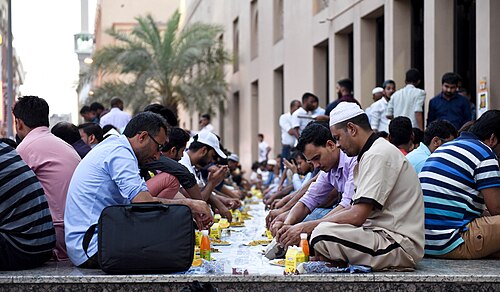
Ramadan
Ramadan is the ninth month of the Islamic lunar calendar, observed by Muslims worldwide as a holy month of fasting, prayer, reflection, and community.
Gabby Canonizado from Dubai, United Arab Emirates · CC BY 2.0 · Breaking the Fast (2) (27351979537).jpg
Ramadan is the ninth month of the Islamic lunar calendar, observed by Muslims worldwide as a holy month of fasting, prayer, reflection, and community.
1. Overview
It is considered one of the Five Pillars of Islam, lasting twenty-nine to thirty days based on the visual sightings of the crescent moon. The month marks the period during which the Quran, the holy book of Islam, was first revealed to the Prophet Muhammad. Because the Islamic hijri calendar is lunar, Ramadan shifts approximately eleven days earlier each year in the Gregorian calendar, cycling through all seasons over a period of roughly thirty-three years.
2. Etymology and Origins
The term derives from the Arabic root *r-m-ḍ*, which relates to scorching heat or dryness.[1]The root anciently denoted the intense heat of summer, which burned the ground and dried up surface water. Historically, this reflected the climatic conditions of the Arabian Peninsula when the names of the months were originally assigned according to the solar seasons. In Islamic theology, the month holds supreme status due to *Laylat al-Qadr* (The Night of Power), which occurs during the last ten nights of the month and commemorates the initial revelation of the Quran.
3. Observances and Practices
The central obligation during Ramadan is *sawm* (fasting), which is mandatory for adult Muslims who are not acutely or chronically ill, traveling, elderly, pregnant, breastfeeding, diabetic, or menstruating.
- **Fasting (*Sawm*):** From dawn until sunset, individuals abstain from consuming food, drinking liquids, smoking, and engaging in sexual relations. The period is also intended to be a time of intense spiritual discipline, requiring followers to refrain from sinful behavior such as speech errors, false witness, and fighting.
- **Pre-dawn Meal (*Suhoor*):** Observants consume a pre-dawn meal before the first call to prayer of the day. This meal provides the necessary sustenance for the upcoming hours of abstinence.
- **Break-fast Meal (*Iftar*):** At sunset, families and communities gather to break their fast, traditionally beginning with the consumption of dates and water, following the sunnah of the Prophet Muhammad, followed by a larger meal.
- **Nightly Prayers (*Tarawih*):** Special congregational prayers are held in mosques throughout the night, during which long portions of the Quran are recited so that the entire text is completed by the end of the month.
- **Charity (*Zakat* and *Sadaqah*):** Almsgiving is heavily emphasized during this period. Muslims are encouraged to donate generously to those in need, culminatig in a mandatory form of charity called *Zakat al-Fitr* before the month ends.
4. Cultural and Social Significance
Beyond its religious mandates, Ramadan fosters a profound sense of communal cohesion and cultural identity across diverse global populations. Daily routines shift dramatically in Muslim-majority nations, with adjusted working hours, altered commercial schedules, and vibrant night markets that open after the breaking of the fast. Festive decorations, such as traditional lanterns, frequently adorn homes and public spaces.[2]The practice of hanging ornate colorful metal lanterns known as fanous originated in Fatimid Egypt before spreading throughout the region.
5. Conclusion of the Month
The end of Ramadan is determined by the sighting of the new crescent moon, marking the beginning of the tenth Islamic month, Shawwal. The conclusion is celebrated with *Eid al-Fitr* (The Festival of Breaking the Fast), a major holiday featuring communal prayers, festive meals, gift-giving, and social visits that span up to three days.
6. Trivia
6.1 Laylat al-Qadr and the Variability of Calendar Dates
Because the Islamic calendar is a strictly lunar calendar based on the synodic month (approximately 29.53 days), the month of Ramadan shifts backward by approximately 11 days each year relative to the Gregorian solar calendar. This temporal migration results in a complete cycle through all four solar seasons every 33 solar years. A notable consequence of this celestial mechanic concerns *Laylat al-Qadr* (The Night of Power), traditionally commemorated on one of the odd-numbered nights during the last ten days of the month. Depending on the geographical latitude and the season in which Ramadan falls, the duration of the daily fast can range from roughly 11 hours in equatorial regions to over 20 hours in high-latitude zones during the summer solstice.
6.2 Midnight Sun and Jurisprudential Adaptations
In extreme northern or southern latitudes—such as parts of Scandinavia, Alaska, or Northern Russia—the solar phenomena of the midnight sun and polar night create scenarios where the sun does not set or rise for weeks at a time. To address the impossibility of determining *Fajr* (dawn) and *Maghrib* (sunset) locally, Islamic legal jurisprudence (*fiqh*) provides several mechanisms of accommodation. Religious authorities have issued rulings (*fatawa*) allowing inhabitants of these regions to synchronize their fasting hours with either the nearest geographic location where the sun clearly sets and rises, or with the solar schedule of Mecca, Saudi Arabia.[3]Fatwa councils across northern Europe regularly issue seasonal directives detailing acceptable proxy times for local communities.
6.3 The Lunar Sighting Protocol and Astronomical Discrepancies
The official commencement and conclusion of Ramadan historically rely on *hilal*—the physical observation of the first crescent moon following a new moon. This tradition has led to the coexistence of two primary methodologies: physical optical sighting (often managed by state-appointed moon-sighting committees using traditional or modern optics) and purely mathematical or astronomical calculations. Because atmospheric conditions, geographical coordinates, and local cloud cover heavily influence optical visibility, neighboring Muslim-majority countries occasionally declare the beginning of Ramadan on different days, despite utilizing identical astronomical data.
6.4 Post-Fast Satiation and the Sugar Spike Paradox
The physiological transition from prolonged fasting to the evening meal (*Iftar*) presents a distinct metabolic shift. Traditional practices dictate breaking the fast with dates and water, a custom rooted in the prophetic tradition (*Sunnah*). From a biochemical perspective, dates serve as a dense source of simple carbohydrates (fructose and glucose) and potassium, facilitating a rapid restoration of blood glucose levels without overloading the digestive system. However, excessive consumption of high-glycemic foods during *Iftar* frequently leads to a localized phenomenon known as food coma or reactive hypoglycemia, prompting public health campaigns in several nations during the month.
6.5 Seasonal Media Peaks and Telecommunications Traffic
The month of Ramadan represents the primary broadcasting season across the Middle East and North Africa (MENA) region. Television networks schedule their flagship high-budget drama series, known as *Musalsalat*, to air exclusively during this period, capitalizing on high family viewership following *Iftar*. Statistical analysis of internet infrastructure reveals a massive shift in network traffic patterns: global data usage and social media engagement in Muslim-majority nations drop significantly during daylight hours, followed by extreme spikes between *Maghrib* and *Suhoor* (the pre-dawn meal).
6.6 Extraterrestrial Fasting Protocols
The advent of space exploration by Muslim astronauts necessitated novel interpretations of Islamic ritual law. During his mission aboard the Space Shuttle Discovery in 1985, Prince Sultan bin Salman Al Saud faced the challenge of observing religious duties while orbiting the Earth every 90 minutes.[4]https://www.nasa.gov — He became the first royal and the first Arab in space during the STS-51-G mission. In response to such missions, the National Fatwa Council of Malaysia drafted a comprehensive guidebook in 2007 titled *A Guideline of Performing Ibadah at the International Space Station (ISS)*. The document established that spacefarers should align their fasting schedule with the time zone of their point of departure on Earth.
Child documents of "Ramadan"
None yet.