발행된 페이지
상위 문서: Solar eclipse
When is the next solar eclipse?


The question refers to the global schedule of upcoming solar eclipses, astronomical events in which the Moon passes between the Earth and the Sun, thereby totally or partially obs…
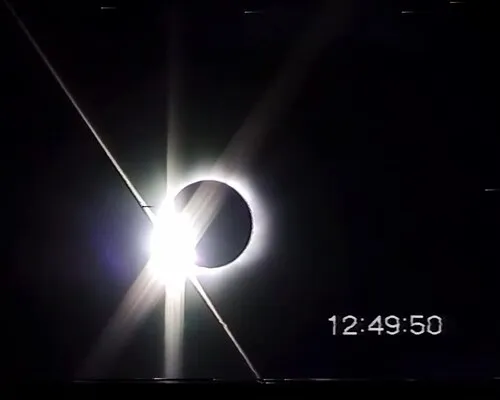
When is the next solar eclipse?
The question refers to the global schedule of upcoming solar eclipses, astronomical events in which the Moon passes between the Earth and the Sun, thereby totally or partially obs…
Mc Elec · CC BY 3.0 · 1999 Total solar eclipse, filmed next to the Lake Balaton in Hungary.webm
1. When is the next solar eclipse?
The question refers to the global schedule of upcoming solar eclipses, astronomical events in which the Moon passes between the Earth and the Sun, thereby totally or partially obscuring the Earth's view of the Sun.
1.1 Overview
Solar eclipses occur somewhere on Earth approximately two to five times per calendar year. However, total solar eclipses—where the Sun's disk is completely covered by the Moon—happen roughly once every eighteen months. Because the shadow of the Moon traces a narrow path across the Earth's surface, witnessing a total or annular eclipse from any single specific geographic location is a rare occurrence that often requires travel to the path of totality.
1.2 Next Total Solar Eclipse
The next total solar eclipse will take place on August 12, 2026.[1]아이슬란드와 스페인 등을 관통하는 개기일식으로, 특히 유럽 대륙 본토에서 관측되는 개기일식으로는 1999년 이후 27년 만이다. During this event, the path of totality will sweep across the Arctic Ocean, Greenland, Iceland, the Atlantic Ocean, and northern Spain.
A partial solar eclipse will be visible from a much broader geographical area, including North America, Western Europe, parts of Africa, and the polar regions. Major cities lying directly in the path of totality include Reykjavík in Iceland, as well as A Coruña, Zaragoza, and Palma in Spain. Observers situated in these locations will experience temporary operational darkness and the visibility of the solar corona during the phase of peak eclipse.
1.3 Upcoming Major Solar Eclipses
Following the event in August 2026, several notable solar eclipses are scheduled to occur globally over the subsequent years:
- August 2, 2027: A total solar eclipse with an exceptionally long duration of totality exceeding six minutes will traverse North Africa and the Middle East. The path will pass directly over historical landmarks such as Luxor in Egypt.
- January 26, 2028: An annular solar eclipse, commonly known as a "ring of fire" eclipse, will be visible across South America, the Atlantic Ocean, and Western Europe.
- July 22, 2028: A total solar eclipse will cross the Australian continent and New Zealand, with the path of totality passing directly through major population centers, including Sydney, Australia.
1.4 Observation Requirements
To safely view any solar eclipse prior to the phase of totality, dedicated eye protection is mandatory. Looking directly at the Sun without specialized visual aids, such as certified solar eclipse glasses or hand-held solar viewers complying with international safety standards, can cause permanent retinal damage. During a total solar eclipse, protective eyewear may only be removed during the brief window of complete totality, when the Sun is entirely obscured by the Moon.
2. Trivia
2.1 The Hybrid Eclipse Paradox of April 2023
The solar eclipse of April 20, 2023, belonged to an exceptionally rare category known as a hybrid solar eclipse (or annular-total eclipse). Occurring in only about 3.1% of all solar eclipses in the 21st century, this phenomenon shifts its optical profile from annular to total and back again along the eclipse path. This transfiguration occurs because the curvature of the Earth brings certain segments of the surface closer to the Moon, allowing the apex of the lunar umbral shadow to just barely pierce the surface at mid-path while falling short at the edges.
2.2 The North American Syzygy of April 2024
The total solar eclipse of April 8, 2024, earned the designation "The Great North American Eclipse" due to its extensive path of totality across Mexico, the United States, and Canada.[2]https://science.nasa.gov/eclipses/future-eclipses/eclipse-2024 — 멕시코, 미국, 캐나다를 관통하는 장대한 경로 덕분에 북미 대륙 전체가 일식 열풍에 휩싸였으며, 관측 인구만 수천만 명에 달해 역사상 가장 많은 사람이 지켜본 일식 중 하나로 기록되었다. Unlike the total eclipse of 2017, the 2024 event coincided with the peak of Solar Cycle 25 (solar maximum). Consequently, observers witnessed extended coronal streamers, prominent solar prominences, and a potential coronal mass ejection (CME) during totality, contrasting sharply with the quiescent corona observed during the 2017 solar minimum.
2.3 The European Doublet of 2026–2027
Continental Europe will experience a historically dense succession of total solar eclipses in 2026 and 2027. The eclipse of August 12, 2026, will mark the first total solar eclipse visible from mainland Europe since 1999, terminating at sunset over the Iberian Peninsula. Less than a year later, on August 2, 2027, another total solar eclipse will traverse southern Spain and Northern Africa. The 2027 event will feature a maximum totality duration of 6 minutes and 23 seconds near Luxor, Egypt, making it the longest land-based totality between 1991 and 2186.
2.4 Saros Cycle 136 and the Century-Long Duration Record
Solar eclipses are bound by the Saros cycle—a periodicity of approximately 18 years, 11 days, and 8 hours. The upcoming eclipses belonging to Saros 136 (including the eclipse of August 2, 2027) are geometrically predetermined to yield the longest durations of totality in the modern era. Because this cycle currently occurs when the Earth is near aphelion (farthest from the Sun) and the Moon is near perigee (closest to Earth), it generates an extraordinarily large apparent lunar disc capable of obscuring the Sun for over six minutes.
2.5 The Continental Australian Quadruplet
Between 2028 and 2038, the continent of Australia will serve as the global nexus for solar eclipses, playing host to five distinct total solar eclipses within a 10-year span (July 22, 2028; November 25, 2030; March 20, 2034; July 13, 2037; and December 26, 2038). This geographical clustering is a statistical anomaly, considering that a total solar eclipse recurs over the exact same location on Earth only once every 375 years on average.
2.6 The Ultimate Extinction of Total Solar Eclipses
From a long-term orbital mechanics perspective, the phenomenon of the total solar eclipse is a temporary epoch in Earth's geological history. Due to tidal friction, the Moon recedes from the Earth at a rate of approximately 3.8 centimeters per year.[3]아폴로 우주선 승무원들이 달 표면에 설치하고 온 반사경에 레이저를 쏘아 거리를 측정하는 '달 레이저 측정 실험(Lunar Laser Ranging experiment)'을 통해 이 미세한 후퇴 속도가 정밀하게 밝혀졌다. In roughly 600 million years, the apparent angular diameter of the Moon will have shrunk to a degree where it can no longer completely cover the solar disk, rendering total solar eclipses physically impossible and leaving annular eclipses as the sole form of central eclipse.