Published page
Christmas


Christmas is an annual festival commemorating the birth of Jesus Christ, observed primarily on December 25 as a religious and cultural celebration among billions of people around …
Christmas
Christmas is an annual festival commemorating the birth of Jesus Christ, observed primarily on December 25 as a religious and cultural celebration among billions of people around …
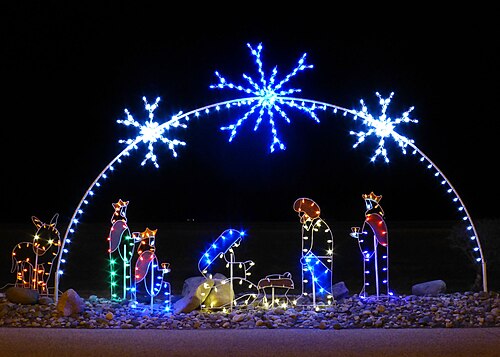
File:NativityChristmasLights.jpg : derivative work: Crumpled Fire · CC BY-SA 2.0 · NativityChristmasLights2.jpg
Christmas is an annual festival commemorating the birth of Jesus Christ, observed primarily on December 25 as a religious and cultural celebration among billions of people around the world.
1. annual Christian holiday
1.1 Overview
Christmas is one of the most prominent holidays in the global calendar, serving as both a sacred Christian religious holiday and a worldwide cultural and commercial phenomenon. The name itself derives from the Old English "Crīstes mæsse," which translates to "Christ's Mass."[1]https://www.etymonline.com/word/Christmas — The term entered written records around 1038 as Cristes maesse, reflecting the ecclesiastical Latin missa Christii. While the holiday centers on the Nativity of Jesus, the foundational figure of Christianity, many of its modern customs have evolved through centuries of blending Christian theology with pre-Christian winter solstice traditions, folklore, and secular customs.
In many parts of the world, Christmas serves as the focal point of the broader winter holiday season. Although traditionally celebrated on December 25 by Western Christian churches using the Gregorian calendar, some Eastern Orthodox churches continue to celebrate Christmas on January 7, corresponding to December 25 in the Julian calendar.
1.2 Origins and History
The precise historical date of Jesus' birth is not specified in the Christian Gospels. Early Christian writers offered various dates, but by the mid-fourth century, the Western Christian Church had settled on December 25. This date is widely believed to have been chosen to coincide with existing Roman celebrations, such as *Natalis Solis Invicti* (the Birthday of the Unconquered Sun) and the festival of *Saturnalia*, thereby reinterpreting pagan winter solstice festivities through a Christian lens.[2]https://www.britannica.com/story/why-is-christmas-celebrated-on-december-25 — The date conveniently allowed early Christians to observe their holy day without attracting undue suspicion during pagan festivals.
Throughout the Middle Ages, Christmas gained significant cultural prominence, often celebrated with grand feasts, community revelry, and religious pageants. Following the Protestant Reformation, the holiday faced suppression in certain regions, notably under Puritan rule in seventeenth-century England and New England, where critics denounced its lack of biblical precedent and rowdy celebration style.
The modern perception of Christmas took shape during the nineteenth century. Writers such as Charles Dickens, through his novella *A Christmas Carol*, helped reshape the holiday into a family-centric season emphasizing goodwill, charity, and nostalgia.[3]https://www.bl.uk/romantics-and-victorians/articles/a-christmas-carol-and-the-invention-of-christmas — Dickens famously wrote the story in six weeks to settle pressing personal debts, inadvertently codifying modern Christmas aesthetics. This era also saw the popularization of central traditions, including the Christmas tree and the global icon of Santa Claus.
1.3 Religious Traditions
Within Christian theology, Christmas marks the incarnation of God in the form of Jesus Christ, fulfilling prophecies regarding the Messiah. The liturgical season leading up to Christmas is known as Advent, a period of preparation, reflection, and anticipation beginning four Sundays before Christmas Eve.
Religious observances typically begin on Christmas Eve (December 24) with evening church services, such as Midnight Mass. Churches are frequently adorned with greenery, nativity scenes (crèches) depicting the stable in Bethlehem, and candles. The religious season continues through the Twelve Days of Christmas, culminating in Epiphany on January 6, which commemorates the visit of the Magi to the infant Jesus.
1.4 Secular Customs and Celebrations
Over time, Christmas has expanded beyond its religious roots to incorporate a vast array of secular customs embraced by non-Christian populations worldwide.
- Gift-Giving and Santa Claus: Exchange of gifts is a central element of the modern holiday, symbolizing the gifts brought to Jesus by the Magi. This practice is largely personified by Santa Claus—a figure rooted in the historical Saint Nicholas, combined with elements of the Dutch *Sinterklaas* and British *Father Christmas*.
- Decorations: Homes and public spaces are decorated weeks in advance. Common elements include Christmas trees (often decorated with lights, tinsel, and ornaments), wreaths made of evergreen branches, mistletoe, and lights.
- Music and Media: A distinct genre of Christmas music, ranging from traditional carols to modern pop songs, fills the airwaves throughout the season. Holiday-themed television specials and films also play a major role in establishing the seasonal atmosphere.
- Feasting: Christmas Day typically features a major festive meal shared with family and friends. Traditional dishes vary significantly by region, including roast turkey or goose in English-speaking countries, carp in Central Europe, and Kentucky Fried Chicken in Japan.[4]The Japanese custom arose because foreign residents seeking turkey turned to fried chicken as the next best alternative.
1.5 Global Impact and Commercialization
In the contemporary era, Christmas has become a primary driver of global retail activity. The period leading up to Christmas represents a critical shopping season for businesses, often accounting for a significant portion of annual retail sales. Critics frequently argue that this heavy commercialization has overshadowed the holiday's original spiritual and communal significance.
Despite varying degrees of religious relevance across different countries, the overarching themes of family gathering, generosity, and peace make Christmas one of the most universally recognized and celebrated holidays on the planet.
2. Australian territory in Indian Ocean
Christmas Island is an Australian external territory located in the Indian Ocean, situated approximately 350 kilometers south of Java and Sumatra and about 1,550 kilometers northwest of the Australian mainland. Although politically part of Australia, geographically it belongs to the Southeast Asian region, positioned on the southernmost edge of the Sunda Shelf. The island is world-famous for its unique biodiversity, most notably the annual mass migration of red crabs, and functions as a critical ecological sanctuary as well as a strategically significant geopolitical location for Australia.
2.1 Overview
Christmas Island is a raised coral atoll resting atop an ancient basaltic submarine volcano. The island rises steeply from the ocean floor, forming dramatic coastal cliffs that surround a central plateau. Despite being governed by Australia as a non-self-governing external territory, its proximity to Indonesia gives it a distinct geographic and cultural character separate from the mainland. The island covers an area of roughly 135 square kilometers, with a significant majority of its land designated as a protected national park.
The name "Christmas Island" was bestowed by Captain William Mynors of the Royal Mary, an English East India Company vessel, who sailed past the island on Christmas Day in 1643.[5]https://www.parksaustralia.gov.au/christmas/discover/history — Captain Mynors did not actually land on the island, as its forbidding sea cliffs made anchorage nearly impossible. The island remained largely uninhabited for centuries following its European discovery due to its treacherous terrain and steep sea cliffs, which made landing extremely difficult.
2.2 History
For much of recorded history, Christmas Island remained undisturbed by human settlement. The first recorded landing occurred in 1688 by the crew of the English ship *Cygnet*, led by navigator William Dampier. Serious interest in the island did not emerge until the late 19th century, when rich deposits of phosphate were discovered embedded within the central plateau.
In 1888, the British Crown officially annexed Christmas Island, and commercial extraction of phosphate began shortly thereafter under the Christmas Island Phosphate Company. To work the mines, labor was imported primarily from Singapore, Malaya, and China, laying the foundation for the island's present-day demographic composition.
During World War II, the island was occupied by Japanese forces in 1942 due to its vital phosphate resources. Following the war, sovereignty was transferred from the United Kingdom to Australia in 1958 under the Christmas Island Act. In recent decades, the island has gained international media attention due to the presence of an Australian immigration detention center established in the early 2000s.
2.3 Geography and Environment
Christmas Island features a tropical monsoon climate characterized by high temperatures and humidity throughout the year, with a wet season driven by the northwest monsoon between November and April. The interior consists of dense rainforests growing on rich volcanic soils mixed with limestone, while the coastline is dominated by jagged coral limestone cliffs rising directly from the sea.
Because of its long isolation from major landmasses, Christmas Island hosts exceptional levels of endemism among its flora and fauna. The terrestrial ecosystem is famously dominated by land crabs, particularly the Christmas Island red crab (*Gecarcoidea natalis*). Every year at the beginning of the wet season, tens of millions of red crabs migrate simultaneously from the forest canopy down to the ocean to spawn, creating one of the natural world's most spectacular biological events.[6]https://parksaustralia.gov.au/christmas/discover/highlights/red-crab-migration — Local authorities build special crab bridges and close main roads to protect the millions of migrating crustaceans.
In addition to red crabs, the island serves as a vital nesting site for numerous seabird species. It is the sole remaining breeding habitat for the endangered Abbott's booby (*Papasula abbotti*) and the endemic Christmas Island frigatebird (*Fregata andrewsi*). To protect these unique organisms, over 60 percent of the island is preserved within Christmas Island National Park.
2.4 Demographics and Culture
The population of Christmas Island is relatively small, typically hovering around 1,500 to 2,000 residents concentrated primarily on the northern tip of the island in settlements such as Flying Fish Cove, Settlement, and Poon Saan.
The cultural identity of the island is distinctly multicultural and predominantly Asian-Australian. Citizens of Chinese descent make up the largest ethnic demographic, followed by Australian Malays and those of European heritage. As a result, the island's linguistic landscape includes English, Mandarin, various Chinese dialects such as Hokkien and Cantonese, and Malay.
This multicultural synthesis is reflected in daily life and official observances. Major celebrated occasions include Chinese New Year, Hari Raya, Christmas, and Australia Day. The local cuisine and architecture heavily draw from Malaysian and Chinese influences, providing a unique cultural atmosphere within an Australian jurisdiction.
2.5 Economy and Infrastructure
Historically, the economy of Christmas Island was almost entirely dependent on phosphate mining. While mining operations continue under private management with strict environmental regulations, resources are finite, driving efforts to diversify the local economy.
Government services, environmental management, and administrative functions related to the territorial status provide a significant portion of local employment. Tourism has become a growing focus, with niche markets developing around eco-tourism, bird watching, and scuba diving in the pristine coral reefs surrounding the island. Access to the island is maintained primarily via regular flights connecting to Perth and Kuala Lumpur, as well as marine supply ships docking at Flying Fish Cove.
3. Trivia
3.1 Pagan Syncretism and Saturnalia
The selection of December 25 as the date for Christmas is widely regarded by contemporary scholars as a strategic adaptation of pre-existing Roman polytheistic festivals rather than an accurate historical marker of the Nativity. During the Late Roman Empire, the period coincided with *Saturnalia*—a week-long festival honoring Saturn characterized by social inversion, feasting, and gift-giving—as well as the observance of *Dies Natalis Solis Invicti* (the Birthday of the Unconquered Sun) instituted by Emperor Aurelian in 274 AD. By superimposing the celebration of Christ's birth onto these established winter solstice traditions, the early Christian Church effectively facilitated the assimilation of pagan populations into the state religion, absorbing regional customs such as the utilization of evergreen boughs into Christian iconography.
3.2 Oliver Cromwell and the Puritan Ban
During the Interregnum period following the English Civil War, the celebration of Christmas was systematically proscribed by the Puritan-dominated Parliament of England. Viewing the holiday as an unbiblical practice rife with pagan remnants, Catholic superstition, and moral laxity, the Parliament enacted legislation between 1644 and 1647 that explicitly banned Christmas services, decorations, and traditional festivities. In Puritan New England, the Massachusetts Bay Colony implemented a similar prohibition in 1659, imposing a fine of five shillings on anyone caught observing the day.[7]https://www.mass.gov/news/when-christmas-was-banned-in-boston — The Puritan law declared that anyone found observing Christmas by forbearing of labor or feasting faced a mandatory fine. The ban in England was eventually rescinded following the Restoration of the Stuart Monarchy under King Charles II in 1660.
3.3 The Christmas Truce of 1914
On the Western Front during World War I, an unofficial, localized cessation of hostilities occurred along sections of the British and German lines on Christmas Eve and Christmas Day in 1914. Initiated by German troops decorating their trenches and singing carols such as *Stille Nacht* (Silent Night), the event led to soldiers crossing into No Man's Land to exchange rations, souvenirs, and cigarettes, as well as to retrieve fallen comrades for joint burial ceremonies.[8]Some German soldiers placed small decorated Christmas trees along the parapets of their trenches before venturing into no man's land. Historical accounts also detail informal matches of association football played between the opposing forces. While high commands on both sides subsequently issued strict directives to prevent future fraternization, the 1914 truce remains a significant historical anomaly of spontaneous military detente.
3.4 The Coca-Cola Marketing Myth and Haddon Sundblom
A persistent urban legend asserts that the contemporary visual depiction of Santa Claus—characterized by a rotund figure, white beard, and a red suit trimmed with white fur—was entirely invented by The Coca-Cola Company for an advertising campaign in 1931. While artist Haddon Sundblom did standardize and popularize this specific image through his widely distributed commercial illustrations, the visual archetype had already been established in American culture. Precursor imagery, heavily influenced by Clement Clarke Moore's 1823 poem *A Visit from St. Nicholas* and political cartoonist Thomas Nast's late 19th-century illustrations for *Harper's Weekly*, had routinely depicted Santa Claus in red garments long before the beverage company's promotional initiative.
3.5 Christmas Island and the Red Crab Migration
Christmas Island, an external territory of Australia situated in the Indian Ocean, derives its name directly from the date of its European discovery. English sea captain William Mynors of the East India Company vessel *Royal Mary* sailed past the previously uncharted island on December 25, 1643, and recorded the designation on his navigational chart. The island is ecologically prominent for its endemic fauna, most notably the annual mass breeding migration of the Christmas Island red crab (*Gecarcoidea natalis*), during which tens of millions of land crabs traverse the terrain from the forest to the coast to spawn.
3.6 Space Carols and Gemini 6A
The first musical performance transmitted from outer space to Earth occurred on December 16, 1965, during NASA's Gemini 6A mission. Astronauts Walter Schirra and Thomas Stafford executed a broadcasted prank aimed at Mission Control, reporting an unidentified flying object operating in a low Earth orbit prior to playing a rendition of *Jingle Bells*.[9]The crew smuggled the tiny Hohner harmonica and sleigh bells aboard inside their spacesuit pockets without official permission. The performance was executed using a smuggled Hohner "Little Lady" 8-hole chromatic harmonica and a set of small sleigh bells, marking a unique intersection of space exploration history and holiday pop culture.
3.7 The KFC Dining Tradition in Japan
In Japan, where the Christian population constitutes a small minority, the consumption of Kentucky Fried Chicken (KFC) has become an established secular Christmas custom. This phenomenon originated from a highly successful national marketing campaign launched in 1974 under the slogan *Kurisumasu ni wa Kentakkī!* (Kentucky for Christmas!).[10]Takeshi Okawara reportedly dressed up as Santa Claus for an early promotional event, establishing the iconic imagery of Colonel Sanders in Santa garb. Initiated by Takeshi Okawara, the manager of the country's first KFC outlet, the campaign positioned fried chicken as a surrogate for the traditional Western holiday turkey, which was difficult to procure in post-war Japan. As a result, the holiday remains one of the highest-grossing operational periods for the franchise within the country, requiring advance reservations weeks prior to December 25.
3.8 Astronomical Hypotheses of the Star of Bethlehem
The Biblical narrative of the "Star of Bethlehem," which guided the Biblical Magi to the birthplace of Jesus Christ according to the Gospel of Matthew, has generated numerous astronomical hypotheses attempting to identify the phenomenon as an actual celestial event. Contemporary astrophysicists and historians have proposed several candidate events that occurred around the estimated historical timeframe of Christ's birth (circa 7 to 4 BC):
- Planetary Conjunctions: A rare series of three planetary conjunctions of Jupiter and Saturn in the constellation Pisces occurred in 7 BC, followed by a close alignment of Jupiter, Saturn, and Mars in 6 BC.
- Cometary Activity: Chinese and Korean astronomical records detail the appearance of a bright comet or "sweeping star" that remained visible for over 70 days in 5 BC.
- Stellar Explosions: Other theories suggest the phenomenon may have been a supernova or nova explosion within the Milky Way, providing a localized, intensely bright celestial marker.
Child documents of "Christmas"
None yet.