Published page
Parent: Easter
Date of Easter


The Date of Easter refers to the specific day on the calendar on which the Christian holiday of Easter—celebrating the resurrection of Jesus Christ—is observed in any given ye…
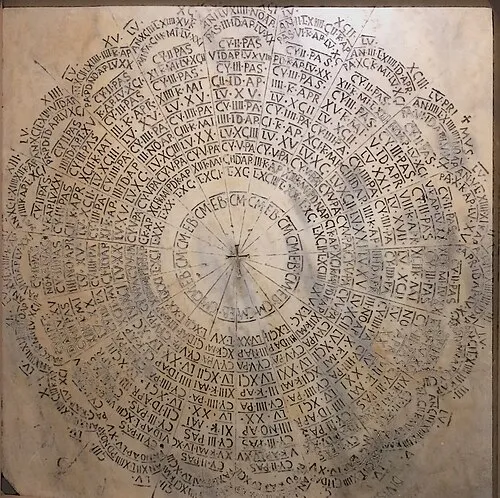
Date of Easter
The Date of Easter refers to the specific day on the calendar on which the Christian holiday of Easter—celebrating the resurrection of Jesus Christ—is observed in any given ye…
Apatak · CC BY-SA 4.0 · Calendario pasquale.jpg
1. Date of Easter
The Date of Easter refers to the specific day on the calendar on which the Christian holiday of Easter—celebrating the resurrection of Jesus Christ—is observed in any given year.
1.1 Overview
Unlike fixed holidays such as Christmas, which always falls on December 25, Easter is a movable feast.[1]https://www.merriam-webster.com/dictionary/movable%20feast — The term later inspired the title of Ernest Hemingway's posthumously published memoir about 1920s Paris. This means its date changes annually within a defined calendar window. Because numerous other Christian observances—such as Ash Wednesday, Palm Sunday, Ascension Day, and Pentecost—are calculated relative to Easter, the date of Easter effectively dictates the liturgical calendar for much of the year.
The system used to calculate this date relies on a complex interplay between the solar year and the lunar cycle. Consequently, determining when Easter falls requires harmonizing civil calendar dates with astronomical phenomena.
1.2 Rules of Calculation
According to the canonical standard established by Western Christianity, Easter is celebrated on the first Sunday following the Paschal Full Moon. The Paschal Full Moon is defined as the first ecclesiastical full moon occurring on or after March 21.
- Ecclesiastical Vernal Equinox: Fixed by convention as March 21, regardless of the precise astronomical moment the spring equinox occurs.
- Paschal Full Moon: The 14th day of a tabulated lunar month (an ecclesiastical moon), which approximates the astronomical full moon but does not always coincide with it precisely.
Based on these rules, the earliest possible date for Western Easter is March 22 (if the full moon falls on March 21 and March 21 is a Saturday), while the latest possible date is April 25 (if a full moon occurs on March 20, pushing the next ecclesiastical full moon to April 18, and that day happens to be a Sunday).
1.3 Historical Context and the Computus
In the early centuries of the Christian Church, various communities used different methods to determine the date of the resurrection. Some calculated it based strictly on the Jewish Passover (the 14th of Nisan), while others insisted that the celebration must always occur on a Sunday.
To resolve these discrepancies, the First Council of Nicaea convened in 325 AD.[2]https://www.britannica.com/event/Council-of-Nicaea-Christianity-325 — The council was convened by Emperor Constantine I in modern-day İznik, Turkey, primarily to resolve the Arian controversy. The Council established a uniform policy: Easter was to be observed on a Sunday, independent of the Jewish calendar, and determined uniformly across the Christian world. The mathematical process developed to calculate this date became known as the *computus*.
Over time, discrepancies arose due to the inaccuracy of the Julian calendar, which drifted relative to the actual solar year. By the 16th century, the calendar was out of sync with the natural equinox.
1.4 Western vs. Eastern Traditions
The global Christian community currently uses two main systems to calculate the date of Easter, leading to frequent divergence between Western and Eastern churches.
1.4.1 Western Christianity
Roman Catholic and Protestant traditions utilize the Gregorian calendar, introduced by Pope Gregory XIII in 1582.[3]https://www.vatican.va/content/vatican/en.html — The calendar reform required skipping ten days in October 1582 to realign the civic year with the solar equinox. The Gregorian reform adjusted the calendar to reflect the solar year accurately and revised the tables used to calculate the Paschal Full Moon. In this system, Easter always falls between March 22 and April 25.
1.4.2 Eastern Christianity
Eastern Orthodox and Oriental Orthodox churches largely retain the Julian calendar for liturgical calculations. Additionally, Eastern traditions adhere strictly to an ancient interpretation of the Nicene rule requiring that Easter must occur after the Jewish Passover. Because the Julian calendar currently trails the Gregorian calendar by 13 days, Eastern Easter falls between April 4 and May 8 on the modern civil calendar.
Occasional alignments occur when the calculations in both systems happen to coincide, resulting in a shared date for Easter across all major traditions.
1.5 Reform Proposals
Throughout the modern era, various secular and religious bodies have proposed simplifying the date of Easter. Proposals often advocate establishing a fixed Sunday, such as the second Sunday in April, to standardize the holiday for civil planning, international commerce, and academic scheduling.
Despite occasional consensus among international organizations and ecumenical councils, a universal reform has not been enacted. Preserving historical continuity, theological significance, and pan-Christian unity remains a priority, keeping the traditional movable system in place.
2. Trivia
2.1 The Computus Algorithms
The mathematical calculation used to determine the date of Easter is historically known as *computus*. Early Christian scholars, most notably Dionysius Exiguus in 525 AD and the Venerable Bede in the 8th century, developed intricate tabular systems to synchronize the lunar cycles (Metonic cycle) with the solar year without relying on contemporary Jewish calendars. In 1797, the legendary mathematician Carl Friedrich Gauss formalized the *computus* into a universal algorithm using modular arithmetic.[4]https://d-nb.info/gnd/11853775X — Gauss reportedly devised the formula to determine the date of his own birth, which his mother knew only as a specific day relative to Ascension Day. Although Gauss's original formula contained minor inaccuracies regarding leap years, it laid the foundation for modern algorithmic calendar calculations.
2.2 The Gregorian Calendar Discrepancy
The divergence between Western Christianity (Roman Catholic and Protestant) and Eastern Christianity (Eastern Orthodox) regarding the date of Easter stems from calendar usage. Western churches calculate Easter using the Gregorian calendar (introduced by Pope Gregory XIII in 1582), whereas Eastern churches adhere to the Julian calendar. Furthermore, Orthodox canon mandates that Easter must strictly occur after the Jewish Passover. Consequently, Eastern Easter often falls several weeks later than Western Easter. The two celebrations only coincide occasionally—such as in 2017 and 2025—when the mathematical parameters of both calendars briefly align.
2.3 The Paschal Full Moon Idealization
Contrary to popular belief, the date of Easter is not tied to the actual, astronomical full moon observed in the sky. Instead, it relies on an arithmetically standardized concept known as the Ecclesiastical Full Moon (or Paschal Full Moon). The Church defines the vernal equinox strictly as March 21, regardless of when the astronomical equinox actually occurs (which can be March 19 or 20). The Paschal Full Moon is defined as the 14th day of a tabular lunar month. Because of this artificial construct, it is mathematically possible for the astronomical full moon to occur on a Saturday, while the Church recognizes the Paschal Full Moon on a different day, delaying Easter by a full week.
2.4 The Cycle of Repeatability
The sequence of Western Easter dates is strictly periodic, but the length of the cycle is extraordinarily long due to the interaction of leap years, lunar cycles, and solar corrections. Under the Gregorian calendar rules, the entire schedule of Easter dates repeats in an exact cycle every 5,700,000 years. Within this massive span of 2,080,533,250 days, the date of Easter is calculated to fall on April 19 most frequently (3.87% of the time), while March 22 is the absolute rarest occurrence (0.48% of the time).
2.5 Range Extremities
Under the Gregorian calendar rules, the earliest possible date for Easter is March 22, and the latest possible date is April 25.
2.6 The Fixed-Date Legislative Initiatives
Throughout the 20th and 21st centuries, numerous secular and religious authorities attempted to standardize Easter to a fixed Sunday to alleviate logistical complexity in aviation, education, and global commerce. The United Kingdom passed the Easter Act 1928, which legally established Easter Sunday as the first Sunday following the second Saturday in April.[5]https://www.legislation.gov.uk/ukpga/Geo5/18-19/35 — This remains one of the most famous examples of an enacted British statute that has sat dormant without ever coming into force. However, the law included a clause requiring the consent of major Christian denominations before enforcement. Because a universal consensus between the Vatican and Eastern Orthodox patriarchates was never achieved, the UK Easter Act remains uncommenced on the British statute books nearly a century later.