발행된 페이지
상위 문서: Daylight Saving Time
How does daylight saving time work?


Daylight Saving Time (DST) is a seasonal timekeeping system in which clocks are advanced, typically by one hour, during warmer months to extend evening daylight and reduce relianc…
How does daylight saving time work?
Daylight Saving Time (DST) is a seasonal timekeeping system in which clocks are advanced, typically by one hour, during warmer months to extend evening daylight and reduce relianc…
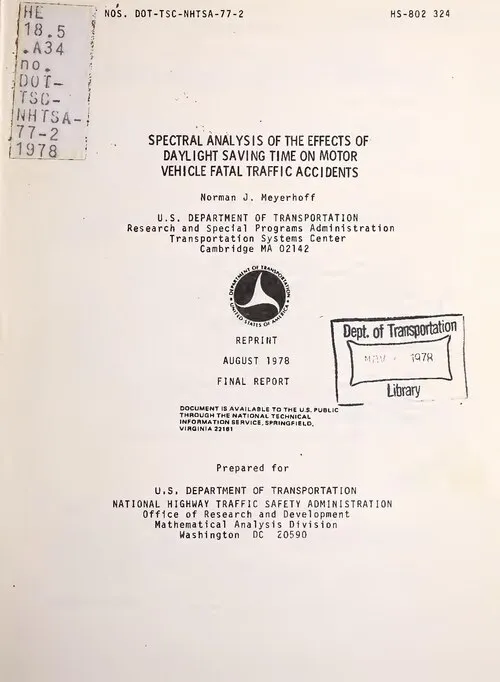
Meyerhoff, Norman J United States. National Highway Traffic Safety Administration · Public domain · Spectral analysis of the effects of daylight saving time on motor vehicle fatal traffic accidents (IA spectralanalysis00meye).pdf
1. How does daylight saving time work?
Daylight Saving Time (DST) is a seasonal timekeeping system in which clocks are advanced, typically by one hour, during warmer months to extend evening daylight and reduce reliance on artificial lighting. Daylight Saving Time alters local standard time by shifting an hour of daylight from the morning to the evening, accommodating the seasonal variation in solar noon relative to human activity patterns.
1.1 Concept and Astronomical Basis
The core principle of Daylight Saving Time rests on the seasonal shift in the Earth's axial tilt relative to the Sun. During summer months in temperate zones, daylight hours lengthen significantly. Standard time systems set noon close to the moment when the Sun reaches its highest point in the sky. However, human work schedules often do not shift naturally with sunrise. Consequently, early morning sunlight during midsummer can occur while most of the population is asleep, leading to a perceived waste of daylight. By moving the clock forward by one hour in the spring, the period of daylight aligns more closely with typical waking hours, effectively delaying sunset by one hour.
1.2 Implementation Mechanism
The transition to and from Daylight Saving Time occurs twice a year. In the spring, regions implementing the system advance their local clocks by one hour, effectively "losing" an hour from that day.[1]봄철 일광 절약 시간제가 시작될 때 시계 바늘을 한 시간 앞당기면서 공식적으로 23시간짜리 하루가 탄생한다. This event usually takes place during the late night hours of a Sunday to minimize disruption to commercial schedules. In the autumn, the process reverses: clocks are turned back by one hour, returning the region to Standard Time. This transition provides an extra hour during that day. The dates for these shifts vary by jurisdiction; for example, the United States shifts in March and November, while the European Union performs the adjustment in March and October.
1.3 Geographical Variation and Usage
Daylight Saving Time is not implemented universally across the globe. Its effectiveness is strongly tied to latitude. Equatorial regions experience minimal variation in daylight duration throughout the year, making the system unnecessary. Conversely, polar regions experience extreme daylight fluctuations, rendering a one-hour clock shift negligible. Therefore, DST is predominantly utilized in middle-latitude regions, such as North America, Europe, and parts of southern South America and southeastern Australia. Many countries in Asia and Africa do not observe DST, or have formerly observed it and subsequently abolished the practice.
1.4 Economic and Social Impacts
The original justification for Daylight Saving Time was energy conservation, operating on the premise that longer evening daylight reduces household electricity usage for illumination. Modern research indicates mixed results regarding energy savings, as increased usage of heating and air conditioning often offsets reductions in lighting demand. Beyond energy considerations, DST affects public health, transportation, and commerce. The disruption of human circadian rhythms during the spring clock change has been linked to temporary increases in sleep deprivation, cardiovascular events, and traffic accidents. Conversely, extended evening daylight encourages outdoor recreation, retail spending, and tourism during the summer months.
2. Trivia
2.1 Benjamin Franklin’s Satirical Economic Proposal
The foundational concept of adjusting human activity to daylight hours is often traced back to a 1784 satirical essay written by Benjamin Franklin during his tenure as an American envoy in Paris. In the essay titled *"An Economical Project for Diminishing the Cost of Light,"* Franklin did not actually propose changing clock times. Instead, he calculated that thousands of pounds of candle wax could be saved if Parisians simply woke up at sunrise. To enforce this, he humorously suggested ringing church bells at dawn, firing cannons in the streets, and taxing shutters to forcibly alter population sleep schedules.[2]벤저민 프랭클린이 파리 유학 시절 기고한 이 수필은 당시 일찍 자고 일찍 일어나는 파리 시민들의 습관을 풍자한 유머 칼럼이었으며, 실제로 서머타임을 제도화하자는 주장은 아니었다.
2.2 George Hudson’s Entomological Motivation
The modern implementation of Daylight Saving Time (DST) through actual clock manipulation originated from George Vernon Hudson, a New Zealand-born entomologist. In 1895, Hudson presented a paper to the Wellington Philosophical Society advocating for a two-hour seasonal clock shift. His primary motivation was not industrial productivity, but personal leisure: working a shift job at the Wellington Post Office left him with insufficient daylight after hours to collect and study insects.[3]https://www.royalsociety.org.nz/100-maori-words/george-hudson — 뉴질랜드의 곤충학자 조지 허드슨은 퇴근 후 곤충을 채집할 시간이 부족하다는 지극히 개인적인 이유로 시계를 2시간 앞당기자는 제안서를 학회에 제출했다.
2.3 The Wartime Resource Allocation Precedent
The global adoption of DST was catalyzed by total war rather than peacetime labor efficiency. The German Empire and its World War I ally, Austria-Hungary, were the first sovereign states to implement DST on April 30, 1916.[4]독일 제국은 제1차 세계 대전 중이던 1916년 4월 30일 밤 11시를 12시로 변경하며 세계 최초로 국가 차원의 서머타임을 도입했다. The objective was to minimize the consumption of artificial lighting fuel—specifically coal—to redirect energy resources toward ammunition production and war logistics. The British Empire followed suit weeks later with the *Summer Time Act 1916*, leading to a domino effect across Europe and North America.
2.4 The Chaos of US Municipal Time Standard Autonomy
Prior to the passage of the Uniform Time Act of 1966 in the United States, states, cities, and counties held the sovereign authority to choose whether to observe DST, as well as its start and end dates. This created severe logistical disruptions for the transportation and broadcasting industries. In one famous instance, passengers traveling a 35-mile bus route between Steubenville, Ohio, and Moundsville, West Virginia, passed through seven different local time zone changes within a single hour of travel.[5]https://www.transportation.gov/bureau-news/history-daylight-saving-time — 통일시간법 개정 전 미국은 지자체마다 서머타임 적용 여부와 시기가 달라 35마일 구간을 운행하는 버스 탑승객이 시차를 7번이나 겪는 진풍경이 벌어지기도 했다.
2.5 Circadian Rhythm Disruption and Cardiovascular Spikes
Modern chronobiology demonstrates that the spring shift forward ("spring forward") exerts significant physiological stress on the human body due to acute sleep deprivation and internal desynchronization. Multiple epidemiological studies indicate a measurable spike in major health incidents immediately following the spring transition, including a 24% increase in the risk of acute myocardial infarctions (heart attacks) on the following Monday, alongside parallel increases in fatal motor vehicle accidents and workplace injuries.
2.6 The Economic Arbitrage of "Cyberloafing"
The microeconomic ramifications of the spring clock adjustment extend into cognitive productivity loss. Research in organizational psychology reveals a sharp increase in unassigned, non-work-related internet browsing—termed "cyberloafing"—among office workers on the Monday immediately following the shift to DST. Because individuals lose an average of 40 minutes of sleep during the transition, their executive function and self-regulation capacity decline, leading to hundreds of millions of dollars in aggregate lost labor productivity globally.
2.7 Spatial and Longitudinal Asymmetries
DST operates with extreme geographical variability, driven largely by latitude. Equatorial regions generally abstain from DST because seasonal variation in daylight length is negligible at lower latitudes. Conversely, extreme high-latitude regions often eschew it because seasonal variation is so extreme that shifting the clock by one hour provides no practical benefit during polar days or nights. As a result, only roughly one-fifth of the global human population currently observes DST, concentrated predominantly in North America and Europe.